Aura, and the Generated Image
Benjamin's essay exists in several versions with a disputed title, and he had already dissolved the original and copy distinction himself. Read against images that have no original at all.
Date
Category
Writer
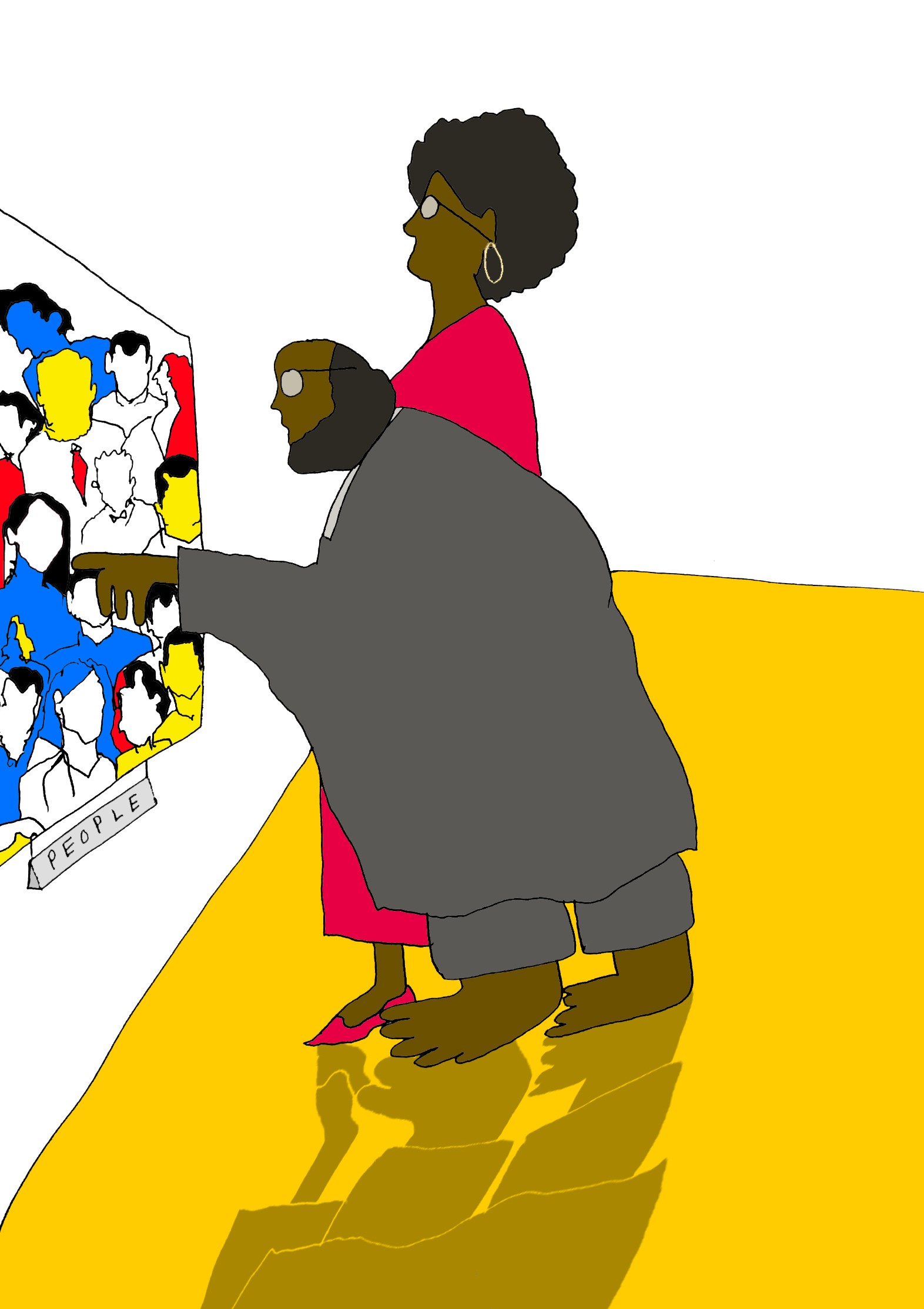
On 25 October 2018, in the Prints and Multiples sale at Christie's New York, a framed print called Portrait of Edmond de Belamy, from La Famille de Belamy sold for $432,500. The estimate had been $7,000 to $10,000. It was made by a Paris collective called Obvious using a generative adversarial network, trained, in their own description, on "a data set of 15,000 portraits painted between the 14th century to the 20th". Within about a day the sale was being used as evidence that Walter Benjamin had been proved right, or proved wrong, about something.
Almost nobody specified which Benjamin they meant. There are at least three texts with a claim to being the essay, two English titles in common circulation that say different things, and a widely repeated reading of the argument that the essay itself contradicts on page 22. I have quoted the essay carelessly myself in client presentations, and this piece is partly an attempt to stop doing that.
Three versions, or four, and two titles
Benjamin began the essay in 1935, in exile in Paris. Between December 1935 and February 1936 he largely rewrote it and added footnotes, producing what is now usually called the second version and usually treated as the authoritative text. That second version was translated into French by Pierre Klossowski and published in 1936 in the Zeitschrift für Sozialforschung, volume 5, issue 1, as "L'œuvre d'art à l'époque de sa reproduction mécanisée". Benjamin kept revising into 1939, producing a third version whose German text was not published until 1955, in the collected writings edited after his death.
Harvard University Press, publishing the standard English edition in 2008 under the editorship of Michael W. Jennings, Brigid Doherty and Thomas Y. Levin, describes its text as "the second, and most daring, of the four versions" composed between 1935 and 1939. Four, not three. I have not been able to establish from a primary source exactly which four texts the Harvard editors are counting, and whether the French translation is being counted as a version in its own right. If you cite the essay, the honest form is to cite a version and a translation, not a year.
The titles matter more than they look. Harry Zohn's translation, the one most people met first, appeared as "The Work of Art in the Age of Mechanical Reproduction". The Harvard edition renders the same German, Das Kunstwerk im Zeitalter seiner technischen Reproduzierbarkeit, as "The Work of Art in the Age of Its Technological Reproducibility". Two separate changes are happening. Technisch becomes technological rather than mechanical, which widens the field from machines to technique in general. And Reproduzierbarkeit becomes reproducibility rather than reproduction, which turns the subject from an activity into a property. Benjamin is not writing about the fact that things get copied. He is writing about what happens to an object once it is the kind of object that can be copied without limit.
The authenticity of a thing is the quintessence of all that is transmissible in it from its origin on.
What aura actually means
The essay's definition is narrow and physical before it is mystical. What a reproduction lacks, Benjamin writes, is "the here and now of the work of art", "its unique existence in a particular place". From that single location everything else follows: "The here and now of the original underlies the concept of its authenticity, and on the latter in turn is founded the idea of a tradition which has passed [the] object down as the same, identical thing to the present day."
Only then does he give the famous formulation, and it is worth noticing that he offers it as an answer to a question he has already answered practically. "What, then, is the aura? A strange tissue of space and time: the unique apparition of a distance, however near it may be." Distance here is not physical remoteness. A painting you can touch still holds you at a distance, because it belongs to a place and a history you are outside of.
The second mechanism is the pair of values. Benjamin proposes that art history can be read "as the working out of a tension between two polarities within the artwork itself", and that "these two are the artwork's cult value and its exhibition value". Cult value belongs to the object that is not meant to be seen: the statue in the cella, the image in the reliquary, the thing whose power depends on being hidden and approached by ritual. Exhibition value belongs to the object made to be shown. Reproduction does not destroy art, on his account. It shifts the ratio, and past a certain point the shift becomes a change of kind.
Technique | What is unique | Where the here and now sits |
|---|---|---|
Panel painting | The object itself | In the object, permanently |
Woodcut or lithograph | The block or stone | In the matrix, shared by the edition |
Photographic print | Arguably nothing | Benjamin says the question stops making sense |
Model output | Nothing at all | Only in the act of publishing it |
The correction most citations need
The popular reading runs: aura belongs to originals, reproduction destroys aura, digital images have no aura, therefore Benjamin predicted the internet. The essay says something more awkward. Benjamin had already worked out, in 1936, that photography breaks the original-and-copy relation rather than merely exploiting it.
From a photographic plate, for example, one can make any number of prints; to ask for the "authentic" print makes no sense.
He treats that as the pivot of the whole argument: "But as soon as the criterion of authenticity ceases to be applied to artistic production, the whole social function of art is revolutionized. Instead of being founded on ritual, it is based on a different practice: politics." So the essay is not resting on a stable distinction between original and copy. It is describing the moment that distinction stops doing any work, and asking what replaces it.
That matters for the generated image, because the usual objection to reading Benjamin against generative models is that there is no original to reproduce. True, but the essay got to the same place eighty years earlier by a different route. What a text-to-image model produces is not a copy of anything in its training set. In the architecture that made high-resolution generation cheap, the latent diffusion model of Robin Rombach, Andreas Blattmann, Dominik Lorenz, Patrick Esser and Björn Ommer, first posted to arXiv in December 2021, the model works "in the latent space of powerful pretrained autoencoders" and uses cross-attention to condition on text. The output is sampled. There is no plate. Benjamin's sentence about the plate applies more completely than he could have intended: not only does asking for the authentic print make no sense, there is no plate to ask about.
What does not transfer
Three things in the essay do not survive the move, and it is worth being blunt about them rather than stretching the text.
Tradition
Benjamin's account of what reproduction destroys is specific: "The technology of reproduction detaches the reproduced object from the sphere of tradition. By replicating the work many times over, it substitutes a mass existence for a unique existence." Detachment presupposes prior attachment. A generated image was never attached. It has no site it left. You can call this an extreme case of what he describes, but you are extending the argument, not applying it, and you should say so.
The masses
The social motor of the essay is a crowd with a described desire: "the desire of the present-day masses to 'get closer' to things, and their equally passionate concern for overcoming each thing's uniqueness", by "assimilating it as a reproduction". That is an appetite for proximity to particular existing things, a cathedral, a star, a painting. Generative image tools are not in the main driven by a wish to get closer to specific objects. They are driven by a wish to have an image where there was none.
The politics
Benjamin's epilogue is not a media-studies observation, it is an anti-fascist argument written by a man who would die in 1940. His diagnosis is economic before it is aesthetic: fascism "attempts to organize the newly created proletarian masses without affecting the property structure", and "sees its salvation in giving these masses not their right, but instead a chance to express themselves". Aestheticised politics is what you get when expression is substituted for property. Quoting the aestheticisation line about a brand campaign is not a small liberty.
Benjamin was not mourning
He is routinely read as an elegist. The Stanford Encyclopedia of Philosophy notes that he had written approvingly of "the emancipation of object from aura" as early as 1931, and that in the later political context he took aura to be "useful for fascism", which made its elimination strategically desirable rather than regrettable. The essay says it outright: "For the first time in world history, technological reproducibility emancipates the work of art from its parasitic dependence upon ritual."
The ambivalence is real, but it is not nostalgia. It is closer to a bet. He thought the loss of aura opened a door and that the door could be walked through in two directions. The thing he actually mourns, briefly, is much smaller and more human. He observes that in early photography "the portrait is central", and that "in the cult of remembrance of dead or absent loved ones, the cult value of the image finds its last refuge". Cult value's last address is a photograph of someone you loved.
What is actually being auctioned
Which returns us to Christie's. The lot was a framed print. Not the network, not the weights, not the training set, not the latent point. Exhibition value has gone so completely total that the market had to manufacture a here and now out of paper, a frame, a signature and a sale date in order to have something to sell. Benjamin's cathedral left its site "to be received in the studio of an art lover". The generated image has no site, so a site is fabricated for it at the point of sale.
The formal version of that fabrication now exists as a standard. The Coalition for Content Provenance and Authenticity publishes Content Credentials, a manifest attached to a file containing assertions about "its origin (i.e., when and where it was created), modifications (i.e., what happened using what tools) and use of AI (i.e., how it was authored)". Actions by an AI or ML system are marked as such through a digitalSourceType field. This is, structurally, an attempt to give an image a here and now by writing one down and signing it.
The coalition is admirably honest about the limit. Its own explainer states that "provenance information alone cannot tell you whether the digital content is true, accurate or factual", and that Content Credentials "do not provide value judgments about whether a given set of provenance data is 'true'", verifying only that the information is well-formed and untampered. A signed claim about origin is not authenticity in Benjamin's sense. It is a receipt. Benjamin's authenticity was a property of a thing's persistence in one place through time. A credential is a property of a document about the thing.
The inversion in the last two lines is the whole story. What we have built is an authenticity that survives reproduction, which is precisely the thing Benjamin said could not exist. Whether it is worth anything culturally is unproven. It is a technical answer to a question that was never technical.
What I am not claiming
I cannot tell you that Benjamin would have had a view about generated images, and any article that tells you he would is selling something. The essay is about a specific historical rupture between roughly 1839 and 1936, in a Europe that was about to go to war, written by someone arguing about the politics of film. It has one genuinely transferable instrument, the cult-value and exhibition-value ratio, and one genuinely transferable warning, that a technology which severs objects from tradition also severs them from the judgement tradition supplied, and that the vacancy gets filled by whoever is organised enough to fill it.
For a studio, the practical residue is small and unglamorous. If exhibition value is now the only value an image starts with, then everything that used to arrive with the object, its provenance, its occasion, its reason for existing at all, has to be supplied by the people commissioning and making it, deliberately, as work. That is not a loss of aura. It is aura becoming a line item.
Sources
Walter Benjamin, "The Work of Art in the Age of Its Technological Reproducibility: Second Version", trans. Edmund Jephcott and Harry Zohn, in The Work of Art in the Age of Its Technological Reproducibility, and Other Writings on Media, ed. Michael W. Jennings, Brigid Doherty and Thomas Y. Levin, Belknap Press of Harvard University Press, 2008. Scanned text, quotations at pp. 20, 22, 23. marxists.org/chinese/pdf/europe/walter-benjamin/benjamin-1936.pdf
Harvard University Press catalogue entry, The Work of Art in the Age of Its Technological Reproducibility, and Other Writings on Media, ISBN 9780674024458, Belknap Press, 31 May 2008. Source of the "second, and most daring, of the four versions" description. hup.harvard.edu/books/9780674024458
"The Work of Art in the Age of Mechanical Reproduction", Wikipedia. Used for the composition and publication chronology: the 1935 draft, the rewriting of December 1935 to February 1936, Pierre Klossowski's French translation in Zeitschrift für Sozialforschung vol. 5 no. 1 (1936), and the 1955 German publication of the third version. en.wikipedia.org/wiki/The_Work_of_Art_in_the_Age_of_Mechanical_Reproduction
"Walter Benjamin", Stanford Encyclopedia of Philosophy. Source for Benjamin's 1931 approval of "the emancipation of object from aura" and his view that aura was "useful for fascism". plato.stanford.edu/entries/benjamin/
Robin Rombach, Andreas Blattmann, Dominik Lorenz, Patrick Esser, Björn Ommer, "High-Resolution Image Synthesis with Latent Diffusion Models", arXiv:2112.10752, submitted 20 December 2021, revised 13 April 2022. arxiv.org/abs/2112.10752
Coalition for Content Provenance and Authenticity, C2PA and Content Credentials Explainer, version 2.2, 22 April 2025. Source for the definition of assertions, the
digitalSourceTypefield, and the statement that provenance alone cannot establish truth. spec.c2pa.org/specifications/specifications/2.2/explainer/_attachments/Explainer.pdfNaomi Rea, "The First AI-Generated Portrait Ever Sold at Auction Shatters Expectations, Fetching $432,500", Artnet News, 25 October 2018. Source for the lot title, the collective Obvious, the $7,000 to $10,000 estimate, the $432,500 result and the 15,000-portrait training description. news.artnet.com/market/first-ever-artificial-intelligence-portrait-painting-sells-at-christies-1379902
Related reading
Latest Articles.
© Moc Mallen Studio
Thoughts, ideas, and perspectives on design, simplicity, and creative process.

