Why Artists Abandon What Works
Cézanne peaked at 67 and Picasso at 26, by the same method on the same data. Exploration followed by focus is the only sequence that reliably precedes a career's best work, and the market punishes it anyway.
Date
Category
Writer

An artist finds a way of working that people want. Galleries can sell it, collectors can recognise it, critics can write about it. The rational move is to keep doing it.
Almost nobody does. And the ones who don't are not being romantic. There is now measured evidence that abandoning what works is the precondition for the best work, and there is measured evidence that the market punishes it anyway.
This is the last essay in a series about how artistic value is made and who decides it. It ends here because this is the question the whole series has been circling: if value is assigned by institutions, markets, estates and juries, why would anyone deliberately do the thing that makes all four of them uncomfortable.

National Gallery of Art, Washington. Monet painted the same façade more than thirty times. Commons
First, the data on when artists do their best work
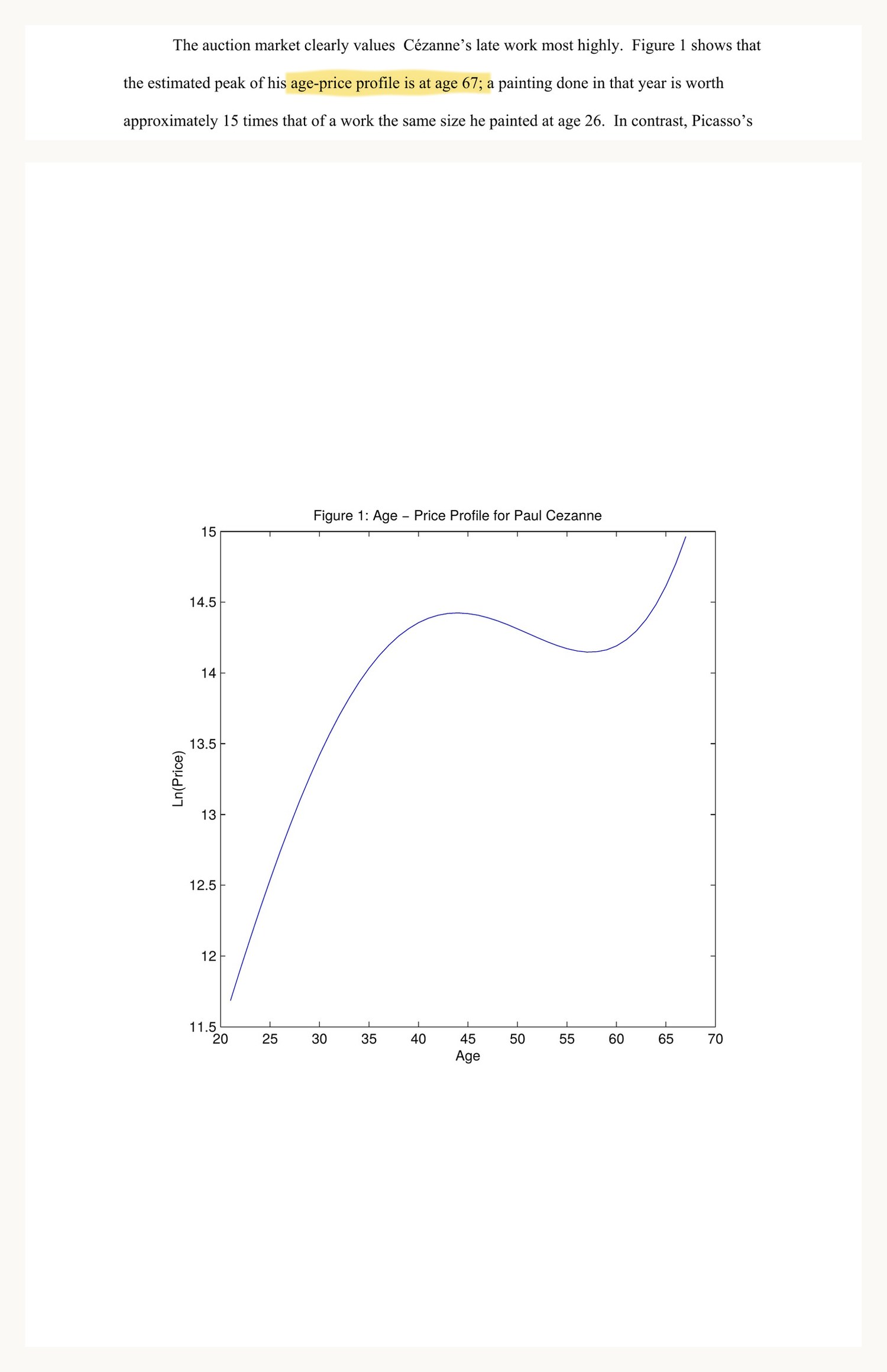
Cézanne's age–price profile peaks at 67; Picasso's at 26. The figure below is Cézanne's own curve.
David Galenson and Bruce Weinberg took 18,333 auction sales of paintings from 1970 to 1997, by fifty painters born between 1796 and 1900, and regressed the natural log of the sale price against the artist's age at execution. For each painter they fitted five specifications, linear through fifth-degree polynomial, selected the best by adjusted R squared, and took the maximum of the fitted curve as the peak age.
They then cross-checked it against something that is not a price: 1,976 reproductions across thirty three English-language art history textbooks, to see whether illustrations cluster near the estimated peak.
Painter | Estimated peak age |
|---|---|
Cézanne | 67 |
Manet | 50 |
Degas | 46 |
Pissarro | 45 |
Renoir | 35 |
Sisley | 35 |
Monet | 29 |
Braque | 28 |
Seurat | 27 |
Picasso | 26 |
Gris | 23 |
From NBER working papers 6888 and 8779, published as Galenson and Weinberg, American Economic Review 91(4), 2001, and Journal of Political Economy 108(4), 2000.
Cézanne at sixty seven. Picasso at twenty six. Same method, same dataset, forty one years apart.

Cézanne painted this mountain more than thirty times and got better at it until he died. Commons
Galenson's account is that there are two kinds of innovator. Conceptual innovators work from ideas, arrive with a plan, and peak young. Experimental innovators work by trial and error, refine the same problem for decades, and peak late. Cézanne did not know what he was looking for and kept looking. Picasso knew, and having known it, moved.
The weakness of the method is inside the papers
Before using any of these numbers it is worth saying what they are not.
Galenson himself did not trust auction prices as a measure of quality, which is why he cross-checked against textbook illustration counts and, for the American cohort, against retrospective composition. That is an implicit concession that the price series measures the market.
And there is a sharper tension. He explains the American generational break, where the Abstract Expressionists peak between thirty eight and fifty four and the next generation peaks between twenty four and thirty five, by attributing it to "a shift in the nature of the demand for modern art during the 1950s."
A change in demand is a market cause. He has just explained a supposed pattern in creativity by a change in what buyers wanted.
So read the table as what it is: the ages at which the market has paid most for each artist's work. That reading is still useful, and for this essay it is the more useful one.
Then, the data on why abandonment is rational
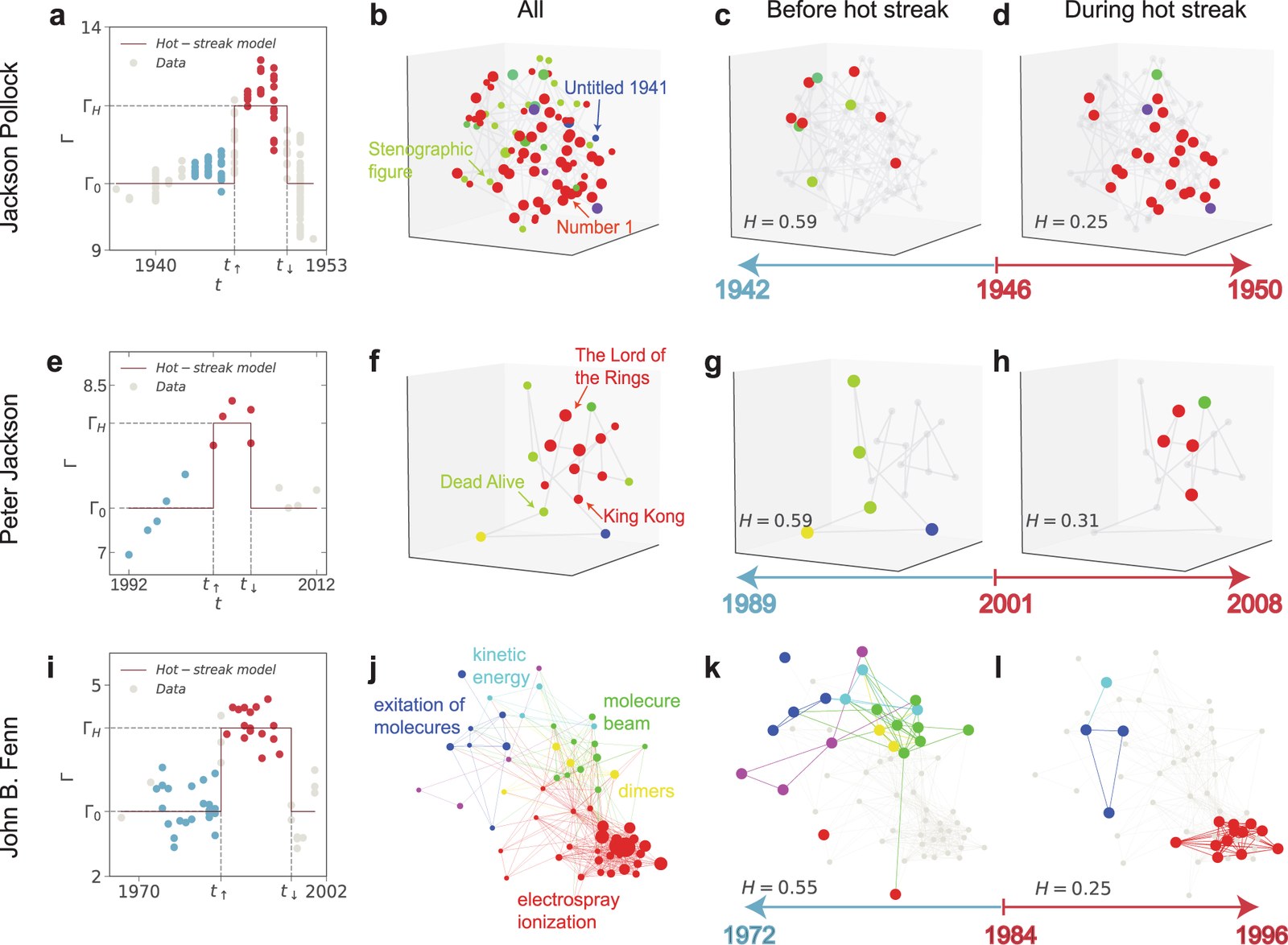
The hot streak fitted to Jackson Pollock's career. The band is the drip period, 1946–1950. CC BY 4.0.

Musée Marmottan Monet. Commons
Lu Liu, Nima Dehmamy, Jillian Chown, C. Lee Giles and Dashun Wang published in Nature Communications in September 2021. They took 2,128 artists with more than 800,000 images of their work, 4,337 film directors with 79,000 films, and 20,040 scientists, and used deep learning to build high-dimensional representations of what each person actually made, so that stylistic or topical diversity could be measured rather than asserted.
Then they looked at what happens immediately before and after a "hot streak," the period in a career when the highest-impact work clusters.
Across all three domains, individuals tend to explore diverse styles or topics before their hot streak, but become notably more focused after the hot streak begins.
The numbers: entropy, meaning diversity of styles or topics, is significantly elevated before a hot streak, with z greater than 2, and significantly below expectation after it starts, with z less than negative 2, in all three domains. And the sequence itself produces a measurable lift in the probability of a hot streak occurring:
Domain | Lift above baseline |
|---|---|
Artists | 20.5 percent |
Scientists | 19.2 percent |
Film directors | 13.8 percent |
Exploration alone did not do it. Exploitation alone did not do it. *Only the sequence produced a statistically significant improvement.*
This is the answer to the economic puzzle. Abandoning what works is not a failure of nerve or a luxury of the already-successful. It is the first half of the only pattern that reliably precedes the best work anyone does.

And the data on what it costs
The market does not want exploration. It wants a recognisable, consistent product, and the clearest evidence of that is not a study but a review.
In October 1970 Philip Guston showed at the Marlborough Gallery in New York. He had been a central figure in Abstract Expressionism. The paintings were cartoon figures: hoods, shoes, cigarettes, clocks, bricks, a bare bulb.
Hilton Kramer's review in the New York Times was titled "A Mandarin Pretending to Be a Stumblebum." He called the change an illusion, and an artifice.
Robert Hughes in Time headlined his "Ku Klux Komix," and later reversed his assessment.
Look at Kramer's two words. Illusion. Artifice. He is not saying the paintings are bad. He is saying Guston is pretending, which is an accusation about sincerity rather than about quality. A change of style was received as a change of character.
The documented consequence is that Guston withdrew further into Woodstock.
The counterweight is worth recording too. De Kooning told him the paintings were about freedom.
Tate on Guston.
I looked for research measuring whether stylistic change depresses prices and did not find any. What exists instead is this review, and the fact that it is still the most quoted piece of art criticism of the 1970s, which tells you how unusual the event was and how the field responded.
What the artists who never changed actually changed
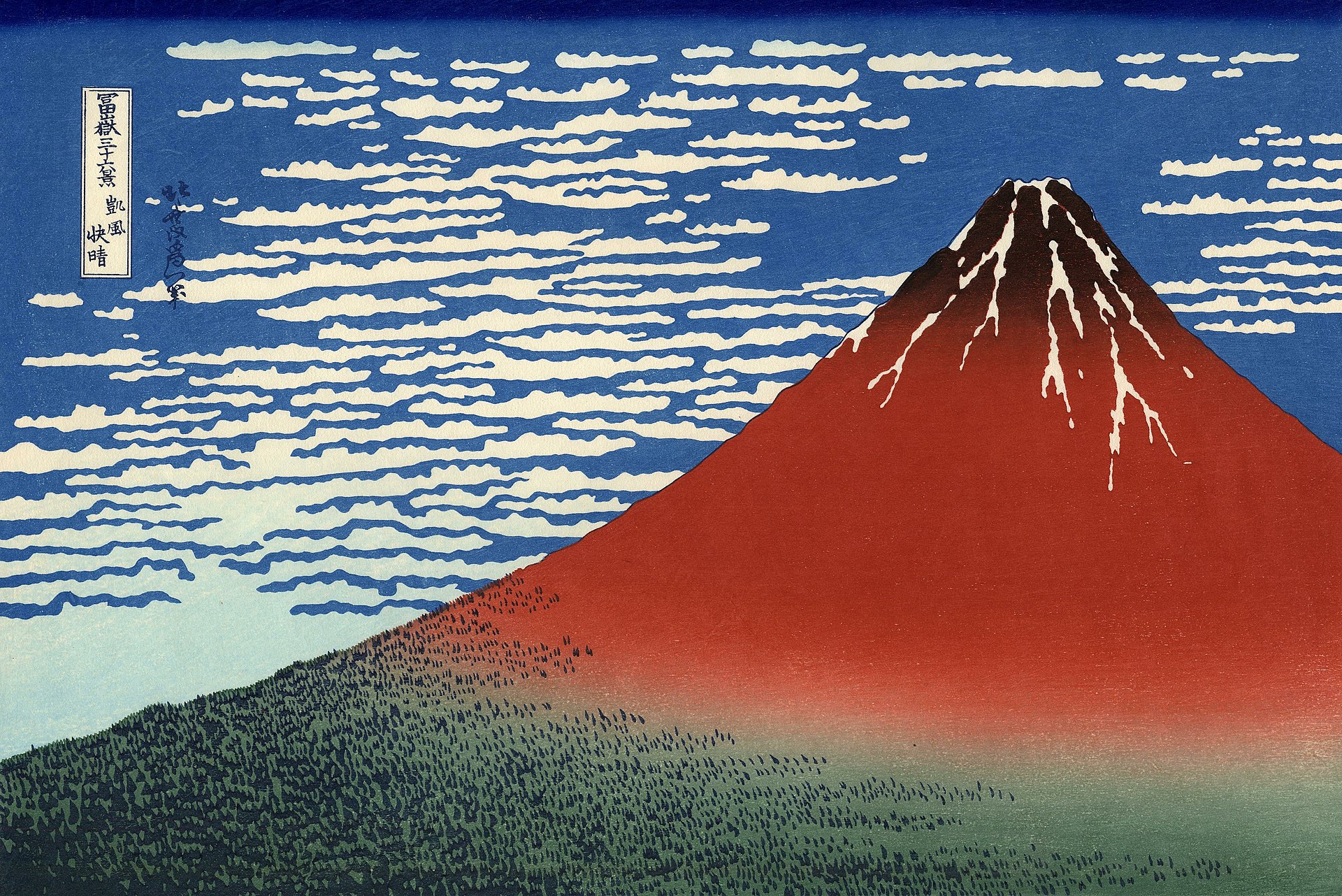
The serial project as a form: one subject, many conditions. Commons
The counter-examples matter, and they are more complicated than they look.
On Kawara began the Today series on 4 January 1966 and continued until his death on 10 July 2014. Nearly three thousand date paintings, made in more than 112 cities, under fixed rules: a painting had to be finished on the day it was begun or destroyed; the date in white lettering, always centred; eight standard horizontal formats from eight by ten inches to four by six feet.
What varied inside that: the language, following each country's convention, with Esperanto where the alphabet was not Roman; the background colour, bold early and darker later; the format, one of eight; and the rate, between sixty three and 241 paintings a year. The exception that proves the rule is three larger vertical paintings made during the Apollo 11 landing in July 1969.
Agnes Martin is the more interesting case, because the standard framing is wrong. She arrived at the grid in the late 1950s and the breakthrough years were the early 1960s. Then in 1967 she left New York abruptly. Her last painting before the break was Trumpet, in which a single rectangle became an overall grid of rectangles. She travelled for eighteen months, settled near Cuba, New Mexico in 1968, and *did not paint until 1971*, resuming substantially around 1973.
The artist held up as the great example of constancy took a six-year gap in the middle. That gap has the same shape as the exploration phase in the hot streak data.
Mark Rothko produced his signature format from 1949 to 1970, twenty one years. Inside it, the palette moved from bright reds and yellows to dark blues and greens by the mid-1950s, and in 1968, in declining health, he switched from oil to acrylic for the large works.
Nobody stays still. The constraint moves to a different level.

The Korean pair

Kim Whanki left. Born 3 April 1913, he studied in Tokyo from 1935 to 1937, worked in Seoul and Busan until 1963 with semi-abstract Korean motifs, jars and mountains and birds and plum blossom, spent roughly 1954 to 1959 in Paris deepening the blues and the ceramic surface, and then moved to New York in 1963 after the São Paulo Biennial.
In New York he put the motifs down. By 1970 he had arrived at the all-over dot paintings, covering the whole surface with small irregular points of oil thinned with turpentine. Where, in What Form, Shall We Meet Again?, 1970, took the grand prize at the Korean Art Grand Award Exhibition and was titled after a poem by his friend Kim Gwang-seop.
Seven years between the move and the arrival. Exploration, then focus, in exactly the shape the 2021 paper describes.
What he said about the jars he gave up is worth keeping: our jars opened my scope on aesthetic quality and on Korean people, and the textbook I used was these jars.
Park Seo-Bo stayed. Born 15 November 1931, he began Écriture in 1967 after watching his three year old son repeatedly write and erase the word "Korea" on a gridded sheet. He worked in that method for more than fifty years, changing materials, introducing hanji from the 1980s, shifting the palette, but not the method.
And the detail that undoes the neat contrast: he *deliberately did not exhibit the works until 1973*. Six years of private work before anyone saw it.
The international market arrived in 2014, forty seven years after he started, with twenty six survey exhibitions between 2014 and 2019 in New York, Los Angeles, Paris, Venice and Seoul.
One artist explored for seven years and then committed. The other committed and then hid the work for six years. Both of them spent roughly the same amount of time doing something nobody was paying for.
Why this question has changed since 2022
Tate on Agnes Martin.
Everything above assumes a style belongs to a person. Galenson's entire method assumes it: you cannot regress the market value of a style on an artist's age unless the style is attributable to that artist.
In September 2022 MIT Technology Review reported that the name of Greg Rutkowski, a living illustrator with credits on Horizon Forbidden West, Dungeons & Dragons and Magic: The Gathering, had been used roughly *93,000 times* in Stable Diffusion prompts, according to Lexica's tracking of ten million images.
Michelangelo, Picasso and Leonardo da Vinci each generated around 2,000 prompts or fewer.
A working illustrator, alive, was being invoked about forty five times more often than any of the Renaissance names, and his work had been scraped largely from ArtStation.
It's been just a month. What about in a year? I probably won't be able to find my work out there because the internet will be flooded with AI art. That's concerning.
Now put that next to Doshi and Hauser's finding from the previous essay in this series: generative AI raises individual novelty by around eight percent while making outputs converge, and readers impose an ownership penalty of at least twenty five percent on work they believe was AI-assisted.
The incentive structure inverts.
Under the conditions Galenson measured, a consistent recognisable style was an appreciating asset, because the market could keep locating the artist. Cézanne got to sixty seven because there was a continuous, identifiable Cézanne to keep buying.
Under mimicry conditions, *a consistent recognisable style is the most efficiently copyable thing an artist owns.* It is the part that can be extracted, named in a prompt, and reproduced at no cost, while the person whose name it is goes on working.
So why keep making new things
Three answers, in increasing order of how much I trust them.
The weakest is the market answer, and it has just reversed. For a century, consistency was the safe strategy and change was punished, which is why Kramer could call Guston's turn an artifice and be taken seriously. That calculation now runs the other way, because consistency is what a model can take.
The stronger answer is the measured one. Exploration followed by focus is the only sequence that reliably precedes the best work in a career, across artists, directors and scientists, with a lift of thirteen to twenty percent. Abandoning what works is not the cost of doing good work. It is the first half of the method.
The strongest answer is the one the whole series has been assembling.
Across ten essays, every single thing that was supposed to be a property of the artwork turned out to be a judgement made by someone else. What counts as skill was decided by an academy and then reversed within nine years. Whether a painting is genuine is decided by a committee that halved Rembrandt and then doubled him back. What a work costs is decided before the bidding starts. Whether an artist is remembered is decided by a widow, a critic, or a dealer who opens a gallery. What a museum shows is decided by lux-hours and an acquisitions policy. Whether an image is authored is decided differently in Washington, Beijing and Seoul.
The one thing in that entire chain that belongs to the artist is *what to do next*.
Not the price, not the attribution, not the reputation, not the shelf in the storage facility, not the legal status of the file. Just the decision about the next piece of work.
Abandoning a style that works is the clearest available exercise of the only part of this that was ever yours.
That is not a romantic claim. It is what is left after you subtract everything the previous nine essays showed was decided by somebody else.
Sources
David Galenson and Bruce Weinberg, "Creating Modern Art," American Economic Review 91(4), 2001, and "Age and the Quality of Work," Journal of Political Economy 108(4), 2000. Working papers: NBER 6888 and NBER 8779
David Galenson, Old Masters and Young Geniuses: The Two Life Cycles of Artistic Creativity, Princeton University Press, 2006
Lu Liu, Nima Dehmamy, Jillian Chown, C. Lee Giles and Dashun Wang, "Understanding the onset of hot streaks across artistic, cultural, and scientific careers", Nature Communications 12, 2021
Lu Liu et al., "Hot streaks in artistic, cultural, and scientific careers," Nature, 2018
Hilton Kramer, "A Mandarin Pretending to Be a Stumblebum," The New York Times, October 1970
Melissa Heikkilä, "This artist is dominating AI-generated art. And he's not happy about it", MIT Technology Review, 16 September 2022
Anil R. Doshi and Oliver P. Hauser, "Generative AI enhances individual creativity but reduces the collective diversity of novel content," Science Advances 10(28), 2024
This is the last of ten. The Korean versions of all ten are on my Naver blog at blog.naver.com/veinism.
Latest Articles.
© Moc Mallen Studio
Thoughts, ideas, and perspectives on design, simplicity, and creative process.


