Who Decides It Is Finished
Somebody once varnished Leonardo's unfinished panel to make it look complete. Five arguments about done, and only one of them settled by the person who made the thing.
Date
Category
Writer

Leonardo stopped working on the Adoration of the Magi in 1482 and left for Milan. The monks of San Donato a Scopeto waited, then gave the commission to Filippino Lippi, who delivered in 1496. The abandoned panel sat in a private house, then in a Medici store, and eventually reached the Uffizi.
For five centuries the question about it has been what kind of unfinished it is. Defeated by his own composition, as the romantic reading has it? Or interrupted?
A four-and-a-half-year conservation campaign that ended in 2017 answered it, and the answer is boring in the best way. The Uffizi's own conclusion: the cleaning made clear that this is much more simply a painting interrupted ex abrupto, at the moment the artist was about to apply the first layers of colour.

Leonardo da Vinci, Adoration of the Magi, about 1482, in its post-2017 cleaned state. 244 × 240 cm, ten poplar planks. Gallerie degli Uffizi, inv. 1890 n. 1594. Photograph by Justin Benttinen, CC BY-SA 4.0, via Wikimedia Commons.
Five arguments about when something is done
1. Michelangelo's Prisoners, and a question the museum refuses to answer

Michelangelo, the Atlas Slave, one of four unfinished Prisoners in the Galleria dell'Accademia, Florence. Photograph by Jörg Bittner Unna, CC BY-SA 3.0, via Wikimedia Commons.
Four figures, roughly 260 to 280 centimetres each, carved for the tomb of Julius II across a project that was redesigned six times between 1505 and 1542 and finally erected in 1545 without them, largely by other sculptors.
They stayed in his workshop until his nephew gave them to Cosimo I in 1564, went into a grotto in the Boboli gardens, and arrived at the Accademia in 1909. They have been read as a deliberate non finito for so long that the reading feels native to the objects.
The Accademia does not say that. Its texts describe the works as unfinished and dwell on the visible chisel and rasp marks, and stop there. The standard sceptical article, Juergen Schulz's "Michelangelo's Unfinished Works" in The Art Bulletin in 1975, argues against a deliberate aesthetic altogether. The museum that owns them declines to adjudicate, which is the correct institutional behaviour and also an admission that nobody knows.
2. Turner's studio, and a keeper who called them botches

J.M.W. Turner, Norham Castle, Sunrise, about 1845. Tate. Photograph by Sailko, CC BY 3.0, via Wikimedia Commons.
When Turner died there were a hundred finished and two hundred and sixty-two unfinished paintings in the house on Queen Anne Street. Tate is careful about this: it is unlikely Turner considered any of them ready to exhibit, and none was shown in public in his lifetime.
So the judgement passed entirely to other people, and you can watch them make it. The Art Journal reckoned only five of the unfinished canvases were worth exhibiting. Ralph Wornum, Keeper of the National Gallery, called them mere botches, pieces of canvas with paint on them, utterly unfit to be exhibited.
By about 1900 The Studio had reversed it: hitherto condemned to obscurity as unfinished, these pictures anticipate to some extent the study of light which later became the inspiration of Impressionism.
Fifty years, same objects, and the verdict inverts. Nothing about the paintings changed. The category did.
3. Cézanne, and the two spots on Vollard's hand
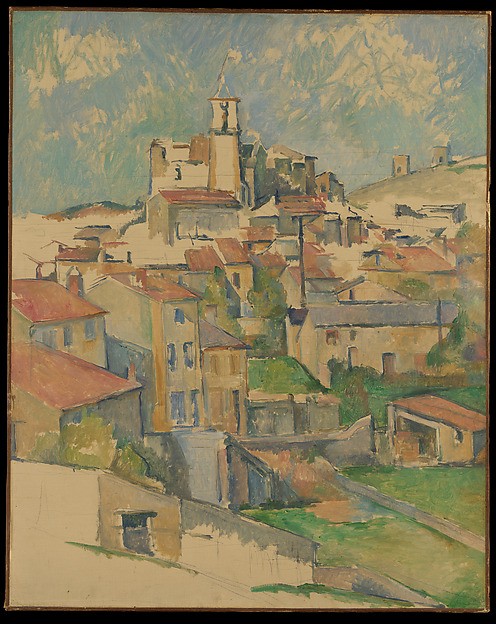
Paul Cézanne, Gardanne, 1885 to 1886. The Metropolitan Museum of Art, 57.181. Open Access, CC0. Primed canvas is visible across the lower third.
Ambroise Vollard sat a hundred and fifteen times for his portrait and asked about two unpainted spots on the hand. Cézanne's answer, as Vollard reported it: if the copy I am making at the Louvre turns out well, perhaps I will be able tomorrow to find the exact tone to cover up those spots.
That is not an artist declaring reserve to be a device. It is an artist saying he has not found the colour yet.
And yet the museums that own the late work do not call it unfinished. The Met's record for Gardanne, with its bare canvas plainly visible, says only that the structures anticipate early twentieth-century Cubism. The Nelson-Atkins, on a late Sainte-Victoire, talks about simplified geometric shapes and shifting planes. Both reframe the reserve as method without ever saying so.
4. The Sagrada Família, and the argument about continuing at all

The Sagrada Família, Barcelona, 2026. Photograph by Wikipsico43, CC BY-SA 4.0, via Wikimedia Commons.
The Basilica's own history is precise about what Gaudí saw: the bell tower dedicated to the apostle Barnabas was the only one he would see finished. He died in 1926.
Ten years later the documentation was destroyed. The Basilica's wording: in 1936 the Sagrada Família is vandalised during the Spanish Civil War, plans and photographs are burnt and the plaster models smashed. Everything since has been built from what could be salvaged and from published plans and photographs.
The central tower of Jesus Christ was completed with its cross in February 2026, bringing the building to 172.5 metres. The chief architect, Jordi Faulí, called it the result of years of work and study of Gaudí's legacy. The Glory façade is still unbuilt, and the Basilica's own blog still describes the building as seventy percent complete and gives no completion date, while the press reports it as finished after 144 years.
The objection has been running since the 1960s. A petition in 2008 drew over four hundred architects and historians. The critic Rowan Moore stated it as well as anyone: Gaudí's architecture was organic, living and responsive, whereas posthumous simulation of his ideas makes them fixed and lifeless.
5. Rodin, and the only case where the maker decided
The Musée Rodin draws the distinction the whole subject needs. A fragmentary figure was made whole and then damaged. A partial figure is one where only the visible elements were ever executed.
Rodin worked in the second mode deliberately. The museum's own text: flawless in form, the fragment earned its independence, broke away from the figure to which it had originally belonged, and became a work of art in its own right. He assembled studies and generally left the joins visible, reviving non finito from Michelangelo on purpose.
On The Walking Man, made from 1878 studies for the torso and legs of a St John the Baptist, the museum is explicit: the missing arms reinforce the effects sought by the artist, who broke away from the academic tradition of full-figure sculpture.
Rodin's own defence, quoted by the museum: didn't they understand anything about sculpture, about study? Don't they think an artist has to apply himself to giving as much expression to a hand or a torso as to a face?
This is the inverse of every other case here. The maker declared it done, and the audience had to catch up.
Who held the pen
Case | Who decided | Verdict stable? |
|---|---|---|
Michelangelo's Prisoners | Nobody. Still open | No. The museum declines to say |
Turner's studio oils | A keeper, then a magazine, then a later magazine | No. Reversed within fifty years |
Cézanne's reserve | Museums, retrospectively | No. Cézanne said he had not found the tone |
Sagrada Família | Successors, against objection | No. Still contested, including whether it is now finished |
Rodin's partial figures | The artist, in writing | Yes |
Table 1. Exactly one of these was settled by the person who made the thing.
Video. "Michelangelo, The Slaves," Smarthistory.
What the Uffizi's restorers actually removed
Back to Leonardo, because the technical report is the most useful document in this article.
What came off the panel was not varnish. Patrizia Riitano lists the layers: animal glue, milk, pigmented patinas, fly specks, and altered, largely oxidised natural resins, all fused into a single brown film. Under that, old discoloured retouching, and the residue of documented interventions in 1724, 1794 and the early twentieth century.
The detail that stopped me: at some early date the whole surface had been covered with a pigmented varnish, probably to flatten the tonal dissonance and let the panel read as a deliberate monochrome. Somebody had tried to make the unfinished painting look finished, by adding a layer.
The cleaning was deliberately partial. Some varnish and patina were left. Two passages were not touched at all, because the underdrawing could not be distinguished from shading: the donkey in front of the hut, and the man seen from behind on the stairs.
And the Uffizi is honest about what it has produced: the result now lets us appreciate a work, but one very different from how it appeared when Leonardo left it interrupted. The warm red-browns now visible were originally cool greens and umber, and everything visible would have been covered by further layers of colour.
So the current state of the painting is a third thing: not what Leonardo left, and not what the eighteenth century made of it, but what a 2017 committee decided to stop at.
Three working consequences
"Finished" is a decision with an owner, and usually the owner is not the maker. Four of the five cases above were settled by keepers, critics, successors and committees. If you want to be the one who decides, you have to say so in writing while you still can, which is what Rodin did and Turner did not.
Somebody will try to make the incomplete thing look complete. The pigmented varnish over the Leonardo is the purest example I have ever found: an intervention whose entire purpose was to hide that the work had stopped early. Watch for the equivalent in your own output, the polish applied to a half-built thing so that nobody asks.
Record what state you stopped in, and why. The Uffizi's willingness to say that the current appearance is not the original appearance is worth more than the cleaning itself. A restoration that documents its own limits is a different object from one that quietly presents itself as recovery.
A walk across the panel itself, the vanishing point that is a physical hole in the wood, the fingerprints along the horizon and the faces that are still only watercolour lines, is on my Korean blog: 베이니월드.
Sources
Object record, dimensions, commission and conservation dates: Gallerie degli Uffizi. The restoration, the layers removed and the pigmented varnish: Uffizi, on the restoration and the non finito, and Opificio delle Pietre Dure. The Prisoners: Galleria dell'Accademia. Turner's studio contents and the contemporary verdicts: Tate Etc. and Tate. Gardanne: The Metropolitan Museum of Art. Gaudí's one finished tower, the 1936 destruction and the 2026 cross: Basílica de la Sagrada Família and Vatican News. Fragmentary versus partial figures, and The Walking Man: Musée Rodin.
Not asserted: whether Leonardo left for Milan in 1481 or 1482, since the Uffizi's own English and Italian pages disagree; the exact terms of the San Donato contract; and the proportion of the Sagrada Família built at Gaudí's death, for which the Basilica gives only "one bell tower" and other sources give figures between fifteen and twenty-five percent.
Latest Articles.
© Moc Mallen Studio
Thoughts, ideas, and perspectives on design, simplicity, and creative process.


.jpg)


