What Painters Did When the Camera Arrived
Paul Delaroche never said painting was dead. What he actually wrote, in the document that went to the French legislature, was that the daguerreotype is an immense service rendered to the arts. And then the miniaturists were destroyed.
Date
Category
Writer

Everyone knows what Paul Delaroche said when he saw a daguerreotype in 1839. From today, painting is dead.
He did not say it. There is no primary source for the sentence before the twentieth century, and there is a primary source for what he actually wrote, which says the opposite, and which was read aloud to the French Chamber of Deputies.

Arago announced Daguerre's process to the Académie des sciences on 7 January 1839 and carried the bill through the Chamber. Commons
What Delaroche actually wrote
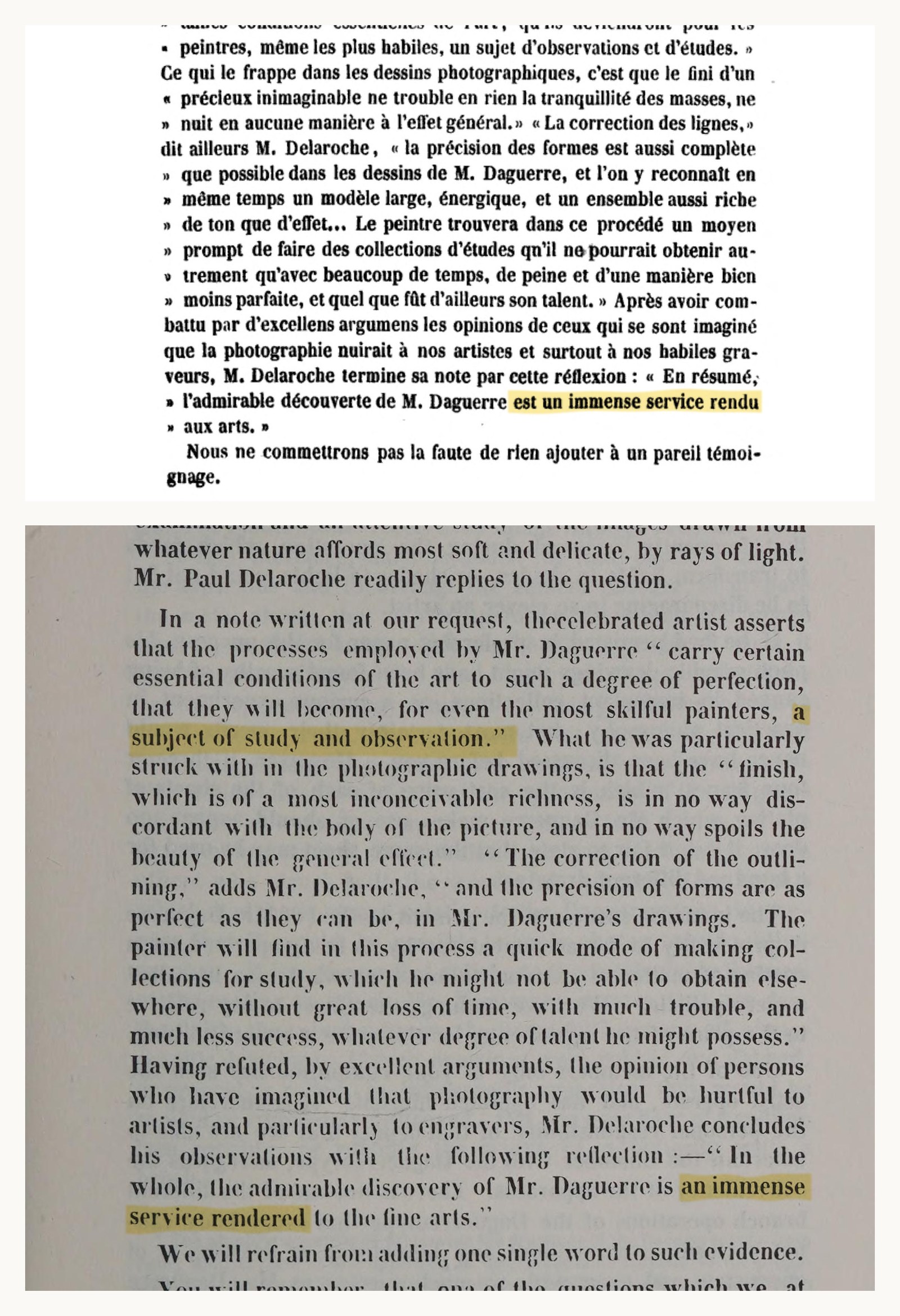
The sentence Delaroche actually wrote, in both 1839 printings: est un immense service rendu aux arts / an immense service rendered to the fine arts. He also called the process a subject of study and observation for painters.
First a correction of the usual framing. Delaroche did not submit an official report. He wrote a note at Arago's request, which Arago then quoted inside his own report to the Chamber of Deputies of 3 July 1839. The text is printed in Daguerre's 1839 manual, in French and in a contemporary English translation, and both are on the Internet Archive.
M. Paul Delaroche declares that M. Daguerre's processes carry certain essential conditions of the art to such a degree of perfection that they will become, for even the most skilful painters, a subject of study and observation.
What strikes him in the photographic drawings is that a finish of unimaginable preciousness disturbs in no way the tranquillity of the masses, and does not injure the general effect.
The painter will find in this process a quick mode of making collections for study, which he might not be able to obtain elsewhere, without great loss of time, with much labour, and in a manner far less perfect.
Arago's own summary of the note:
After having combatted, with excellent arguments, the opinions of those who imagined that photography would injure our artists and above all our skilful engravers, M. Delaroche ends his note with this reflection:
In short, the admirable discovery of M. Daguerre is an immense service rendered to the arts.
The man who supposedly declared painting dead anticipated the displacement argument and argued against it in writing, in the document that went to the legislature, and described the machine specifically as a reference-gathering tool for painters.

Historique et description des procédés du daguerréotype et du diorama. Arago's report, with Delaroche's note inside it, is printed here. Commons

National Gallery, London. This is the finish Delaroche was talking about when he said the daguerreotype achieved it without disturbing the masses. Commons
The people who actually lost
A generation that had cheerfully given its hundred guineas for a Ross, a Newton, or a Thorburn suddenly ceased to care. archive.org
The painters were fine. The miniaturists were destroyed.

Watercolour on ivory, 10 by 8 centimetres, signed and dated 1847. Eight years after the daguerreotype was announced, this trade was still working, and within one generation it was gone. Commons
J. J. Foster's Miniature Painters, British and Foreign, published in London in 1903, is written from close enough to the event to be evidence.
But in the period of neglect of the art which followed the discoveries of Talbot and Daguerre, miniature painting well-nigh perished of inanition, so that a popular belief arose that the art had altogether ceased to be practised.
it must be owned that photography put miniatures out of fashion; a generation which had cheerfully given its hundred guineas for a Ross, a Newton, or a Thorburn, suddenly ceased to care for such, and disastrous indeed were the immediate results.
A hundred guineas. That is the price of the skill, and the price went to zero.
Two names make it concrete. Sir William Charles Ross RA declared on his deathbed in 1860 that it was all up with future miniature painting. Robert Thorburn ARA, born 1818, was at the top of the trade, and photography ended his earlier style abruptly. *He retrained into oils.* When he died in November 1885 his contemporaries had almost forgotten that he had made his name as a miniaturist at all.
The Times, in a leader on his death, called him a man who found himself
stranded with a cargo of unsaleable talents
and likened him to the owner of a cellar of rare wines whose friends had with one consent turned teetotallers, and then, directly, to a hand-loom weaver when the new machinery arrived.
In 1885, contemporaries were already reaching for the automation analogy.
What the painters who survived actually did
They became photographers
Gaspard-Félix Tournachon, who called himself Nadar, was a caricaturist and novelist before he was a photographer. He worked as a caricaturist from 1848 and turned to portrait photography in 1854.

Gustave Le Gray trained as a painter under François-Édouard Picot and *under Paul Delaroche*. He exhibited paintings at the Salon in 1848 and 1853, made his first daguerreotypes in 1847, published a treatise in 1850, joined the Missions Héliographiques in 1851 and co-founded the Société héliographique.
The chain is real and it is worth stating plainly: the teacher who allegedly declared painting dead trained the first generation of art photographers, including Le Gray, Charles Nègre, Henri Le Secq and Maxime Du Camp.
Disdéri patented the carte de visite on 27 November 1854, and a contemporary German account of his Paris operation describes it as the Temple of Photography, selling three to four thousand francs of portraits a day. Nadar's summary of what that did to everyone else:
Either you had to succumb, that is to say, follow the trend, or resign.
They used it as an instrument

Delacroix's journal for 1853 is the richest document available, because in a single year it contains ambivalence, professional regret, a copyright anxiety and a theory of the machine as a training instrument.
On 21 May 1853 he showed friends photographs of nude models made by Eugène Durieu, then put Marcantonio's engravings in front of them, and recorded that they felt a sentiment of repulsion and almost of disgust at the incorrectness, the mannerism and the lack of naturalness. The disgust was directed at the engravings, after looking at photographs.
Then, in the same passage:
Let a man of genius use the daguerreotype as it ought to be used, and he will rise to a height we do not know. So far this machine-art has done us nothing but a detestable service: it spoils the masterpieces for us, without completely satisfying us.
Also in 1853, the painter Riesener advised him to publish his sketches by photography, and Delacroix noted he had already had the thought and that it would be fruitful. And painters around him were asking whether one could paint from Durieu's photographs without being accused of plagiarism. That anxiety is a hundred and seventy years old.
And on 15 October 1853:
Had this invention been made thirty years ago, like that of the daguerreotype, perhaps my career would have been fuller. The facility of painting at every moment, without the tedium of the palette, and then the instruction the daguerreotype gives to a man who paints from memory, are inestimable advantages.
Note where he puts the value. Not in the photograph. In *knowing how it ought to be used*.
And the machine corrected them
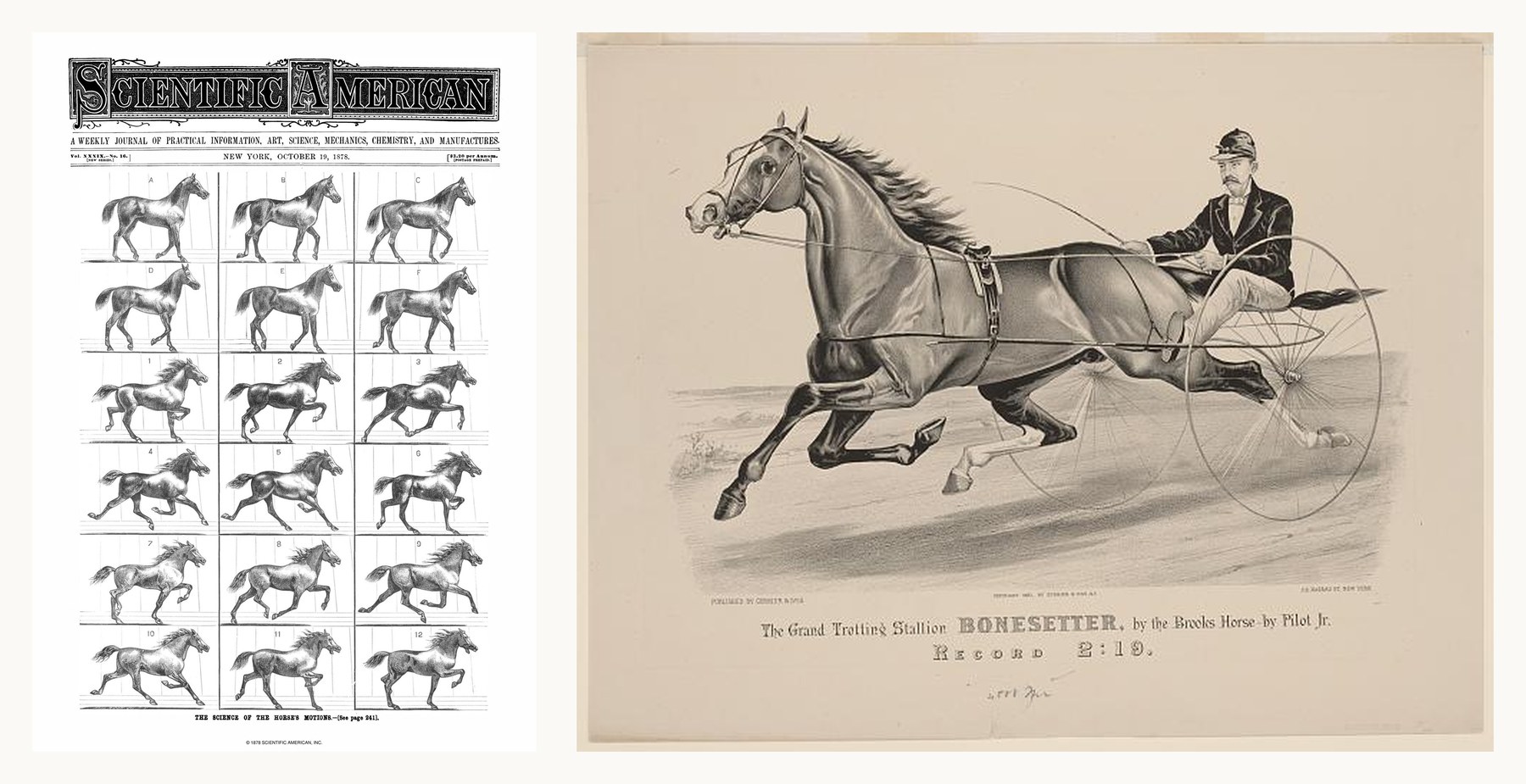
Left: the corrected frames on a mass-circulation cover, with the line no artist would have dared to draw a horse as a horse really is when in motion. Right: three years later, America's largest print house is still selling the flying gallop.

Musée du Louvre. The flying gallop: all four legs extended, fore and aft. Commons
In 1872 Leland Stanford hired Eadweard Muybridge, wanting a proper picture of a horse at full speed. In June 1878 Muybridge set a battery of twelve cameras along the track at the Palo Alto Stock Farm, with shutters tripped by wires, and demonstrated the result publicly on 15 June.

Here is the correction that usually gets told wrong. Painters were not wrong that a galloping horse has all four hooves off the ground. They were wrong about *which phase of the stride* that happens in. It occurs when the legs are collected beneath the body, at the transition from pulling with the front legs to pushing with the back, not when they are extended fore and aft.
The convention had the right fact attached to the wrong moment, and no amount of looking would have caught it, because the eye cannot resolve it.

Philadelphia Museum of Art. Eakins arranged Muybridge's 1883 lecture at the Pennsylvania Academy and worked alongside him in 1884. This painting relied on photographic motion studies to get the gait right. Commons
SFMOMA on Muybridge.
Now the measurements
The historical parallel is only worth anything if the present case can be measured, and it can.
Xiang Hui, Oren Reshef and Luofeng Zhou published in Organization Science in 2024. They scraped the Upwork freelancer API from January 2022 to April 2023, one and a quarter to one and a half million monthly observations, and ran a difference-in-differences comparing occupations more and less exposed to generative AI.
Effect | Writing services | Image services |
|---|---|---|
Monthly jobs | down 2.0 percent | down 2.1 percent |
Monthly earnings | down 5.2 percent | down 5.2 percent |
Hui, Reshef and Zhou, "The Short-Term Effects of Generative Artificial Intelligence on Employment," Organization Science 35(6), 2024, pp. 1977 to 1989.
Moderate effects. And then the finding that matters:
we do not find evidence that high-quality service, measured by their past performance and employment, moderates the adverse effects on employment. In fact, we find suggestive evidence that top freelancers are disproportionately affected by AI.
Quantified: each one percent increase in prior platform earnings was associated with an additional 1.1 percent reduction in jobs and 3.3 percent reduction in income, for image services.
Being good did not help. Being good made it worse. Which is exactly what happened to Ross and Thorburn, who were the best miniaturists in Britain.
The second study is about what the tool does to the work rather than to the market. Anil Doshi and Oliver Hauser published in Science Advances on 12 July 2024: 293 writers, three conditions, 600 separate evaluators.
Measure | With one AI idea | With five AI ideas |
|---|---|---|
Novelty | up 5.4 percent | up 8.1 percent |
Usefulness | up 3.7 percent | up 9.0 percent |
Novelty, least creative writers | up 6.3 percent | up 10.7 percent |
"How well written," least creative writers | up to 26.6 percent | |
Similarity to the AI's own ideas | up 5.2 percent | up 5.0 percent |
Individual output improves, and improves most for the weakest writers. Collective output converges. The authors call it a social dilemma: with generative AI, writers are individually better off, but collectively a narrower scope of novel content is produced.
And one more finding, about authorship rather than quality: evaluators imposed an *ownership penalty of at least 25 percent* on writers who had received generative AI ideas.
So what is the answer
Three claims, each of which rests on something verifiable rather than on encouragement.
*One. "Be excellent" is not a strategy.* The data says quality did not moderate the loss and top performers were hit harder. The history says the same: Ross and Thorburn were the best in Britain, and that is precisely why they had the furthest to fall. A skill that is valuable because it is scarce becomes worthless when it stops being scarce, and being unusually good at it accelerates the exposure rather than cushioning it.
*Two. The scarce thing is knowing what the machine is for. Delacroix, 1853: the value waits on a man of genius who uses the daguerreotype as it ought to be used*. Delaroche, 1839: the machine is a subject of study and observation for painters, a means of gathering material. Both men, looking at the thing in the first fifteen years of its existence, located the value in judgement and application rather than in production. Neither of them was consoling anybody. They were describing what they could see.
*Three. Distinctiveness becomes scarce precisely because the tool erodes it.* Doshi and Hauser measured the erosion. If everyone's floor rises and everyone's outputs converge, then whatever does not converge carries the premium. That is not a moral argument about authenticity. It is an arithmetic consequence of the convergence they measured.
There is a fourth claim I would like to make and cannot support. Every survival route documented above ran through a relationship. Le Gray survived through Delaroche's studio and the Société héliographique. Delacroix's entire photographic practice ran through Durieu, Riesener and Pierret. Eakins got to Muybridge because he arranged the lecture. I could not find research establishing that the social dimension is what does the work, so I will state it as an observation and not as evidence.
What I can say is that the last time a machine took over a core artistic skill, the people who were destroyed were the ones whose value was entirely in execution, and the people who were fine were the ones who already thought of execution as a means.
Sources
Daguerre, Historique et description des procédés du daguerréotype et du diorama, Paris 1839, containing Arago's report of 3 July 1839 with Delaroche's note. French · contemporary English translation
Comptes rendus hebdomadaires des séances de l'Académie des sciences, tome 8, session of 7 January 1839. Internet Archive
J. J. Foster, Miniature Painters, British and Foreign, vol. 1, London 1903. Internet Archive
Journal de Eugène Delacroix, Tome 2, 1850 to 1854, Plon, Paris 1893. Project Gutenberg
Xiang Hui, Oren Reshef and Luofeng Zhou, "The Short-Term Effects of Generative Artificial Intelligence on Employment," Organization Science 35(6), 2024
Anil R. Doshi and Oliver P. Hauser, "Generative AI enhances individual creativity but reduces the collective diversity of novel content", Science Advances 10(28), 2024
The Korean version of this research, built around the Delaroche correction, is on my Naver blog at blog.naver.com/veinism.
Latest Articles.
© Moc Mallen Studio
Thoughts, ideas, and perspectives on design, simplicity, and creative process.


