The Work That Begins After Death
Fifteen exhibitions in five years, three volumes of letters, about two hundred paintings released over thirty four years. Posthumous fame is not weather. It is labour, and it has names.
Date
Category
Writer

The story everyone knows is that Vincent van Gogh sold almost nothing in his lifetime and became the most famous painter in the world after he died. It is told as though fame arrived on its own, the way weather arrives.
It did not. It arrived because a twenty eight year old widow with an infant son spent the next thirty four years of her life making it arrive, and we can count what she did.

Photograph by Raoul Saisset. Vincent painted Almond Blossom for this baby. Commons
What Jo van Gogh-Bonger actually did
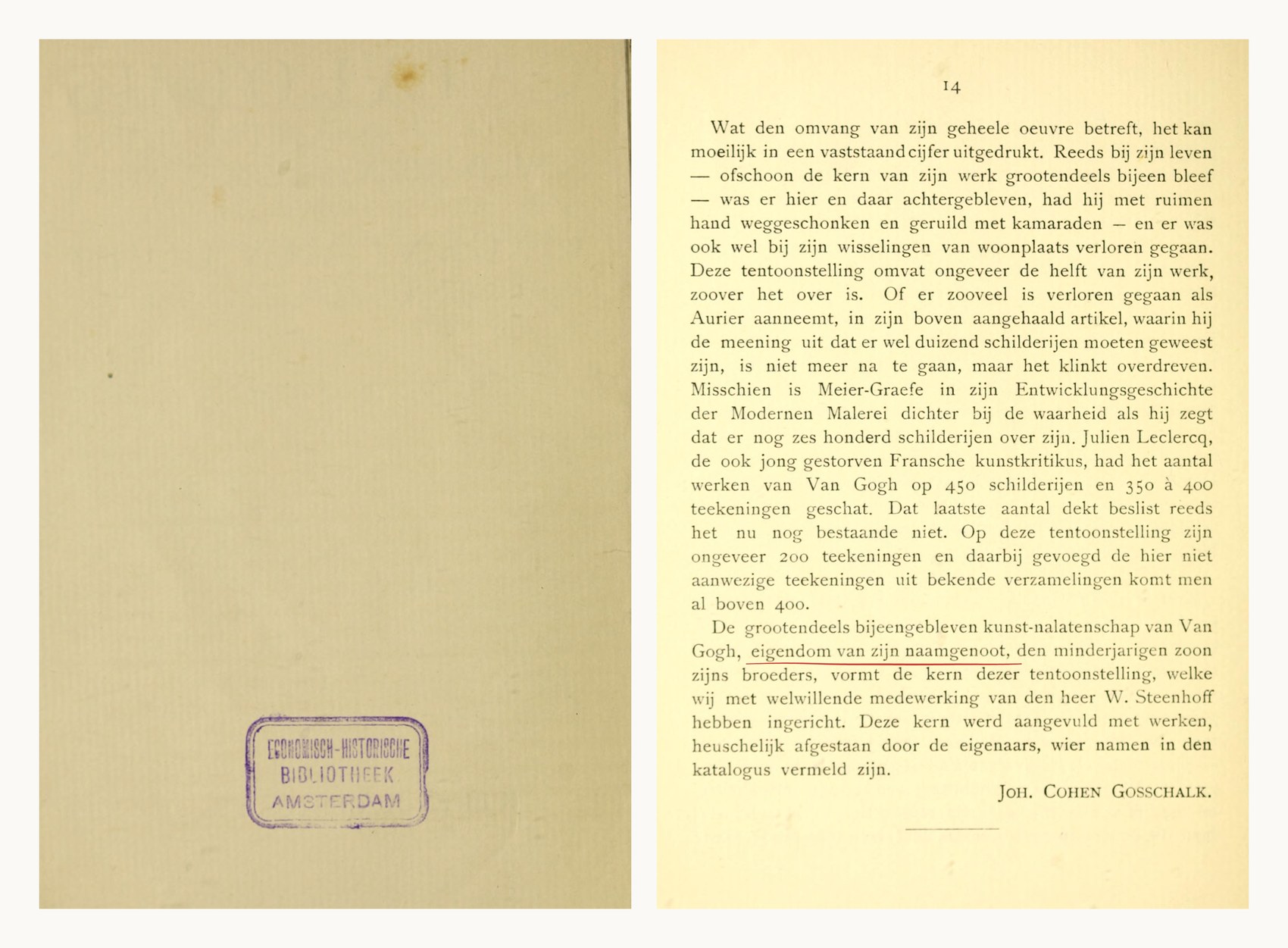
430 catalogued works, from an estate held in trust for a minor. The catalogue says so on page 14: the collection belongs to zijn naamgenoot, den minderjarigen zoon zijns broeders. archive.org
She married Theo in April 1889, aged twenty six. Theo died in January 1891, seventeen months later. She inherited several hundred paintings, a larger number of drawings, and a box of letters, and she was widely advised to get rid of them.
When | What |
|---|---|
Summer 1905 | Retrospective at the Stedelijk, 430 catalogued works |
1905 | The Stedelijk Museum retrospective, Amsterdam, more than four hundred works |
1914 | Edited, annotated and published Vincent's letters to Theo in three volumes |
by 1925 | Had translated two thirds of the letters into English |
1891 to 1925 | Sold almost two hundred paintings and more than fifty works on paper |
From Hans Luijten, Jo van Gogh-Bonger: The Woman Who Made Vincent Famous (Bloomsbury, 2022), as reported by The Art Newspaper. The 1914 Dutch edition is fully digitised.
Fifteen exhibitions in five years is not grief management. It is a campaign.
But the letters are the part that changed everything, and the mechanism is worth being precise about. The paintings on their own were difficult, foreign, and in 1900 not obviously good. The letters supplied a first-person account of why they were made. They turned a body of work into a biography, and what the twentieth century actually bought was the biography.
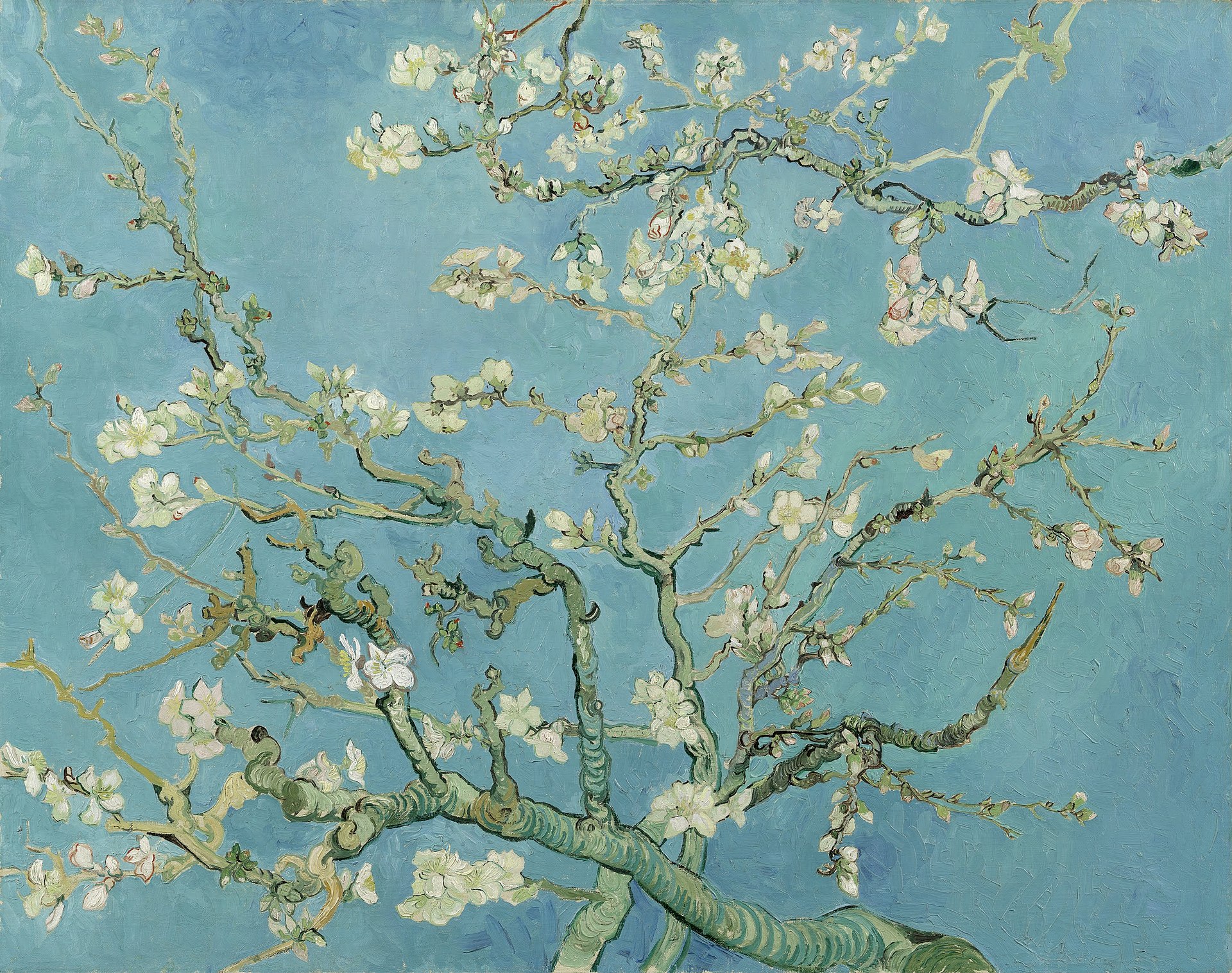
Van Gogh Museum, Amsterdam. Painted as a gift for Jo and Theo's newborn son. Commons
She also declined to sell. Luijten's account describes her negotiating with dealers, and thwarting acquisition attempts she thought premature. Roughly two hundred paintings released over thirty four years is about six a year. Whether that was a deliberate strategy of supply restriction is Luijten's reading rather than a documented policy, and it should be attributed to him. The release rate itself is a fact.
The counter-intuitive finding
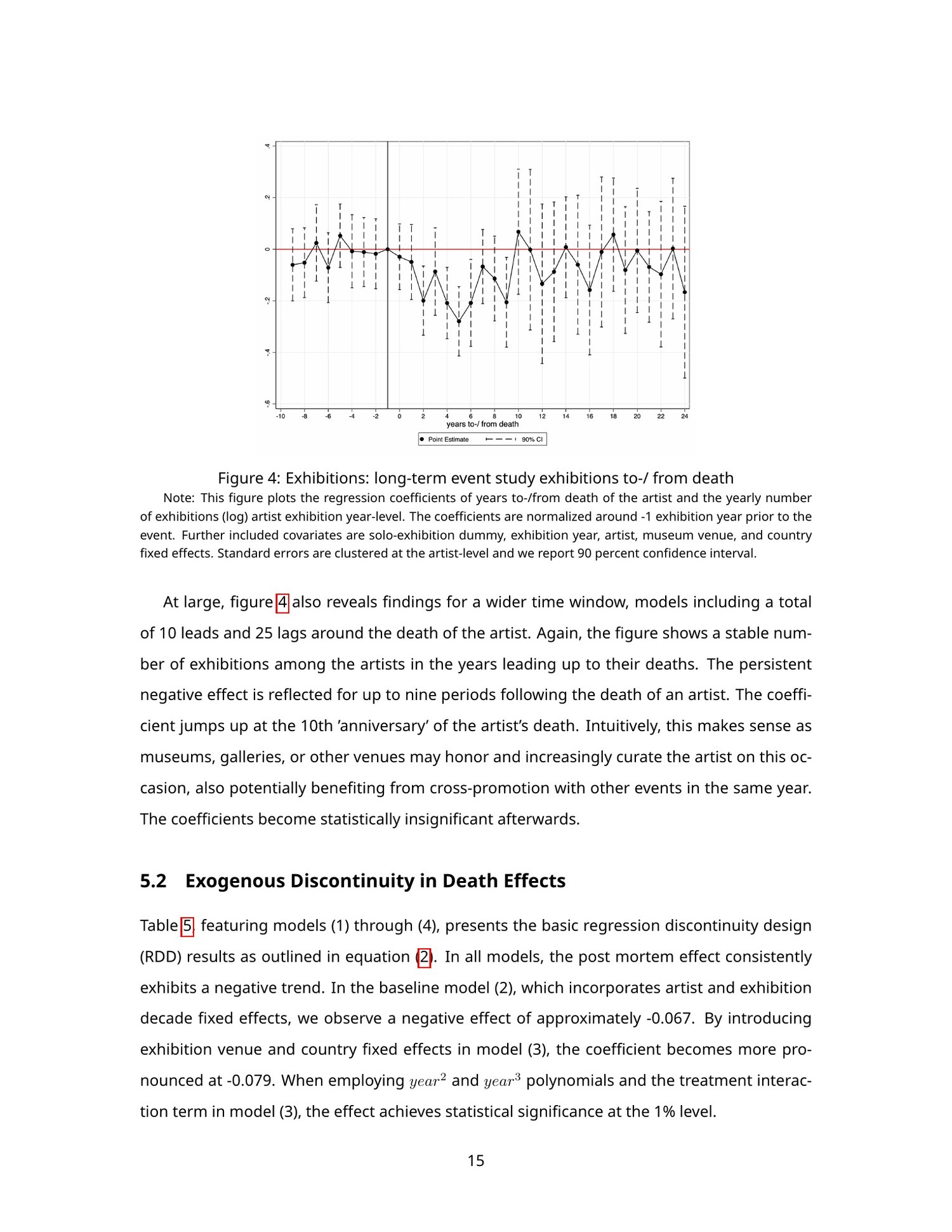
Exhibitions after an artist's death, plotted against the year of death. The line sits below zero for nine years and comes back at the tenth. CC BY 4.0.
The common sense version says an artist's death is a promotion: scarcity becomes permanent, the market re-rates, the museums call.
Alexander Cuntz and Matthias Sahli tested that on a thousand prominent artists born after 1900, looking at exhibition histories and auction records. Their WIPO working paper found the opposite at the start.
An artist's death initially reduces exhibition activity. Exhibitions return to pre-death levels roughly ten years after death.
And a second finding that closes the loop: there is a real posthumous price premium, but the premium raises insurance costs, which makes the work harder to exhibit. Market value and institutional access pull against each other.
So the decade after death is a trough, not a boom. Something has to pull an artist out of it, and that something is people doing work.
The work has a job description now
Organisation | What it does |
|---|---|
Andy Warhol Foundation | Founded 1987. The 1988 Sotheby's sale of Warhol's own collection raised about $25.3m. Grants roughly $15m a year. Has distributed about 52,000 works to more than 320 museums |
Pollock-Krasner Foundation | Lee Krasner was executor from 1956; the foundation was created by her 1985 bequest. More than 5,000 grants in 79 countries, over $87m |
Estate of Jean-Michel Basquiat | Run by Gerard Basquiat until 2013, then by the artist's sisters Lisane Basquiat and Jeanine Heriveaux. Their 2022 King Pleasure was the family's first self-organised exhibition, over two hundred works |
Joan Mitchell Foundation, CALL | Founded 2007. Employs "legacy specialists" who help artists organise studios, document work, and develop narrative around their trajectory |
Schwartzman& | Founded 2020 by Allan Schwartzman. Advises seven estates. Does not sell; coordinates with galleries |
AFELL | A leaders' list for artist foundations and estates, started in 2019 as a Google group, now 300+ members |
From ARTnews, "As the Canon Expands, the Business of Artists' Estates Booms", and The Art Newspaper, "The great artists' estates race".
"Develop narrative around their trajectory" is the foundation's own phrase, in its own job description. It is the thesis of this essay stated by the institution that performs it.
The scale of the labour is easier to see in a small estate than a large one. Cat Gardère took on her father Paul Gardère's estate after his death in 2017. She catalogued the assets for probate at forty hours a week for three years, then hired archivists to build a digital archive. The outcome was a solo exhibition at Cooper Union and inclusion in Surrealism and Us at the Modern Art Museum of Fort Worth in 2024.
Three years of full time work to make an artist's output legible enough to be considered.
Rediscovery is a judgement, and judgements can be wrong

The critic who wrote Vermeer back into art history, photographed by the man who photographed everyone. Commons
Théophile Thoré, writing under the pseudonym W. Bürger while in political exile, published "Van der Meer de Delft" in the Gazette des Beaux-Arts in three instalments, on 1 October, 1 November and 1 December 1866. His own opening line:
A dozen years ago, Jan van der Meer of Delft was almost unknown in France. His name was missing from the biographies and histories of painting.
He attributed more than seventy works to Vermeer, including many he himself regarded as uncertain. He had already authenticated more than a dozen in his 1860 volume on the Dutch museums, and personally acquired more than a dozen.
Today thirty four paintings are universally accepted.

Mauritshuis, The Hague. Commons
The gap between seventy and thirty four is the honest shape of rediscovery. The man who saved Vermeer also invented roughly half of him, and the half he invented had to be dismantled by later scholars using the methods described in the previous essay in this series.
The Guggenheim on Hilma af Klint.
Hilma af Klint is the cleanest case, because the interval is documented at both ends. She died in 1944, leaving 1,200 paintings, 100 texts and 26,000 pages of notes, with an instruction that nothing be exhibited for twenty years. In 1970 the paintings were offered to the Moderna Museet in Stockholm as a donation and were refused. In 1986 a few were included in The Spiritual in Art at LACMA, where Hilton Kramer dismissed her as simply not an artist in their class. In February 2013 the Moderna Museet gave her a solo exhibition.
From 12 October 2018 to 23 April 2019 the Guggenheim showed Hilma af Klint: Paintings for the Future. It drew more than 600,000 visitors, the most attended exhibition in the museum's history. The catalogue sold more than 30,000 copies, breaking the record set by the 2009 Kandinsky show. Membership sales rose 34 percent.
Between 1970 and 2019 the paintings did not change. The gatekeepers did.
The Korean version, which is better documented than most

Van Gogh Museum, Amsterdam. Commons
Park Su-geun died on 6 May 1965, poor. Lee Jung-seop had died in 1956, poorer.
In April 1970 a dealer named Park Myung-ja opened Gallery Hyundai in Insa-dong, Seoul. Her inaugural exhibition was Park Su-geun. In 1972 the gallery mounted the first posthumous exhibition of Lee Jung-seop, and followed it with further shows in 1999 and 2015.
A Seoul Shinmun feature in January 2010 put it directly: the legends of Park Su-geun and Lee Jung-seop were substantially created by Park Myung-ja, a dealer with a good eye. The same article describes the situation before Gallery Hyundai existed: painters were treated as craftsmen, and paintings were things you obtained rather than purchased.
Date | Work | Price |
|---|---|---|
14 December 2006 | Park Su-geun, On the Street | ₩1.04bn, then a Korean record |
March 2007 | People in the Market | ₩2.5bn |
May 2007 | Washerwomen by the Stream | ₩4.52bn, a new record |
From Korean press records via the Korean Wikipedia entry on Park Su-geun. The auction house for the third sale is not confirmed here.
A painter dies poor in 1965. A dealer opens a gallery in 1970 with his show. Forty two years later a single canvas passes four and a half billion won.
The labour in between has a name and a street address.
What this changes about the question
"Why do some artists become more famous after they die" is the wrong question, or rather it is a question about weather.
The better question is: who did it, what did it cost them, and what did they have to believe to start?
Jo van Gogh-Bonger began in 1891 with no evidence that she was right. Thoré-Bürger began in the 1850s with a painter nobody could name. Park Myung-ja opened a gallery in 1970 in a country where paintings were not bought. The Hilma af Klint foundation held 1,200 canvases for forty three years after a national museum said no.
Each of them spent decades on a judgement that could have been wrong, and in Thoré-Bürger's case was wrong about half the time.
That is the actual mechanism of posthumous reputation. Not scarcity, not the market, not death. A small number of people deciding to do many years of unpaid administrative work on behalf of someone who cannot thank them.
Sources
Hans Luijten, Jo van Gogh-Bonger: The Woman Who Made Vincent Famous, Bloomsbury 2022; Dutch original Alles voor Vincent, 2019. The Art Newspaper's review
Brieven aan zijn broeder, edited by J. van Gogh-Bonger, 1914, digitised in full
Alexander Cuntz and Matthias Sahli, "Ars longa, vita brevis," WIPO Economic Research Working Paper 76, 2023
ARTnews, "As the Canon Expands, the Business of Artists' Estates Booms"
The Art Newspaper, "The great artists' estates race", 2017
Essential Vermeer, "Thoré-Bürger and the Rediscovery of Johannes Vermeer"
Guggenheim Museum, Hilma af Klint: Paintings for the Future
The Korean version of this research, which goes further into Gallery Hyundai and the Korean market, is on my Naver blog at blog.naver.com/veinism.
Latest Articles.
© Moc Mallen Studio
Thoughts, ideas, and perspectives on design, simplicity, and creative process.


