The Skull Behind the Merchandise
A Basquiat went from $5,200 in 1982 to $110.5m in 2017. The economics of the death effect, the eight-guilder vanitas market, and why the symbol dictionaries are contested.
Date
Category
Writer

In 1982 a collector bought a Basquiat from the Annina Nosei Gallery for five thousand two hundred dollars. In 1984 another one sold at Christie's for nineteen thousand. On 18 May 2017 a third, painted in 1982, sold at Sotheby's for a hundred and ten and a half million dollars, to Yusaku Maezawa, setting the record at the time for any work by an American artist at auction.
Basquiat died on 12 August 1988, aged twenty-seven.
The obvious inference is that dying young multiplies your prices. That inference is testable, economists have tested it, and it is more interesting than it looks.
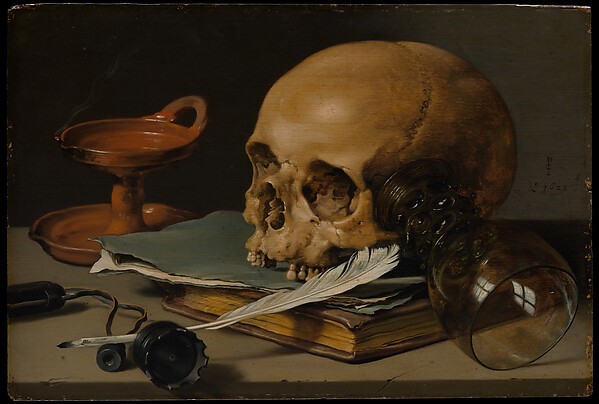
Pieter Claesz, Still Life with a Skull and a Writing Quill, 1628. Oil on panel, 24.1 × 35.9 cm. The Metropolitan Museum of Art, 49.107. Open Access, CC0.
Five ways a death gets priced
1. The death effect is real and it is not a law
The economics literature is small and specific. Itaya and Ursprung's finding is that the price jumps on impact only when the death is unexpected, and that the size of the jump varies inversely with the artist's age at death. If a terminal illness has been announced, the price moves at the announcement and there is no second jump at the funeral.
Ursprung and Zigova went further with a regression-discontinuity design across artists who died between 1985 and 2010, and found that the heterogeneity across artists is substantial, explained mainly by age and reputation at death. Their worked example of the priced-in case is Keith Haring, whose illness was public.
So the honest version is: a young, sudden, unexpected death produces the largest effect; an old artist with a big late output may produce none at all; and where the illness was known, the market has already moved before the death.
Basquiat is the maximal case on every variable. Twenty-seven, sudden, and already famous.
2. What a seventeenth-century picture of death cost
The Dutch vanitas is the closest historical thing we have to an industry that priced mortality directly.
Montias's count of the Amsterdam Orphan Chamber auctions between 1597 and 1638 is over five hundred sales, roughly ten thousand paintings, for a little over eighty thousand guilders. That is an average of about eight guilders a painting. An established master could expect a thousand to twenty-five hundred guilders a year.
Eight guilders. These were not devotional objects. They were a mass-market product with a moral surface, produced by a workforce that, in the ten largest Dutch cities, nearly doubled per head of population between the 1610s and the 1640s.
3. The two pictures, and where the skull sits
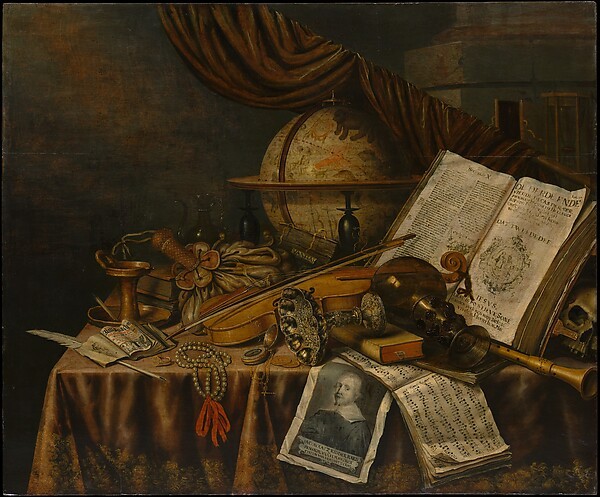
Edwaert Collier, Vanitas Still Life, 1662. Oil on wood, 94 × 112.1 cm. The Metropolitan Museum of Art, 71.19. Open Access, CC0.
Claesz, 1628: a skull, a toppled glass, a guttering oil lamp, a quill, some books. The skull is in the middle and it is the largest object in the picture.
Collier, 1662, thirty-four years later: a globe, an open book, a violin with a broken string, a shawm, a silver tazza, a green roemer, a pocket watch, pearls, a money bag, a flag, a printed portrait, an hourglass — and a skull, tucked into shadow behind the open book at the right edge, where most people do not find it.
The Met's own commentary on the Collier is unusually blunt: a fairly conventional but well-composed vanitas, executed with a dry, rather petty touch. But the composition tells you something the label does not. In thirty-four years the skull has been pushed off centre by merchandise.
4. The part where the dictionary is wrong
Object | What the popular reading says | What the institution actually says |
|---|---|---|
Skull | Death | Death. This one holds |
Watch, hourglass | Time running out | Time running out, or a display of a luxury instrument |
Shell | Vanity | The National Gallery: "both an exotic collector's piece and, like the skull, a reminder of a life lost" |
Soap bubble | Homo bulla, life as a bubble | Convention, widely accepted, rarely sourced to a period text |
Books | The futility of learning | "Learning and intellectual endeavour." The futility is inferred |
Table 1. Museums hedge. Symbol dictionaries do not. That gap is where the argument lives.
Eddy de Jongh's iconological school reads apparently realist Dutch scenes as carrying disguised symbolism, decoded through period emblem books. Svetlana Alpers, in The Art of Describing, argues the symbol-hunt misses the thing itself — that Dutch painting is a descriptive tradition, closer to maps and lenses than to rebuses.
The Open University's summary of the dispute is the fairest statement of where it stands: against de Jongh, that the hunt for hidden meaning obscures the formal achievement; against Alpers, that we have almost no documentary evidence of how seventeenth-century viewers actually read these pictures. Neither position can be confirmed.
Which means the confident object-by-object table that every article about vanitas prints, including the one above, is itself a de Jongh-shaped artefact.
5. Who certifies
Both markets needed someone to say what was real, and both gave up.
The Andy Warhol Art Authentication Board closed in 2012; Joel Wachs cited being sued around ten times and at least ten million dollars in defence costs. The Basquiat Authentication Committee disbanded in September 2012 after eighteen years, saying it had fulfilled its goal. The art-law press reads both as litigation risk; the committees' own stated reasons differ, and both should be reported.
What happens when nobody certifies is the Orlando Museum of Art. In February 2022 it opened Heroes & Monsters, twenty-five supposed Basquiats. The FBI seized them in June. An auctioneer named Michael Barzman later admitted to the FBI that he and another man had made around twenty to thirty of them, taking five to thirty minutes each, and sold them on eBay with a fabricated storage-locker provenance. One of the works was painted on a cardboard box carrying a FedEx label that an independent expert said could not have been manufactured before 1994, six years after Basquiat died.
The museum's director was ousted, sued, countersued, and died in January 2025. Both lawsuits were dropped the following month.
What I take from it
The vanitas painters were selling, at eight guilders, a picture whose subject was that none of this lasts. That is not a contradiction; it is the business model. You cannot sell a memento mori to someone who does not already own things.
The modern version runs the same way, just with the skull further back in the composition. A market that pays a hundred and ten million dollars for a painting made by a man who died at twenty-seven is not ignoring his death. It is pricing it.
The uncomfortable part is not that the market is cynical. It is that Collier's arrangement — the skull present, correctly labelled, and behind everything else — is a fairly accurate picture of how anyone holds this, including me.
Latest Articles.
© Moc Mallen Studio
Thoughts, ideas, and perspectives on design, simplicity, and creative process.

