The Skill That Stopped Being the Point
In 1708 Roger de Piles scored fifty six painters out of twenty in four columns. Poussin got six for colour. What that table reveals about where the criterion for good art has actually lived since 1667.
Date
Category
Writer
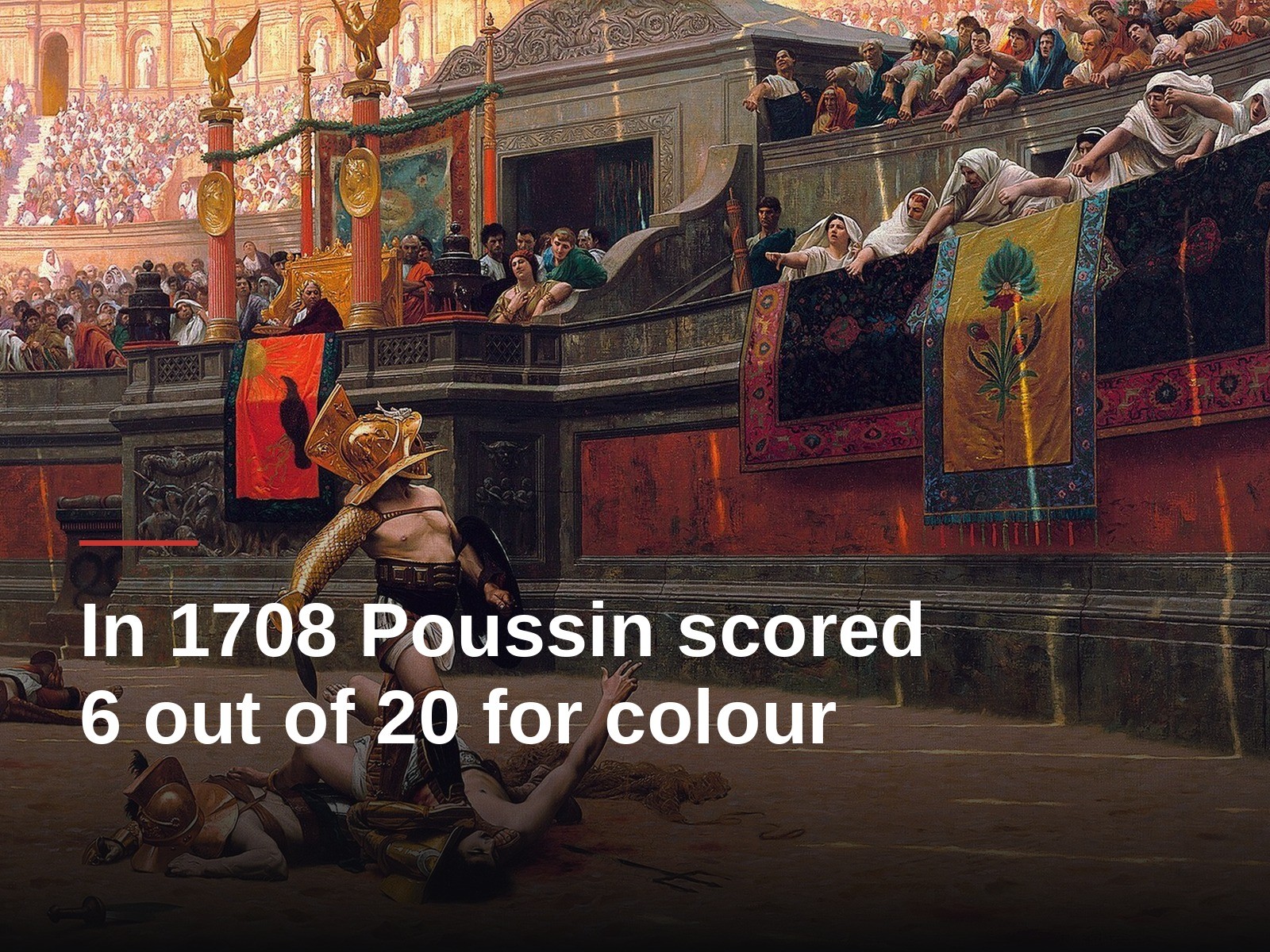
In 1708 a French critic named Roger de Piles published a table at the back of a painting manual. It scored fifty six painters out of twenty in four columns: composition, drawing, colour, and expression. Nicolas Poussin, the painter the French Academy had spent half a century canonising, scored six for colour. Michelangelo scored four. Caravaggio and Bassano scored zero for expression.
The table is usually treated as a curiosity. It is not. It is the first time in Western art writing that the quality of a painting was broken into separate, independently scored components, which is to say the first time anyone admitted that being good at painting was more than one thing and that a painter could be excellent at one of them and hopeless at another.

Poussin by Et in Arcadia ego. De Piles gave him seventeen for drawing and six for colour. Commons
De Piles explains his own scale in the text. Twenty is reserved for a perfection we do not know in its full extent. Nineteen is for the highest perfection we do know, which nobody has yet reached. Eighteen is the practical ceiling. Nobody in his table clears sixty five out of a possible seventy two.
And two painters tie at sixty five: Raphael and Rubens. A Roman draughtsman and a Flemish colourist, deliberately levelled.
The criterion was never the hand

Félibien, preface to the Conférences de l'Académie Royale, Paris 1668. Underlined: landscape above still life, living animals above dead things, and the portraitist who has not yet reached that high perfection of the Art. archive.org
To see why that tie was an argument rather than an opinion, go back forty years.
In 1667 the Académie royale de peinture et de sculpture held a series of lectures. Its historiographer, André Félibien, wrote the preface, and in one paragraph he set out the ranking that would organise European painting for two centuries: still life at the bottom, then landscape, then living animals, then portrait, then history painting at the top.
Every textbook compresses this into a five rung ladder. Félibien never numbers it. He argues upward, by difficulty, and the criterion he actually names is not skill.
There is a very particular art detached from the material and from the hand of the artisan, unlike the trades where the industry and dexterity of the hand suffice to produce beauty.
His phrase for what a painter is ranked by is la grandeur des pensées, the greatness of the thoughts. Not the quality of the brushwork. The size of the idea.

An Academy prize picture: Ingres, Achilles Receiving the Envoys of Agamemnon, 1801. History painting, the top of the ladder, painted by a nineteen year old. Commons
This matters because the story everyone tells about modern art is that technical skill was the criterion until the avant garde threw it out. The institution that supposedly enforced skill wrote down, at the moment of its founding, that skill was the part of painting it considered lowest.
What the Academy did with that
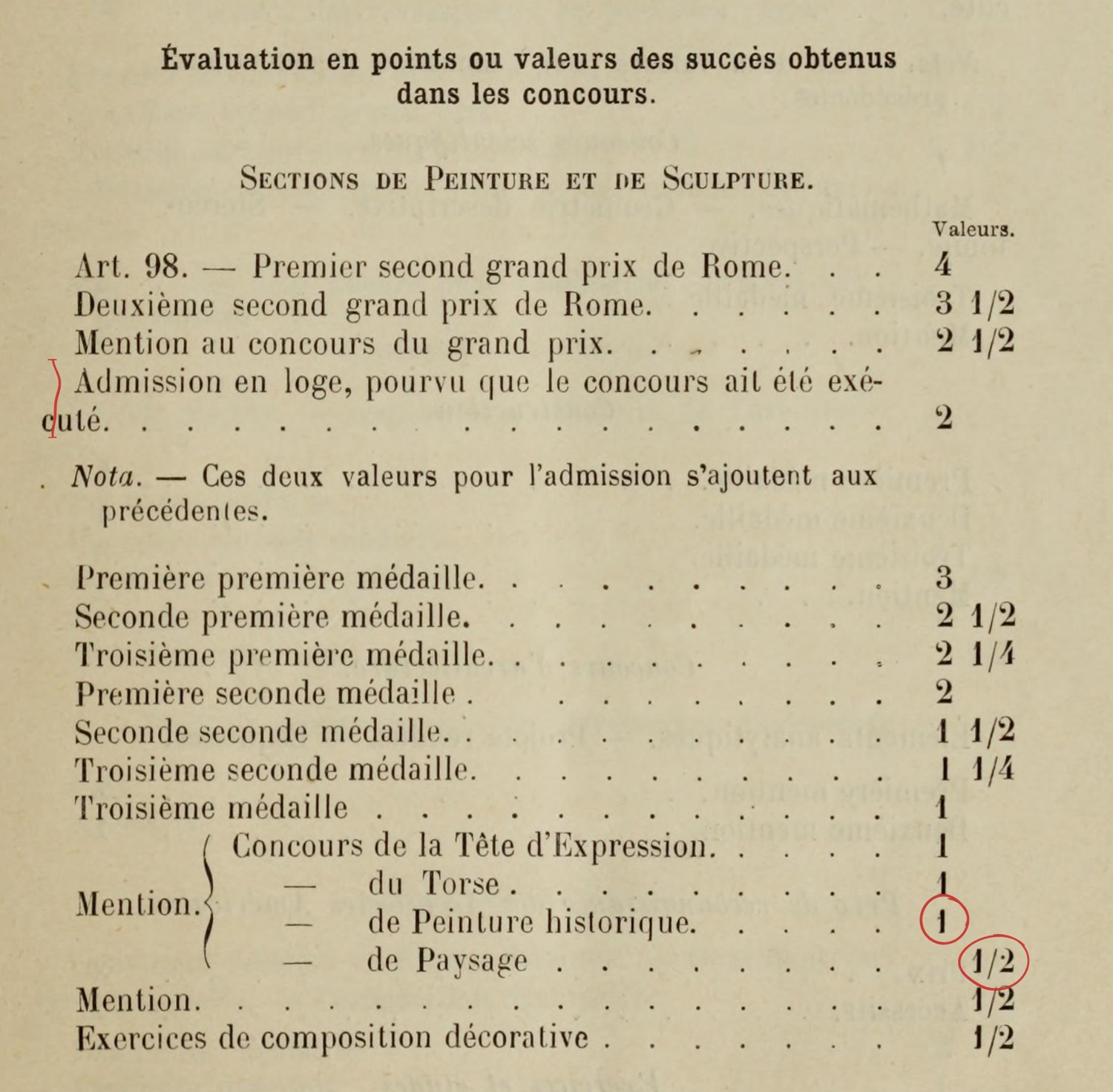
The School's own rulebook, 1895: Évaluation en points ou valeurs des succès obtenus dans les concours. A mention for history painting is worth 1. A mention for landscape is worth ½. Félibien's ladder, still printed as arithmetic 227 years later. archive.org
It turned it into a career ladder. Applicants were admitted to the Academy at a level determined by the kind of subject they intended to paint. Students copied prints, then plaster casts, then and only then the live model.
The Prix de Rome, established in 1663 and not abolished until André Malraux ended it in 1968, ran the ladder as a competition. Entrants had to be male, unmarried, under thirty, and enrolled at the École des Beaux Arts. Women could compete only from 1903. Round one was a painted oil sketch on a biblical or mythological subject. Round two was a nude study, painted in four sessions of seven hours. Round three locked the candidate alone in a loge, an individual studio, to produce a large canvas on an imposed historical subject. The figure of seventy two days is widely repeated; I could not find it in the School's own printed regulations, which give an exact duration for every other trial held en loge and none for this one, because the Grand Prix was run by the Académie at the Institut rather than by the School. The prize was four or five years in Rome at state expense.
Seventy two days of enforced solitude is not a test of hand skill. It is a test of whether you can sustain an idea. The French Ministry of Culture's account of the competition reads like a description of a doctoral viva.
Jean Léon Gérôme and the machinery of the Salon, from the Yale University Art Gallery lecture series.
1708: quality gets disaggregated
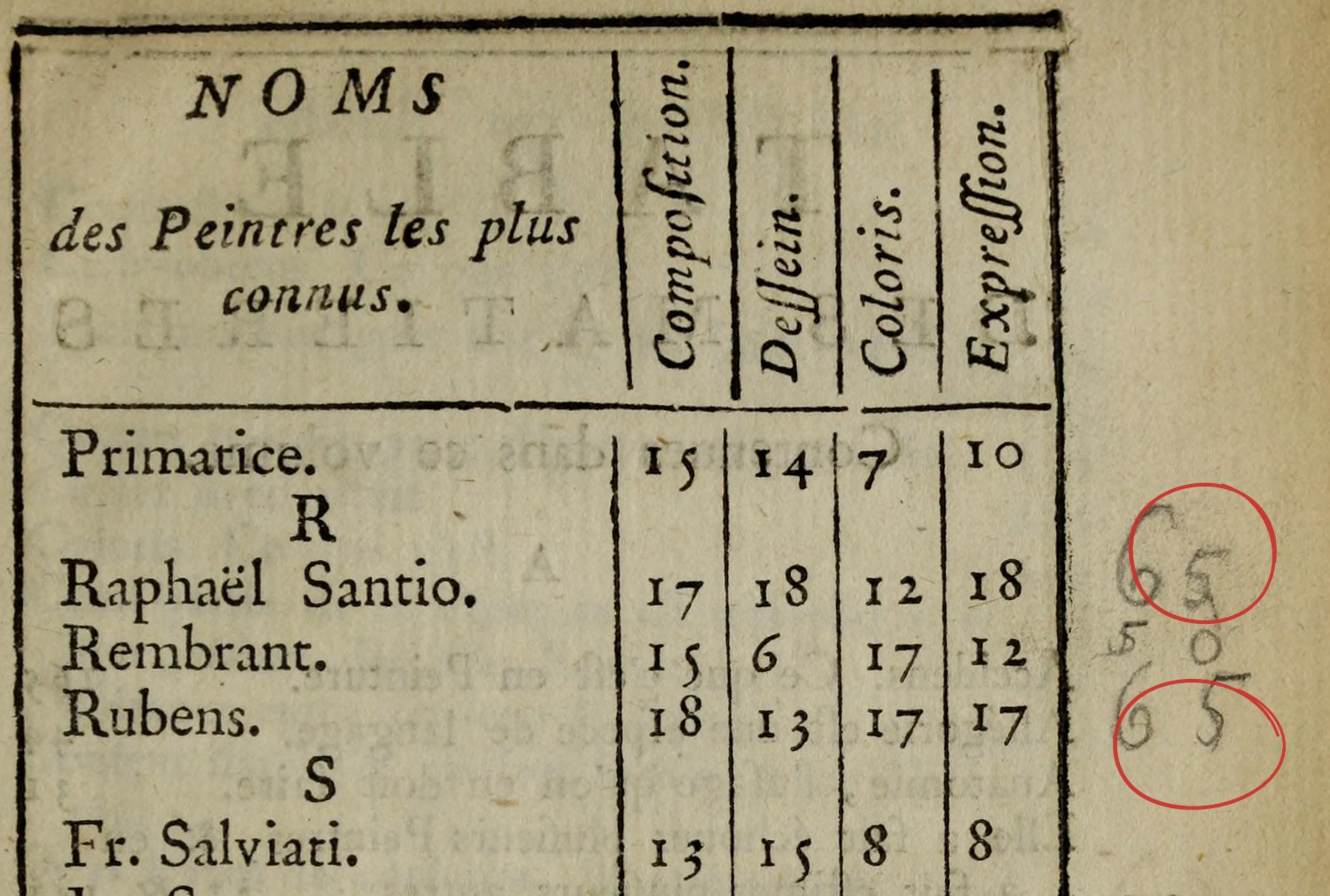
De Piles, Cours de Peinture par Principes, Paris 1708. The pencilled totals in the margin are an eighteenth century owner's: 65 beside Raphael, 65 beside Rubens. He added the rows up himself and found the tie. archive.org
De Piles was the leader of the Rubénistes, against Charles Le Brun's Poussinistes. Le Brun's official formulation in 1672 was that the function of colour is to satisfy the eyes whereas drawing satisfies the mind. De Piles's counter was not that colour is nicer. It was that colour is more true to nature, and that colour can be judged by anyone.
That second clause is the one that breaks things. If the criterion is drawing, judgement requires training, and the Academy owns the training. If the criterion is colour, anyone with eyes has standing. De Piles was elected to the Academy in 1699. The quarrel is generally treated as settled by 1717.

Rubens scored eighteen for composition, thirteen for drawing, seventeen for colour, seventeen for expression. Total sixty five, tied with Raphael. Commons
Here is the part that should make anyone writing about taste uncomfortable.
In 2008 two economists, Victor Ginsburgh and Sheila Weyers, regressed de Piles's four scores against the number of paintings by each artist sold at auction between 1977 and 1993, and against the length of each artist's entry in Turner's Dictionary of Art. Their paper found that de Piles's colour scores correlate best with modern valuations, and that his drawing scores correlate negatively.
Three hundred years later, the column the Academy considered inferior is the one that predicts. The column it considered supreme runs backwards.
1863 to 1874: nine years
The usual account of the Salon des Refusés and the first Impressionist exhibition is a story about subject matter. Manet painted a prostitute, the bourgeoisie was scandalised, modernity arrived.
Read the actual reviews and that is not what the critics were angry about.

Musée d'Orsay, Paris. Commons
Théophile Gautier, reviewing the Salon of 1865:
The tone of the flesh is dirty. The shadows are indicated by streaks of boot polish, more or less wide. We could still forgive ugliness, but true ugliness, studied, redeemed by some splendid colour effect. Here there is nothing, we are sorry to say, but the will to attract attention at any price.
Every complaint in that passage is technical. Flesh tone, shadow handling, colour effect. Gautier is not saying the subject is obscene. He is saying the painting is badly made.
Smarthistory on Olympia.
Nine years later Louis Leroy published his satire of the first Impressionist exhibition in Le Charivari, 25 April 1874. He invented a companion, Joseph Vincent, a landscape painter decorated under several governments, and walked him around the show. The word "finished" appears six times in two thousand words. It is the axis of the whole review.
Wallpaper in its embryonic state is more finished than that seascape.
That sentence, written about Monet's Impression, Sunrise, is where the movement got its name. And this one, written about Cézanne:
Do you remember the Olympia of M. Manet? Well, that was a masterpiece of drawing, accuracy, finish, compared with the one by M. Cézanne.
In 1865 Olympia was condemned for dirty flesh and boot polish shadows. In 1874 it is the benchmark of finish. The criterion did not collapse. It moved, and it moved fast, and it moved while the same generation of critics was still writing.

Musée Marmottan Monet, Paris. Leroy's review of this picture named the movement. Wikisource has the full text. Commons
Finish was a real criterion, not a prejudice
The academic system distinguished the esquisse and the ébauche, private preparatory stages, from the finished exhibitable picture. A surface that looked unresolved did not read as a stylistic choice. It read as a painter who had stopped early. Albert Boime's The Academy and French Painting in the Nineteenth Century (1971) is the standard account of how that private stage became publicly exhibitable and then became the point.

Phoenix Art Museum. The finish is the argument. Commons
1960: a new criterion, and its author's objection to it
Clement Greenberg's "Modernist Painting" was first delivered as a Voice of America lecture in 1960. Its proposal is precise:
The essence of Modernism lies, as I see it, in the use of characteristic methods of a discipline to criticise the discipline itself, not in order to subvert it but in order to entrench it more firmly in its area of competence.
And the specific criterion:
It was the stressing of the ineluctable flatness of the surface that remained, however, more fundamental than anything else to the processes by which pictorial art criticized and defined itself under Modernism. For flatness alone was unique and exclusive to pictorial art.
This is the passage that got Greenberg his reputation as the man who reduced painting to flatness. It is worth reading his own postscript, which almost nobody quotes:
There have been some further constructions of what I wrote that go over into preposterousness: That I regard flatness and the inclosing of flatness not just as the limiting conditions of pictorial art, but as criteria of aesthetic quality in pictorial art; that the further a work advances the self-definition of an art, the better that work is bound to be. The philosopher or art historian who can envision me, or anyone at all, arriving at aesthetic judgments in this way reads shockingly more into himself or herself than into my article.
The full text is online at the University of Chicago. Greenberg was describing a historical logic, not handing out marks. The reduction of his argument to a scoring rubric is itself an instance of the thing this essay is about: people want a criterion badly enough that they will manufacture one out of a description.
1964: nothing intrinsic
Arthur Danto's "The Artworld" appeared in The Journal of Philosophy in 1964 and coined the term, by which he meant an atmosphere of art theory. George Dickie turned it into a definition. The 1974 version:
A work of art is an artifact upon which some person acting on behalf of the artworld has conferred the status of candidate for appreciation.
The 1984 version is tighter: an artwork is an artifact of a kind created to be presented to an artworld public. Stated plainly, the institutional theory says that nothing intrinsic to an object makes it art. Not skill, not beauty, not resemblance. What makes it art is that someone authorised has presented it as such. The Stanford Encyclopedia of Philosophy entry sets out the standard objections, of which circularity is the sharpest.
This is where most accounts stop, with a shrug: quality is whatever the institution says it is. But there is a piece of evidence that complicates it, and it comes from a psychology lab.
2011: people can tell
In 2011 Angelina Hawley-Dolan and Ellen Winner published a study in Psychological Science with a title that gives away the result: "Seeing the Mind Behind the Art: People Can Distinguish Abstract Expressionist Paintings From Highly Similar Paintings by Children, Chimps, Monkeys, and Elephants."
Forty psychology majors and thirty two art students were shown paired images, one by an abstract expressionist and one by a child or an animal, matched for superficial similarity. Sometimes the labels were correct, sometimes deliberately reversed, sometimes absent.
Both groups chose the professional work above chance in every condition, including when the labels were reversed. The art students discriminated more strongly, but the non artists did it too. And the effect was larger on the question "which is better" than on the question "which do you prefer."
What the study rules out | What it does not rule out |
|---|---|
That the emperor has no clothes | That institutions shape reputation |
That expertise is required to see a difference | That price and quality diverge |
Hawley-Dolan & Winner, Psychological Science 22(4), 2011, pp. 435 to 441. Journal record
The interesting part is the reasons participants gave. They justified their choices by reference to the artist's intentions: they said they could see that somebody meant something. They were not scoring brushwork. They were reading for a mind.
The circle closes
Put the three findings next to each other.
Félibien, 1667: the criterion is la grandeur des pensées, an art detached from the material and from the hand of the artisan.
De Piles, 1708: the fourth column is expression, by which he says he means not the character of each object but la pensée du cœur humain, the thought of the human heart.
Hawley-Dolan and Winner, 2011: ordinary viewers pick the professional work above chance, and explain their choice by reference to intention.
Three hundred and forty four years, three different vocabularies, one criterion. Not the hand. The mind the hand is reporting on.
What actually changed in the nineteenth century was not the criterion but the evidence. For two centuries, the visible proof that a serious mind was at work was a highly finished surface, because that surface cost time and time was the observable signal. When photography made the finished surface cheap and when Manet made an unfinished one deliberate, the signal stopped working. The criterion stayed. The evidence for it had to be rebuilt.
Which is why "he can really paint" stopped being a compliment. It did not stop being a skill. It stopped being evidence.
Sources
André Félibien, Conférences de l'Académie Royale de Peinture et de Sculpture pendant l'année 1667, preface. Getty copy at the Internet Archive
Roger de Piles, Cours de peinture par principes, Paris 1708, with the appendix "La Balance des peintres." Internet Archive
Victor Ginsburgh and Sheila Weyers, "On the Contemporaneousness of Roger de Piles' Balance des Peintres," in The Aesthetics of Value, Routledge 2008. PDF
Louis Leroy, "L'Exposition des Impressionnistes," Le Charivari, 25 April 1874. English text at Wikisource
Clement Greenberg, "Modernist Painting," 1960. Full text
Stanford Encyclopedia of Philosophy, "The Definition of Art"
Angelina Hawley-Dolan and Ellen Winner, "Seeing the Mind Behind the Art," Psychological Science 22(4), 2011. Record
L'Histoire par l'image, French Ministry of Culture, "Le concours du Prix de Rome"
A Korean version of this research, built around de Piles's scorecard and what happened to it over three centuries, is on my Naver blog at blog.naver.com/veinism.
Latest Articles.
© Moc Mallen Studio
Thoughts, ideas, and perspectives on design, simplicity, and creative process.


