The Size of a Credit Card
Warhol said a gruesome picture repeated stops having any effect. Holbein's Dance of Death was made for repetition at edition scale, on blocks 65 millimetres tall, and it still works.
Date
Category
Writer

Between 1962 and 1967 Andy Warhol silkscreened car crashes, electric chairs, suicides, race riots and a tuna-fish poisoning, usually repeating the same image across a canvas until it stopped reading as an image.
He explained the method in ARTnews in November 1963, to Gene Swenson, in one sentence:
When you see a gruesome picture over and over again, it doesn't really have any effect.
That is a claim about attention, not about death. It says the problem with an atrocity photograph is not that it is too strong but that it stops working, and that the mechanism which makes it stop working is repetition.
I want to test that against a set of pictures from 1538 that were designed to be repeated, at scale, in an edition, and that are still working.
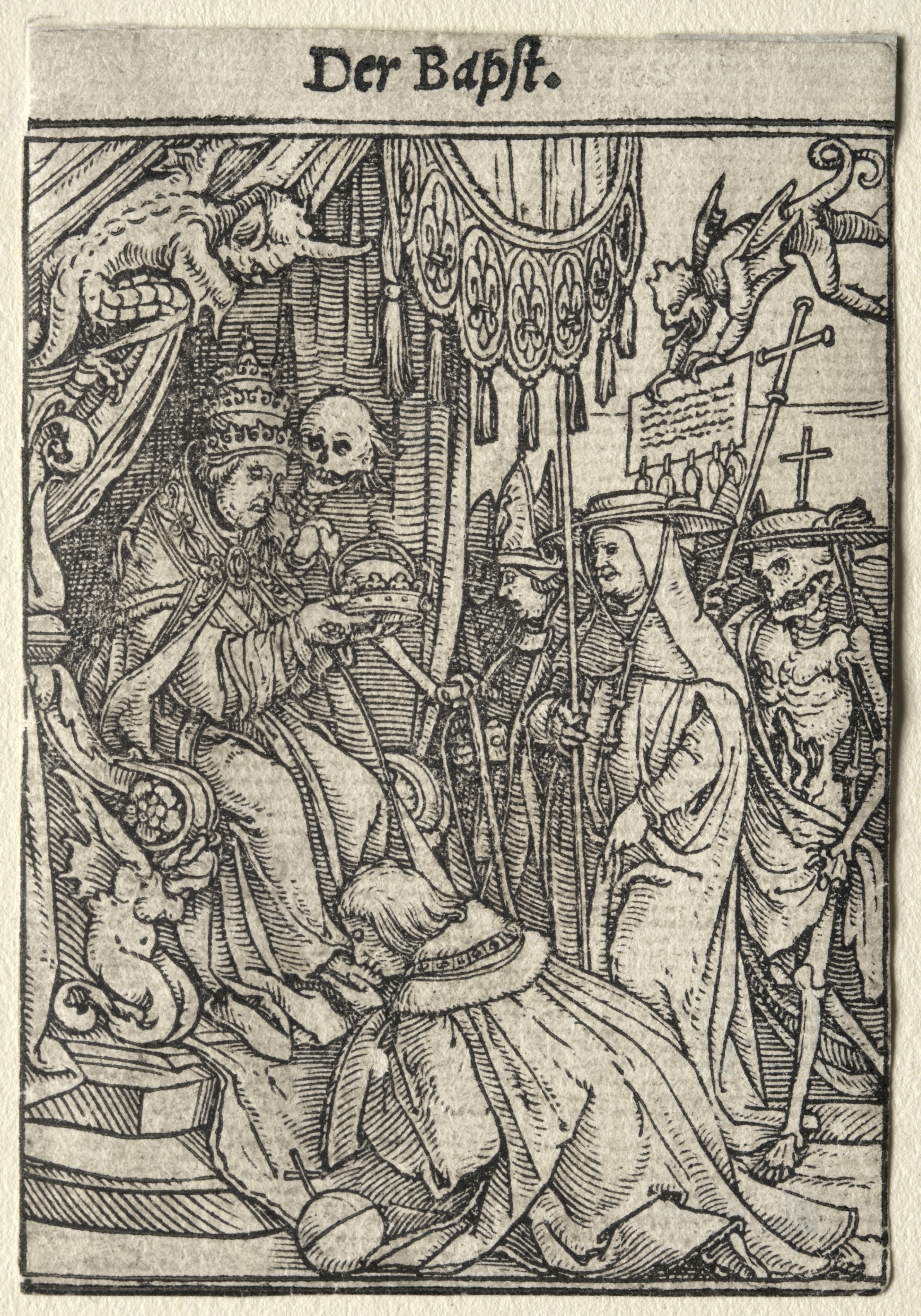
Hans Holbein the Younger, designer; Hans Lützelburger, blockcutter. The Pope, from the Dance of Death, designed about 1523–26. Woodcut, block roughly 65 × 49 mm. The Cleveland Museum of Art, 1929.147. CC0.
Five pictures about death made for volume
1. Holbein's blocks are the size of a credit card
The Dance of Death was designed in Basel in the 1520s, cut by Hans Lützelburger, and published in Lyon in 1538 by the Trechsel brothers, twelve years after the cutter had died. The first edition has forty-one cuts. Later editions add a beggar, a soldier, a waggoner, a gambler, a robber, a blind man, a drunkard, a fool and four children.
Each block is about sixty-five by forty-nine millimetres. Smaller than a credit card. Inside that area Holbein puts six or seven figures, an architectural setting, furniture, props and a legible facial expression.
Two corrections, since both are repeated constantly. Holbein did not cut the blocks; Lützelburger did, and every museum record names him. And the series was not published in 1526. It was designed then and printed twelve years later.
2. The sequence is a social ladder, and Death is the one keeping order
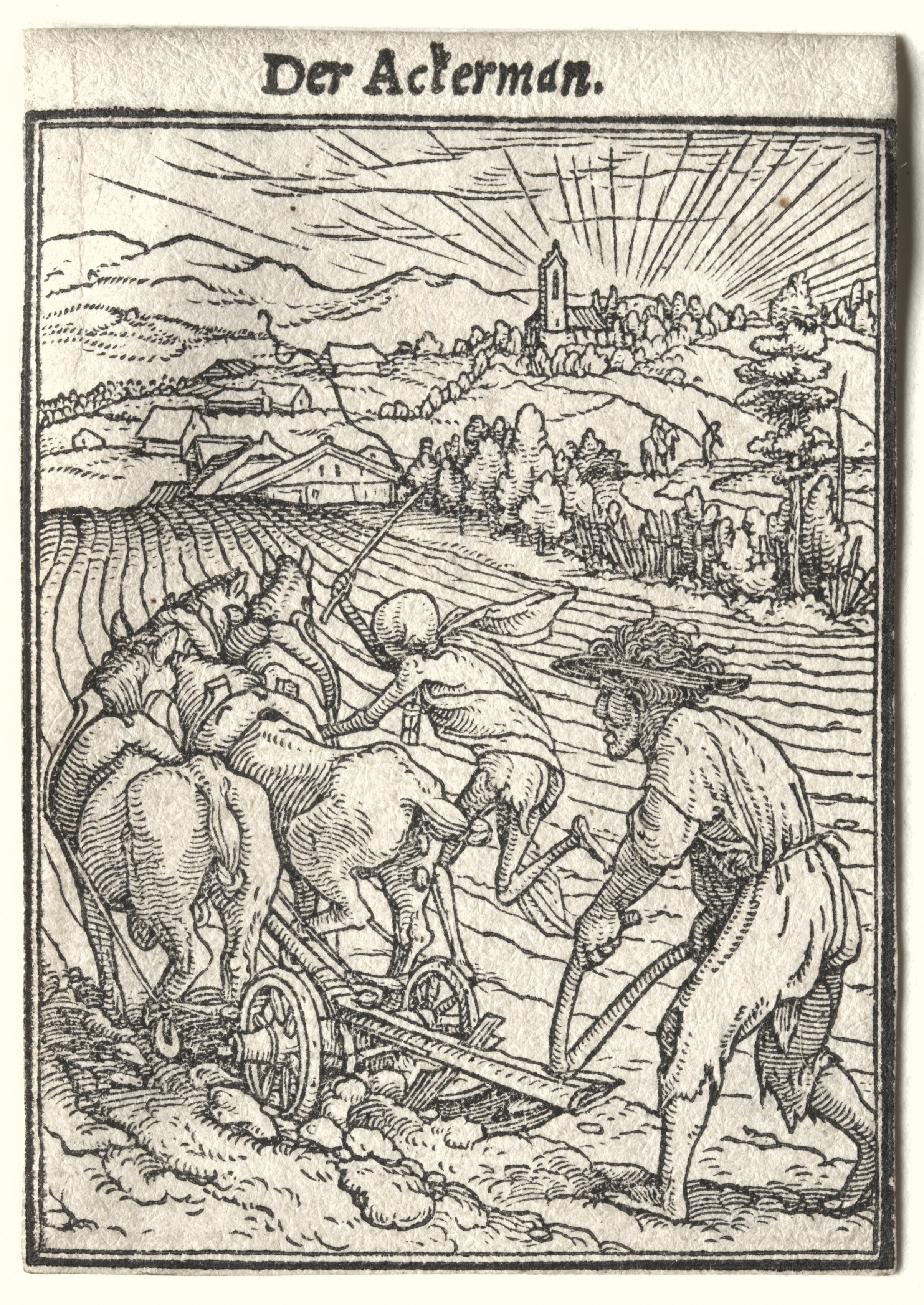
The Ploughman, from the same series. The Cleveland Museum of Art, 1929.168. CC0.
After Creation, the Fall, the Expulsion and a cemetery, the plates go in rank order: Pope, Emperor, King, Cardinal, Empress, Queen, Bishop, Duke, Abbot, Abbess, Nobleman, Canon, Judge, Advocate, Counsellor, Preacher, Priest, Mendicant Friar, Nun, Old Woman, Physician, Astrologer, Rich Man, Merchant, Shipman, Knight, Count, Old Man, Countess, Noble Lady, Duchess, Pedlar, Ploughman, Young Child.
The joke is structural. The higher the rank, the more undignified the interruption. Death crowns the Pope. Death seizes the Emperor's sword mid-judgment. Death pulls the Abbot's robe and takes his mitre.
And then at the very bottom of the ladder, the Ploughman. Death does not interrupt him at all. Death whips the horses and drives the plough for him, toward a setting sun. It is the only plate in the series where Death helps.
3. What repetition does at edition scale
Holbein, 1538 | Warhol, 1962–67 | |
|---|---|---|
Unit | A 65 mm woodblock, printed in an edition | A silkscreen, pulled repeatedly onto one canvas |
Repetition is | Across copies, in many hands | Within the picture, in one field of view |
Subject | Death, generic, arriving by rank | One specific photograph of one specific event |
Source of image | Invented | A press photograph, usually uncredited |
Effect claimed | Memento mori. You will be next | The image "doesn't really have any effect" |
Table 1. Both artists repeat. Holbein repeats the object so that everyone owns one. Warhol repeats the image so that nobody can see it.
That is the difference worth holding onto. Multiplying the copies spreads a picture. Multiplying the image inside one picture kills it. Warhol was working on the second, and he said so.
4. The electric chair is a photograph of an empty room
The chair Warhol used is not a drawing and not a scene of an execution. It is a 1953 press photograph of the death chamber at Sing Sing, empty, the chamber in which the Rosenbergs were executed that year.
And the timing is the part nobody mentions. Eddie Lee Mays was executed at Sing Sing on 15 August 1963 — the last execution in New York State. New York repealed capital punishment in 1965.
So Warhol began printing the chair in the year the chair stopped being used, from a ten-year-old photograph of an empty room. Nothing about it is reportage.
5. The photographs had owners
This is the strand that connects to the rest of this series.
Patricia Caulfield sued over the hibiscus photograph behind Flowers. Charles Moore sued over the Life civil-rights photographs behind Race Riot. Fred Ward sued over the Life cover behind the Jackie prints. All three settled out of court, and the Metropolitan Museum's own record for Birmingham Race Riot says plainly that the unmitigated borrowing resulted in a lawsuit.
Warhol thereafter resolved to work from his own photographs. Which is to say: the practice changed because of litigation, thirty years before the Supreme Court took up the question.
Holbein had no such problem. The blocks were his workshop's, and the only person with a claim was the man who cut them, who was dead before they were printed.
What I take from it
The Swenson quote is usually read as callousness. I think it is a technical observation, and a correct one, and it cuts against Warhol's own work as much as anything else.
Holbein's answer to the same problem was the opposite: make the thing small, make the composition dense enough that you have to lean in, and give every plate a different joke so that no two repetitions are the same repetition. Forty-one variations, not one image forty-one times.
Both are strategies for an image that has to survive being seen too often. Only one of them was still funny five hundred years later.
Latest Articles.
© Moc Mallen Studio
Thoughts, ideas, and perspectives on design, simplicity, and creative process.

