The Prize at the Colorado State Fair
An AI image won first prize at the Colorado State Fair in 2022 and set off four years of institutions writing down what they think authorship is. Washington, Beijing and Seoul reached three different answers from the same facts.
Date
Category
Writer

In late August 2022 a board game designer named Jason M. Allen won first place in the Digital Arts and Digitally-Manipulated Photography category at the Colorado State Fair fine arts competition. The prize was three hundred dollars. The picture was called Théâtre D'opéra Spatial and he had made it with Midjourney, then adjusted it in Photoshop and upscaled it with Gigapixel AI.
One of the judges, Cal Duran, said afterwards: we have to kind of embrace those changes, and as artists we kind of have to let our ego go.
What followed is the most useful thing that has happened to this argument, because Allen then tried to register the copyright, and that forced a series of institutions to write down, on the record, what they actually think authorship is.

National Gallery of Art, CC0. The same argument, one hundred and sixty years earlier. Commons
The four years since
Date | Event |
|---|---|
21 September 2022 | Registration application filed |
13 December 2022 | The Copyright Office refuses registration |
24 January 2023 | First request for reconsideration, declined 6 June |
12 July 2023 | Second request for reconsideration |
5 September 2023 | The Review Board affirms the refusal |
26 September 2024 | Allen sues the Register of Copyrights, Allen v. Perlmutter, D. Colo. |
25 August 2025 | Allen moves for summary judgment, relying on Feist and Burrow-Giles v. Sarony |
as of March 2026 | No ruling. A decision was expected in the second or third quarter of 2026 |
Two different iteration counts circulate and the discrepancy is itself informative. Press reports say more than 900 renderings. The Copyright Office decision records Allen's own representation as at least 624 prompt revisions.
And note what he is arguing with. Burrow-Giles v. Sarony, 1884, is the case that let photography into copyright by holding that the protectable element was the photographer's selection and arrangement rather than the camera's operation. The precedent that admitted the last machine is being used to argue for the next one.
The original local news report.
What the Copyright Office actually wrote
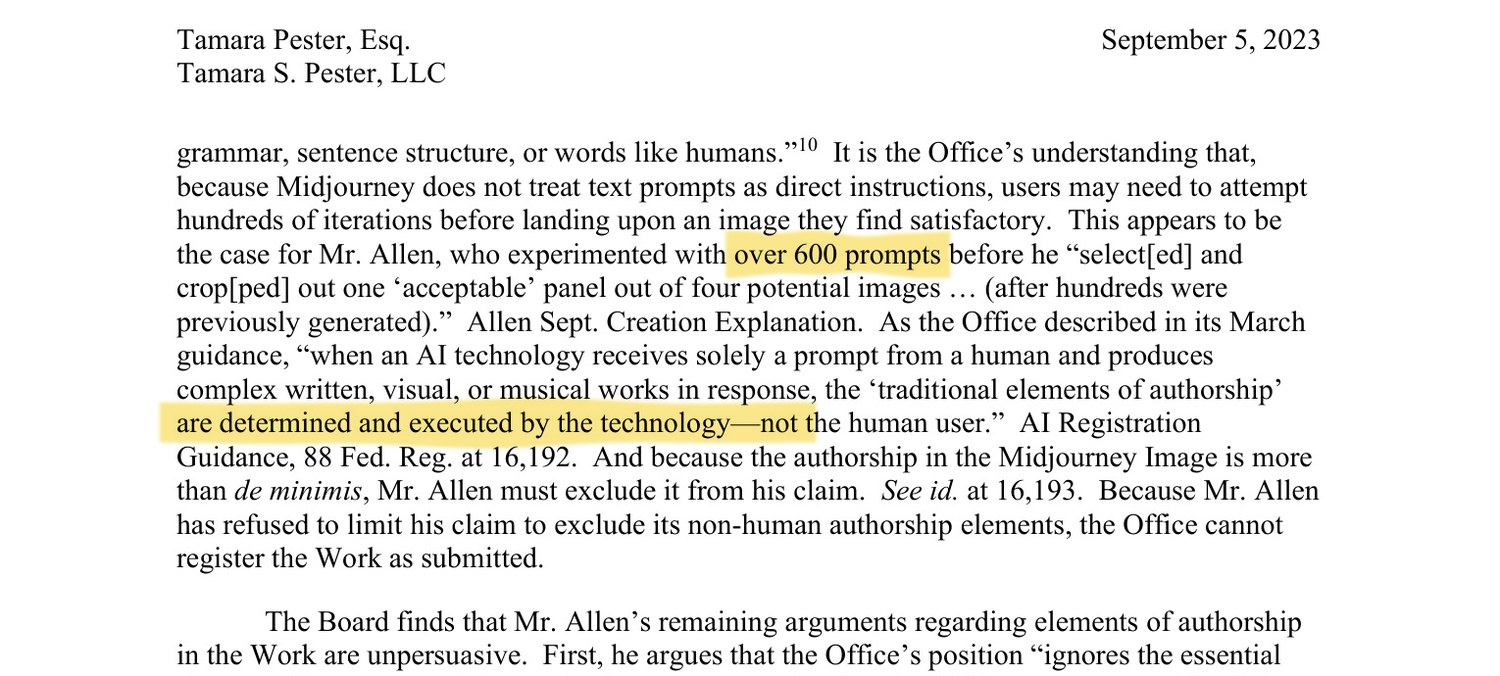
Six hundred prompts, and the reason they did not count: the traditional elements of authorship are determined and executed by the technology, not the human user. copyright.gov
when an AI technology receives solely a prompt from a human and produces complex written, visual, or musical works in response, the "traditional elements of authorship" are determined and executed by the technology, not the human user.
The Board added that Midjourney does not interpret prompts as specific instructions and does not understand grammar, sentence structure, or words the way humans do. Allen's Photoshop work and upscaling were not enough, because he claimed the whole work rather than disclaiming the Midjourney layer.
In Zarya of the Dawn, a letter dated 21 February 2023, the Office protected Kris Kashtanova's text and the selection, coordination and arrangement of text and images as a compilation, but not the Midjourney images themselves. Its reasoning is worth the space:
closer to suggestions than orders, similar to the situation of a client who hires an artist to create an image with general directions as to its contents.
The client analogy is precise and it cuts both ways. A client who commissions a painting does not own the copyright. But an artist who directs a photographer, a printer, a fabricator or a studio of assistants generally does.
The Office's formal position came in January 2025, in Part 2 of its Copyright and Artificial Intelligence report. Four conclusions, of which the second is doing the work:
Conclusion | |
|---|---|
1 | Questions of copyrightability and AI can be resolved under existing law, without legislative change |
2 | Based on the functioning of current generally available technology, prompts do not alone provide sufficient control |
3 | Human authors are entitled to copyright in their own authorship perceptible in AI outputs, and in creative selection, coordination or arrangement, and in creative modifications |
4 | Using AI tools to assist rather than stand in for human creativity does not affect the availability of protection |
Copyright and Artificial Intelligence, Part 2: Copyrightability, January 2025.
Read the qualifier in conclusion two again. Based on the functioning of current generally available technology. The Office left itself a door.
And then the question was settled, in one jurisdiction
The Thaler line is now over. Stephen Thaler tried to register A Recent Entrance to Paradise listing his own system as the author. The D.C. district court ruled against him, and on 18 March 2025 the D.C. Circuit affirmed unanimously, Judge Patricia Millett writing:
The best reading of the Copyright Act is that human authorship is required for registration.
On *2 March 2026 the Supreme Court denied certiorari*. As of now, no human author means no US copyright, at appellate level, undisturbed.
The same facts, the opposite answer
On 27 November 2023 the Beijing Internet Court decided Li v. Liu, case (2023) Jing 0491 Min Chu No. 11279.
The plaintiff had generated an image with Stable Diffusion and documented the process in detail: positive prompts, negative prompts, iteration steps 33, height 768 pixels, CFG scale 9, random seed 2692150200 then 2692150199, plus model weight adjustments over multiple rounds.
The court held the image to be protectable fine art.
The picture involved is independently completed by the plaintiff and reflects the plaintiff's personalized expression.
It is man who does intellectual investment throughout the creation process, not AI model.
Different people can generate different pictures by entering different prompt words and setting different parameters.
Damages of 500 yuan, a public apology, fifty yuan in costs.
Nearly identical facts. Many prompts, many parameters, iterative selection. The US Copyright Office says the machine determined the expression. The Beijing Internet Court says the human did.
Korea sits with the United States. The Ministry of Culture, Sports and Tourism and the Korea Copyright Commission published a Generative AI Copyright Guide on 27 December 2023 stating that registration is unavailable for AI output where no human creative intervention can be identified in any expressive act, and that a copyrighted work requires a natural person as author. Prompts alone do not create authorship. What can be registered is the creatively modified or added portion, and only that portion, or a compilation where selection and arrangement show creativity. Registering AI output falsely as one's own work engages the criminal provisions of the Copyright Act.
What the lawsuits have actually produced
Case | Status as of September 2026 |
|---|---|
Andersen v. Stability AI, N.D. Cal. | Filed January 2023. On 12 August 2024 direct infringement, induced infringement and Lanham Act trade dress claims survived dismissal. All four defendants remain. No settlements. No merits ruling |
Getty Images v. Stability AI, UK | Judgment 4 November 2025. Getty *dropped* its training and output claims mid-trial. The court therefore never ruled on whether training is infringement. Secondary infringement rejected: model weights contain no copies. A narrow trade mark win on the iStock watermark, described as historic and extremely limited |
Bartz v. Anthropic | June 2025: training on lawfully purchased copies was fair use; use of pirated library copies was not. A *$1.5 billion* settlement announced 5 September 2025, about $3,000 per book |
GEMA v. OpenAI, Munich | November 2025, a rightsholder win. Lyrics used in training were returned almost identically |
Stand back from that table and the shape is clear. As of September 2026 there is still *no US merits verdict on whether training a generative image model on copyrighted art is infringement*. The two best chances to get one were abandoned on jurisdictional grounds or are still in discovery.
What artists have actually won money on is piracy. Anthropic settled for one and a half billion dollars not because training was ruled unlawful but because the books were stolen.
What the labs found
Two studies, run independently, reach the same structure.
Horton, White and Iyengar published in Scientific Reports on 3 November 2023: six experiments, *2,965 participants*, evaluating visual art labelled as human-made, AI-made or collaborative.
Art labelled AI-generated was rated lower on monetary value and skill, even though *more than seventy percent of participants said they could not tell the images apart without the labels. And a strange second-order effect: directly comparing human-labelled to AI-labelled art made people rate the human work as more* creative than when they compared human to human. The presence of AI inflates perceived human creativity.
Porter and Machery published in the same journal on 14 November 2024, with 1,634 and 696 participants, mixing poems by named poets from Chaucer onward with ChatGPT-3.5 outputs.
Discrimination was *below chance, at 46.6 percent*. AI poems were judged human-authored more often than actual human poems were. Blind to authorship, the AI poems scored higher on rhythm and beauty. Told the author was AI, the preference reversed entirely. Expertise with poetry did not improve discrimination.
Put them together. People cannot tell. Blind, they slightly prefer the machine. Told, they penalise it sharply.
The judgement is about provenance, not about the object. Which is Benjamin's aura, relocated from the artefact to the identity of the maker.
The argument is older than it looks
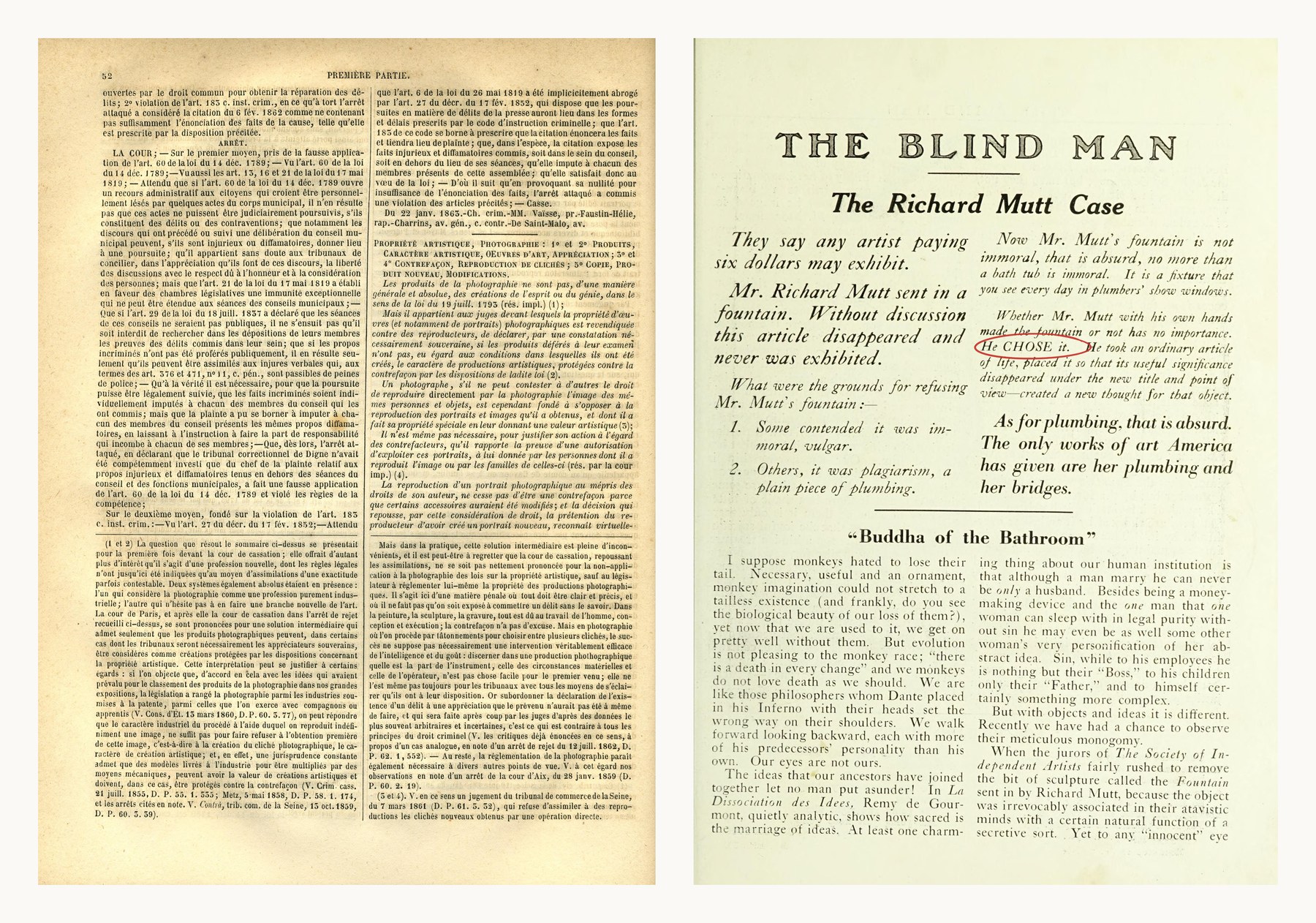
Left: the Cour de cassation, 28 November 1862, on whether a photograph can be a creation of the mind. Right: Whether Mr. Mutt with his own hands made the fountain or not has no importance. He CHOSE it. The capitals are the 1917 compositor's, not mine.

Baudelaire, in his Salon of 1859:
l'industrie, faisant irruption dans l'art, en devient la plus mortelle ennemie
Industry, bursting into art, becomes its most mortal enemy.
Look at the grammatical subject. Not photography. L'industrie. His target was an industry, not a technique. When people argue about whether the objection to AI art is aesthetic or economic, that subject is the whole question, and Baudelaire had already picked the second.

The definitive image of the man who called photographic industry art's most mortal enemy is a photograph. Commons
And against him, the position that makes the AI case possible. From The Blind Man, May 1917, on the urinal submitted as Fountain:
Whether Mr Mutt with his own hands made the fountain or not has no importance. He CHOSE it.
The 1938 Dictionnaire abrégé du Surréalisme defines a readymade as an ordinary object elevated to the dignity of a work of art by the mere choice of an artist. Tate's summary of the shift is from artist-as-maker to artist-as-chooser.
If choosing is making, then selecting one output from 624 is the same gesture, differing only in scale. That is the strongest available argument for Allen, and it is not a silly one.
The strongest argument against it is not aesthetic either. It is that Duchamp chose a urinal that a factory made for its own purposes, with nobody's work taken without consent. The objection artists actually raise, when you read what they write rather than what gets quoted, is about labour and consent. It shows up in the Andersen plaintiffs' surviving trade dress claim, which is a claim about market identity and livelihood rather than picture quality, and in the fact that the one enormous settlement so far was about stolen books.
Where that leaves the question
Is an AI-generated image art?
The institutional theory says it became art the moment the Colorado State Fair jury conferred first prize on it, which is precisely why the artists' objection took the form of attacking the jury rather than attacking the image. On Dickie's definition, that is not a dodge. It is the mechanism working exactly as described.
Whether it has an author is a different question, and it now has three different official answers in three jurisdictions, from the same facts.
And whether it is good is a third question, on which the only evidence we have says people cannot tell until you tell them, and then they mind a great deal.
The honest summary is that the argument being had in public is about aesthetics, the argument being had in court is about property, and the argument that will actually decide it is about whose work went into the training set.
Sources
US Copyright Office, Théâtre D'opéra Spatial Review Board decision, 5 September 2023
US Copyright Office, Zarya of the Dawn letter, 21 February 2023
US Copyright Office, Copyright and Artificial Intelligence, Part 2, January 2025
Thaler v. Perlmutter, D.C. Circuit, 18 March 2025; certiorari denied 2 March 2026
Beijing Internet Court, Li v. Liu, official English judgment
문화체육관광부 · 한국저작권위원회, 『생성형 AI 저작권 안내서』, 27 December 2023
Horton, White and Iyengar, "Bias against AI art can enhance perceptions of human creativity", Scientific Reports, 2023
Porter and Machery, "AI-generated poetry is indistinguishable from human-written poetry", Scientific Reports, 2024
Tate, Art Terms: Readymade
The Korean version of this research, with the Korean guidance and the three-jurisdiction comparison worked out, is on my Naver blog at blog.naver.com/veinism.
Latest Articles.
© Moc Mallen Studio
Thoughts, ideas, and perspectives on design, simplicity, and creative process.


