The Collection You Never See
The National Museum of Korea holds 412,216 objects and shows 9,884. Half of that gap is physics: at fifty lux, a work on paper can be lit for thirty days a year. The other half is editorial.
Date
Category
Writer

The National Museum of Korea holds 439,535 objects. Its permanent displays carry 10,697 of them.
That is 2.43 percent.
It is worth starting with Korea rather than with the Louvre, because the Korean figure is one the institution itself publishes. The Metropolitan Museum, the Museum of Modern Art, Tate and the Louvre do not publish an "objects on view" count at all. Every percentage you have read about them is a derivation by someone outside the building.

This is what a museum looked like when it showed everything it had. Floor to ceiling, edge to edge, no wall left empty. Commons
The number nobody can source
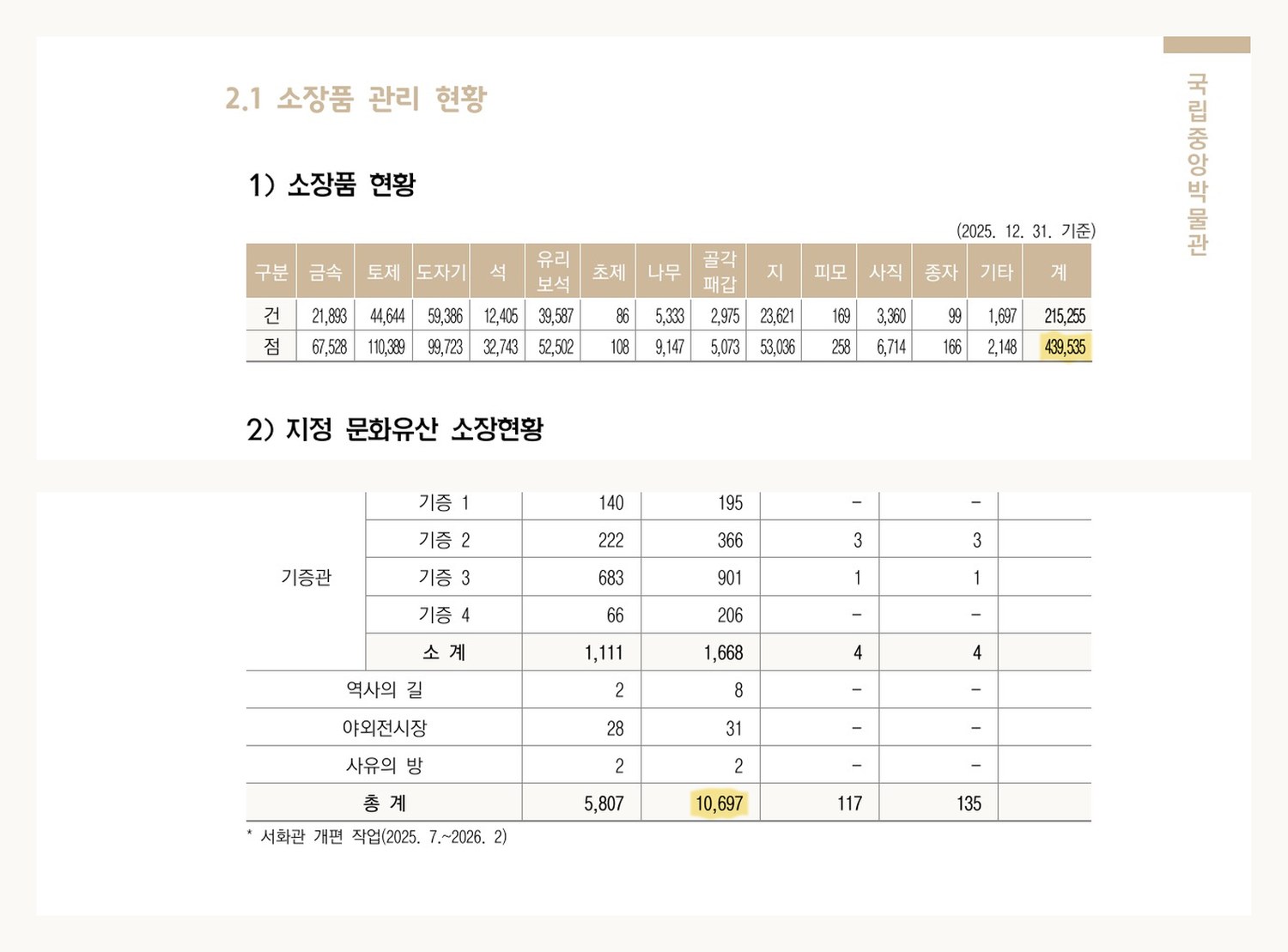
439,535 objects held; 10,697 on permanent view. Both figures are the museum's own, from the same report, as of 31 December 2025.
The sentence "museums display less than ten percent of their collections" is everywhere. I went looking for the study behind it and could not find one.
The most rigorous published attempt is journalism, not scholarship: Christopher Groskopf's survey for Quartz, 20 January 2016. He searched the online catalogues of twenty museums in seven countries for works by thirteen major artists, 2,087 works in total, and found that *44 percent were on display*. His individual findings are more striking than his average: the National Gallery of Art in Washington had 199 Rothkos in storage and two on view. Across thirteen museums, 862 Cartier-Bresson photographs were in storage and one was on view. Across seven museums, fifty three Egon Schiele drawings, none on view.
The same article asserts that the largest museums display about five percent of their collections. No source is given for that number, and I could not trace it.
Institution | Holdings | On view | Rate |
|---|---|---|---|
National Museum of Korea | 439,535 | 10,697 | 2.43 percent |
Museum Boijmans Van Beuningen | 154,000+ | not published | museum's own figure: 8 percent |
British Museum | about 8 million | not published | about 1 percent |
National Gallery, London | 2,600 | not published | about 38 percent |
Victoria and Albert Museum | about 2.8 million | not published | |
MMCA, Korea | about 12,000 | not published | press reporting: under 10 percent |
National Museum of Korea display figure from the museum's own permanent gallery pages. British Museum and National Gallery figures via The Art Newspaper, 28 May 2025. Boijmans from its own depot page.
Notice the National Gallery in London: 38 percent. It is a small, tightly edited collection of 2,600 pictures with no archaeology, no textiles, no prints and drawings department. The display rate is a function of what kind of collection you have, not of institutional virtue.
The hardest constraint is physics
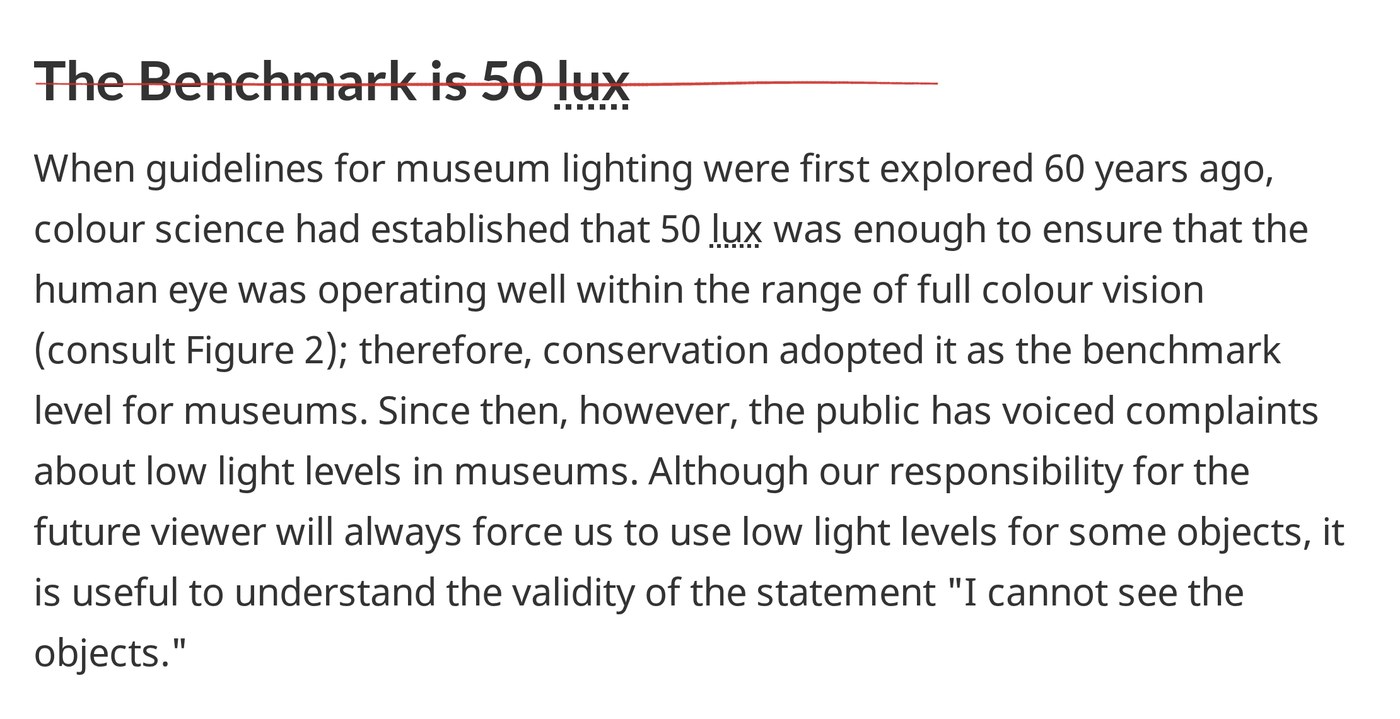
Where the number comes from: colour science established that 50 lux was enough for full colour vision, and conservation adopted it as the benchmark. Government of Canada.

A princely collection as one crammed room. Commons
Before any argument about taste or diversity, there is an arithmetic problem that cannot be legislated away.
Sensitivity | Materials | Maximum illumination | Maximum exhibition |
|---|---|---|---|
Sensitive | works on paper, photographs, textiles | 50 lux | three months every five years |
Less sensitive | oil paintings, wood, leather | 150 lux | three months every two years |
Least sensitive | metal, ceramic, stone, glass | 300 lux | continuous |
Conservation Center for Art and Historic Artifacts, "Light Exposure for Artifacts on Exhibition."
The governing rule is that lux multiplied by hours gives cumulative exposure, and the damage is irreversible. CCAHA's own illustration: 100,000 lux for one hour does the same damage as 50 lux for two thousand hours.
Work the numbers. A common annual budget for the most sensitive category is 12,000 lux-hours. At 50 lux that is 240 hours a year. At eight hours of gallery opening, that is *thirty days*.
The Met's Drawings and Prints department holds around 80,000 works. The Boijmans holds about 89,000 prints and drawings out of 154,000 objects. There is no version of those institutions in which those holdings are on permanent view, at any budget, in any building, under any director.
This is why storage is not primarily an editorial decision. For roughly half of what a large museum owns, the alternative to storage is destruction.

Before conservation science, display and storage were the same thing, and the pictures paid for it. Commons
Then there is the editorial decision
The rest is choice, and the choice has a shape.
Chad Topaz and eight co-authors scraped the online catalogues of eighteen major US art museums, covering more than nine thousand unique artists, and published the result in PLOS ONE in March 2019.
Group | Share of artists |
|---|---|
Men | 87 percent |
White | 85 percent |
Asian | 9 percent |
Hispanic or Latinx | 2.8 percent |
Black or African American | 1.2 percent |
Topaz et al., "Diversity of artists in major U.S. museums", PLOS ONE 14(3): e0212852, 2019.
The paper's own conclusion is more useful than the headline: museums can increase diversity *without* altering their temporal or geographic emphases. That is, the skew is not forced by the decision to collect European old masters. It is a separate choice sitting on top of that one.
The Guerrilla Girls' 1989 poster asked whether women have to be naked to get into the Met, and gave the count: under five percent of artists in the modern sections were women, and 85 percent of the nudes were female. They recounted in 2005 and got three percent and 83 percent. It had got worse. In 2012 they got four percent and 76 percent.
What a museum is actually allowed to do with what it owns
Acquisition policy is where storage cost becomes legally binding. MoMA's Collections Management Policy, adopted 20 April 2020, is unusually public, and the criteria are worth quoting because they are not about quality.
All works proposed for acquisition to the Collection should be relevant to the Museum's stated mission and should be in, or capable of being returned to, an acceptable state of conservation, unless the physical condition is integral to the meaning of the work.
The Museum must be able to house and care for the proposed acquisition according to generally accepted museum practices.
Only works for which legal title can be firmly established should be considered for acquisition.
The second of those is the one to sit with. A museum is formally barred from acquiring what it cannot store. Storage is not the afterthought. It is an entry condition.
Disposal is harder than acquisition. The Association of Art Museum Directors' rule is that proceeds from deaccessioned works may be used only to acquire other works. On 15 April 2020, with museums closed, the AAMD board resolved that until 10 April 2022 it would not censure members who also used proceeds for the direct care of the collection.
What happened next is the clearest available picture of what museums actually believe.
Museum | Date | Outcome |
|---|---|---|
Baltimore Museum of Art | October 2020 | Three works, including a Warhol Last Supper estimated at $40m, expected to raise $65m. Withdrawn from Sotheby's two hours before the sale |
Brooklyn Museum | October 2020 | Twelve works through Christie's, $6.6m with premium. Top lot Cranach's Lucretia, $5.1m |
Everson Museum, Syracuse | 6 October 2020 | Jackson Pollock, Red Composition (1946), $12m hammer at Christie's |
Berkshire Museum | 2017 to 2018 | Twenty two works, $53.25m, under a court-approved cap of forty works and $55m |
Sources: ARTnews, The Art Newspaper, the Everson Museum's own release, and Artsy.
The Baltimore case is the informative one. Eleven former trustees asked the Maryland Attorney General to investigate. Two former board chairmen rescinded fifty million dollars in pledged gifts. Two artists resigned from the board. The sale was called off two hours before it began, and the museum's stated purpose had been to buy work by women and artists of colour and to fix staff pay.
The sector's revealed preference is that a museum may keep an object it will never show, but may not sell it to show something else.

Crates, ladders, the hang in progress. Most of a museum's labour looks like this rather than like a gallery. Commons
So they started building the storage instead
Winy Maas of MVRDV on the Rotterdam depot.
Facility | Opened | Key figures |
|---|---|---|
Louvre Conservation Centre, Liévin | 8 October 2019 | 18,500 sq m total, 9,600 of storage, about 250,000 works by 2024, €42m construction |
Depot Boijmans Van Beuningen, Rotterdam | 5 November 2021 | 39.5 m high, 15,541 sq m, 154,000 objects, fourteen compartments and five climate zones. The first fully public art depot |
V&A East Storehouse, London | 31 May 2025 | more than 250,000 objects and 1,000 archives |
MMCA Cheongju, Korea | 27 December 2018 | 19,855 sq m in a converted tobacco factory, capacity about 11,000 works, ₩57.7bn |
Liévin was not built because the Louvre ran out of room. It was built because roughly ten thousand square metres of the Louvre's Paris reserves sit underground inside the Seine's hundred-year flood zone. During the 2016 floods the museum closed and moved 35,000 works in forty eight hours, at a revenue loss of €1.5 million.
The Boijmans depot is organised by material and climate requirement rather than by period or movement, which tells you what the organising logic of a collection actually is once display is removed from the equation. It is conservation, and after that, research access.
A curator at MMCA Cheongju gave the best description of the difference, and it has been quoted ever since: if the ordinary gallery is a department store, this is Costco.

Rijksmuseum, CC0. Everything visible, nothing conserved. Commons
The honest version of the question
The question "why does a museum hide most of what it owns" contains an assumption that does not survive contact with the numbers.
For roughly half of a large collection, display is not a choice between showing and hiding. It is a choice between thirty days of visibility a year and a work that fades to nothing within a generation. That part is physics.
For the rest, it is editorial, and the editorial record is documented: 87 percent male, 85 percent white, and a sector that would rather keep an object forever unseen than sell it to buy something it does not have.
Both halves are true at once, and conflating them is how the argument usually goes wrong. The conservation constraint is real and it is not an excuse. The editorial skew is real and it is not explained by the constraint.
What the new buildings represent is an attempt to stop choosing between them. Rotterdam's answer, which is to make the storage itself the exhibition, is the first genuinely new idea about this problem in about two hundred years.
Sources
National Museum of Korea, permanent exhibition pages
Christopher Groskopf, "Museums are keeping a ton of the world's most famous art locked away in storage", Quartz, 20 January 2016
Conservation Center for Art and Historic Artifacts, "Light Exposure for Artifacts on Exhibition"
Chad M. Topaz et al., "Diversity of artists in major U.S. museums", PLOS ONE, 2019
Musée du Louvre, Louvre Conservation Centre press kit
Museum Boijmans Van Beuningen, about the Depot
The Art Newspaper, "Pallets not plinths", 28 May 2025
A Korean version of this research, built around the National Museum of Korea and MMCA Cheongju figures, is on my Naver blog at blog.naver.com/veinism.
Latest Articles.
© Moc Mallen Studio
Thoughts, ideas, and perspectives on design, simplicity, and creative process.


