Painted Without Permission, Kept Anyway
Hogarth priced Gin Lane at a shilling so it would travel. Haring painted Crack Is Wack without asking and the city gave him a van. What happened to each picture afterwards was decided by neither of them.
Date
Category
Writer

On 27 June 1986 Keith Haring painted a mural on a handball court by the Harlem River Drive at 128th Street, without asking anyone. He was summonsed for it and pleaded to disorderly conduct. Accounts of the fine disagree: his own foundation says twenty-five dollars, most secondary sources say a hundred.
Then the city changed its mind. Graffiti writers had altered the lettering to read "Crack is It," and the Parks Commissioner, Henry J. Stern, invited Haring back to repaint it. Stern supplied materials and a van, offered him a choice of eight sites, and turned up to the repainting wearing an autographed Crack Is Wack T-shirt.
Haring repainted it on 3 October 1986. The Parks Department catalogues it as a monument, has restored it twice, and the playground is named after it.
The reason he painted it was his studio assistant Benny Soto, who was addicted to crack.
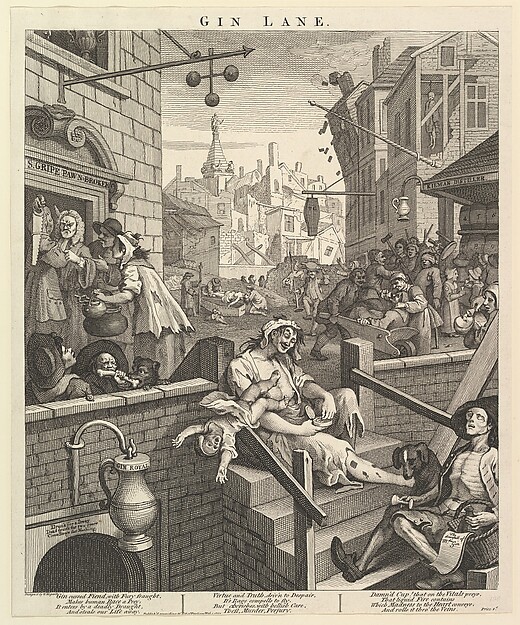
William Hogarth, Gin Lane, 1 February 1751. Etching and engraving. The Metropolitan Museum of Art, 32.35(124), Harris Brisbane Dick Fund. Open Access, CC0.
Five pictures made to change what people did
1. Gin Lane and Beer Street, 1751

William Hogarth, Beer Street, 1 February 1751. Etching and engraving. The Metropolitan Museum of Art, 91.1.141, Gift of Sarah Lazarus. Open Access, CC0.
Hogarth issued both plates on the same day, 1 February 1751, at one shilling each, and he said in his own advertisement exactly why:
the Subjects of these Prints are calculated to reform some reigning Vices peculiar to the lower Class of People, in hopes to render them of more extensive use, the Author has published them in the cheapest Manner possible.
He also cut the plates with deliberately thicker lines so they would survive a long print run at that price. The distribution strategy is built into the engraving technique.
The two prints are a pair, meant to be pinned up side by side, and the argument is carried by how hard each one is to read. Gin Lane has to be deciphered: overlapping bodies, collapsing masonry, small lettering, a receding spire, everything coming apart under the eye. Beer Street reads instantly: stable verticals, whole bodies, large clear signage.
In Gin Lane only three businesses are sound. The distiller, the pawnbroker and the undertaker. In Beer Street only one is failing, and Hogarth labelled it: N Pinch, Pawn Broker.
2. What the print did and did not do
This is the part that is almost always overstated.
Date | Event |
|---|---|
January 1751 | Henry Fielding publishes his Enquiry into the Causes of the late Increase of Robbers |
1 February 1751 | Hogarth issues Gin Lane and Beer Street |
25 June 1751 | The Sale of Spirits Act receives royal assent |
1 July 1751 | The Act comes into force |
Table 1. The prints precede the statute by five months and follow Fielding by two weeks. They accompanied a campaign that had been running since 1729. They did not cause it.
Parliament had been legislating on spirits through eight acts since 1729. The 1751 Act was the last of a long series. And the consumption decline that followed is credited by historians at least as much to rising grain prices and falling real wages as to the statute — Jessica Warner's finding is that each earlier gin act worked briefly and then consumption rose again.
Per-capita spirits consumption in England peaked at about 2.2 gallons in 1743, fell to about 1.2 by 1752 and about 0.6 by 1757. Those are the numbers that hold up. The viral ones about seven thousand gin shops and every fourth house in St Giles do not.
3. Crack Is Wack, and a city that reversed itself in three months
Put the two campaigns side by side and the asymmetry is the whole point.
Gin Lane, 1751 | Crack Is Wack, 1986 | |
|---|---|---|
Commissioned by | Nobody. Hogarth's own initiative | Nobody. Haring's own initiative |
Legal status at creation | Lawful, sold by the artist | Unlawful. Summons issued |
Distribution | One shilling, printed for volume | One wall, on the approach to a highway |
Institutional response | None required | Parks Commissioner supplied a van and paint |
Status now | Museum print, public domain | City-catalogued monument, in copyright until 2061 |
Table 2. The eighteenth-century campaign was legal and disposable. The twentieth-century one was illegal and is now conserved by the city that prosecuted it.
Haring had the harder problem, and he solved it with the same instinct Hogarth had: make it readable at speed, from a distance, by people who are not stopping. Hogarth was solving for a shilling print pinned to a wall. Haring was solving for a driver on the Harlem River Drive.
4. The scale of the thing being argued about
The crack epidemic is not a vibe, and the figures are worth stating plainly.
New York City homicides peaked at 2,245 in 1990.
Of 414 New York homicides studied for 1988, 53 per cent were drug or alcohol related; of the drug-market killings, 61 per cent involved crack.
New York mothers reporting cocaine use rose from 1 per 1,000 live births in 1981 to 21 per 1,000 in 1988.
Nationally, cocaine-related deaths rose from 3.3 to 21.5 per million across the 1980s.
Hogarth had a consumption series and a moral panic. Haring had a homicide curve.
5. Who gets to keep it
Hogarth's prints are public domain. The Met releases its impressions under CC0: anyone can reproduce, crop, sell or alter them.
Crack Is Wack is on public land, restored with public labour, catalogued by a city agency, and it cannot be reproduced without written permission from the Keith Haring Studio. Nothing clears until 2061.
A mural painted illegally on city property, to warn the public about a public emergency, restored at public expense, is a private asset. That is not hypocrisy on anyone's part. It is just what the two systems produce, and it is why this piece has a Hogarth at the top instead of a Haring.
What I take from it
Both artists understood the same thing: a public-health image has to survive being glanced at. Hogarth built that into the depth of the engraved line. Haring built it into the speed of the drawn one.
What they did not control, either of them, was what happened to the picture afterwards — whether it became a cheap thing anyone could copy or a protected thing nobody can. That was decided by the legal system each of them happened to be standing in, and neither of them chose it.
Latest Articles.
© Moc Mallen Studio
Thoughts, ideas, and perspectives on design, simplicity, and creative process.

