One Pigment, Four Hands
Blue-and-white began as a failure to make porcelain. A thousand years of forks in which the constraint held and the meaning changed completely, ending in a fake origin myth written to sell plates.
Date
Category
Writer

In the ninth century, potters in Basra tried to make Chinese porcelain and failed, because Iraq has no kaolin. What they made instead was earthenware with an opaque white tin glaze, which looked like porcelain from a distance, and then they painted cobalt blue onto that white surface.
That failure is the origin of blue-and-white. Everything that followed, in China, Korea, the Netherlands and England, descends from a workaround.
I keep coming back to this sequence because it is the clearest case I know of a design system propagating through forks. The constraint stayed almost fixed for a thousand years: one pigment, cobalt oxide, painted onto a white body and sealed under a clear glaze, fired once. What changed at every stop was what the constraint was made to mean.
Five forks
1. Kashan, and the direction of the copying
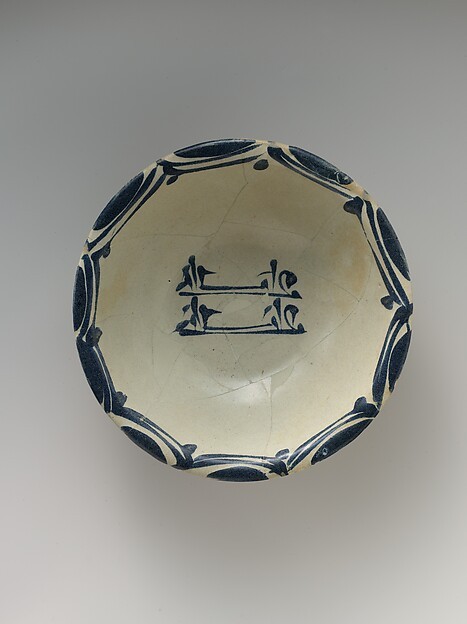
Bowl emulating Chinese stoneware, 9th century, attributed to Iraq, probably Basra. The Metropolitan Museum of Art, 63.159.4. Open Access, CC0.
The cobalt came from a mine about thirty-five kilometres southwest of Kashan, near Qamsar. Persian texts call the ore lajvard, and a fourteenth-century treatise describes it as white silver shining in a sheath of hard black stone.
The chemistry matters more than it sounds. The Kashan ore is high in iron and arsenic and has almost no manganese. That fingerprint is what later lets analysts tell imported cobalt from Chinese cobalt in a Ming vase, and it is also what gives the early Chinese wares their characteristic blotches.
Note the direction of travel. In the ninth century, Iraq was imitating China, not the other way round. The Met says of its own bowl that Iraqi potters were trying to replicate the luminous quality and hard body of Chinese whitewares. The pigment went east; the white went west.
2. Jingdezhen, and a dated object
Underglaze cobalt at Jingdezhen begins around 1300 to 1320 and is fully developed by the mid-fourteenth century. The Chinese name for the imported ore was huihui qing, Islamic blue.
The anchor is a pair of vases in London, museum number PDF B.613 and B.614, Jingdezhen, 636 millimetres tall, and dated by their own inscription. The text is a temple donation: a disciple named Zhang Wenjin presents a set of incense burner and flower vases in prayer for the protection of his whole family, recorded on a propitious day in the eleventh year and fourth month of the Zhizheng era, which is 1351.
The single most important dated object in the history of blue-and-white carries a date only because somebody was giving it to a temple, not because anybody thought the pot was worth dating.
The reign-by-reign supply history reads like a dependency log. Yuan large wares use imported ore. Hongwu uses local only, because civil war cut the imports. Yongle to Chenghua imperial wares go back to imported. From Wanli onward it is refined domestic cobalt from Zhejiang, because the imported supply ran out. The colour of the object is a direct readout of trade conditions.
3. Joseon, and scarcity as an aesthetic
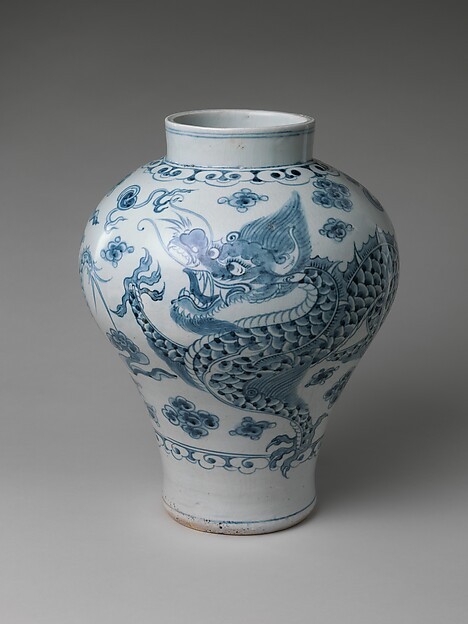
Dragon jar, Korea, Joseon dynasty, second half of the 18th century. Porcelain with underglaze cobalt-blue design, 43.8 cm. The Metropolitan Museum of Art, 2010.368. Open Access, CC0.
Korea had the kilns and not the pigment. The National Museum of Korea states it plainly: the cobalt used on Joseon blue-and-white was very expensive and could only be imported from China, and most of the designs made with this precious material were painted by the official court artists of the Royal Bureau of Painting.
The official kilns at Gwangju, administered by the Saongwon, are dated to around 1467. Access was restricted, and not decoratively: the Korea Heritage Service records that even a member of the scholar-official class faced eighty strokes of the cane for using blue-and-white, and that it was permitted to the royal household alone.
What that scarcity produced is the interesting part. Chinese blue-and-white fills the surface. Korean blue-and-white puts a bird and a spray of plum on one side of a jar and leaves the rest white. The constraint was budgetary and the result reads as restraint, and by the eighteenth century, when cobalt was being mined in Korea itself and the pressure was off, the aesthetic had already hardened into a preference.
Look at the dragons on the Met jar and count the claws. There are four. Five is the Chinese imperial dragon. Four is the fork, encoded in an animal.
And the object Korea is most famous for, the 달항아리 or moon jar, has no cobalt on it at all. A jar thrown as two hemispheres and joined at the waist, its seam left visible, entirely white. The most celebrated vessel in the tradition is the one that declined the system.
4. Delft, and faking the body

Dish with chinoiserie decoration, Delft, about 1685 to 1695, marked AK for Adrianus Kocx. Tin-glazed earthenware. Rijksmuseum, BK-1963-30. CC0.
Between 1602 and 1682 the Dutch East India Company imported millions of pieces of Chinese porcelain into Europe. Then the Ming fell in 1644 and the supply broke.
Delft's answer was not porcelain and could not be. It is earthenware with a tin glaze, the same solution Basra had reached eight centuries earlier for the same reason: no kaolin. So Delft faked the body it could not make, and the consequence is that the design became pure surface, free to drift into chinoiserie invention and then into Dutch subjects entirely.
Worth noticing that the Delft potters were copying a Chinese export ware, kraak, which was itself already designed for the European market. They were forking a fork.
5. Staffordshire, and a myth written to sell plates

Blue willow plate, 19th century, attributed to Mintons. Cooper Hewitt, Smithsonian Design Museum. Public domain, via Wikimedia Commons.
The willow pattern appears around 1790, probably for Spode, and the attribution to a single designer is genuinely contested. Transfer printing replaced the brush, which means the mark stopped being a gesture and became a reproduction.
Then the part that should be taught in every design course. The pattern is an entirely European invention with no Chinese source, and the ancient Chinese legend attached to it was written in England to promote sales. The canonical version, with the lovers Koong-se and Chang, the pursuing mandarin and the two birds, was published anonymously in the magazine The Family Friend in 1849, roughly sixty years after the pattern itself.
The documentation was forged after the fact to explain a design that had no story. And the punchline is that Chinese potters subsequently copied the English willow pattern, so the imitation travelled back to the thing it had never been imitating.
What propagates and what does not
Stop | What was inherited | What was changed |
|---|---|---|
Basra, 9th c. | The look of Chinese white ware | The body: tin glaze instead of porcelain |
Jingdezhen, 14th c. | The pigment | Total coverage, registers, an imperial visual grammar |
Joseon, 15th c. | The pigment and the technique | Emptiness. And four claws instead of five |
Delft, 17th c. | The image | The body again, and eventually the subject matter |
Staffordshire, 1790s | The genre | The mark, from brush to print. And a fabricated origin story |
Table 1. A thousand years of forks. The constraint survives every one of them.
Video. "Asia, The David Vases," British Museum.
Three things this changed for me
A constraint survives a fork better than a rule does. Nobody carried a style guide from Basra to Staffordshire. What travelled was a physical limit, one pigment that survives the firing, and every culture rediscovered the same consequences from it. The durable part of a design system is the part that is enforced by the material rather than by agreement.
Scarcity, once it becomes taste, outlives the scarcity. Korean restraint started as a procurement problem. By the time cobalt was locally mined and cheap, restraint had become the thing that was wanted. Ask which of your own house conventions started as a limitation and stayed after the limitation went.
Somebody will write the origin story, and it may not be true. The willow pattern's legend is a marketing document from 1849 attached to a design from 1790. A system's own account of where it came from is a later artefact, written by someone with a reason, and it should be dated like anything else.
A close look at one Joseon dragon jar, glaze pooling and brush loading and all four claws, is on my Korean blog: 베이니월드.
Sources
Kashan cobalt chemistry and the lajvard descriptions: Matin and Pollard, Archaeometry, Oxford ORA. The Basra bowl: The Metropolitan Museum of Art, 63.159.4. The David Vases and their inscription: British Museum, PDF B.613. Cobalt cost, the Royal Bureau of Painting and the Bunwon kilns: National Museum of Korea and the International Journal of Korean Art and Archaeology. The eighty-strokes penalty and the difficulty of obtaining pigment: Korea Heritage Service. The dragon jar: The Metropolitan Museum of Art, 2010.368. VOC import volumes and the Delft response: Essential Vermeer. The invented willow legend and its 1849 publication: Victoria Gallery and Museum, University of Liverpool.
Not asserted, because I could not source it: the frequently repeated claim that cobalt was worth twice its weight in gold at Jingdezhen; the exact legal clause behind the eighty-strokes penalty; and whether the Met jar's cobalt is imported or Korean-mined, which the museum record does not say.
Latest Articles.
© Moc Mallen Studio
Thoughts, ideas, and perspectives on design, simplicity, and creative process.


.jpg)