Half of Rembrandt
The accepted Rembrandt corpus went from 614 paintings to 146 and back to 340, with no painting discovered or destroyed. Who decides that a work is genuine, and what happens when they change their mind.
Date
Category
Writer

In November 1985 a curator at the Gemäldegalerie in West Berlin announced that one of the most reproduced paintings in Germany was not by Rembrandt. The Man with the Golden Helmet had been attributed to him by Wilhelm von Bode, and for most of a century it had been the picture Germans put on biscuit tins. Jan Kelch's conclusion was that important details of its style did not match Rembrandt's known work, and that it had probably been painted around 1650 by someone in his circle.
Then Kelch said the sentence that this entire essay is about.
It is not a fake. It remains a great masterful work.
Nothing happened to the painting. The paint did not move. What changed was a line of text on a wall label, and with it the painting's insurance value, its loan requests, its reproduction rights, its place in the room, and the number of people who would cross Berlin to see it.

Gemäldegalerie, Staatliche Museen zu Berlin. The Commons filename itself now carries the corrected attribution. Commons
The count
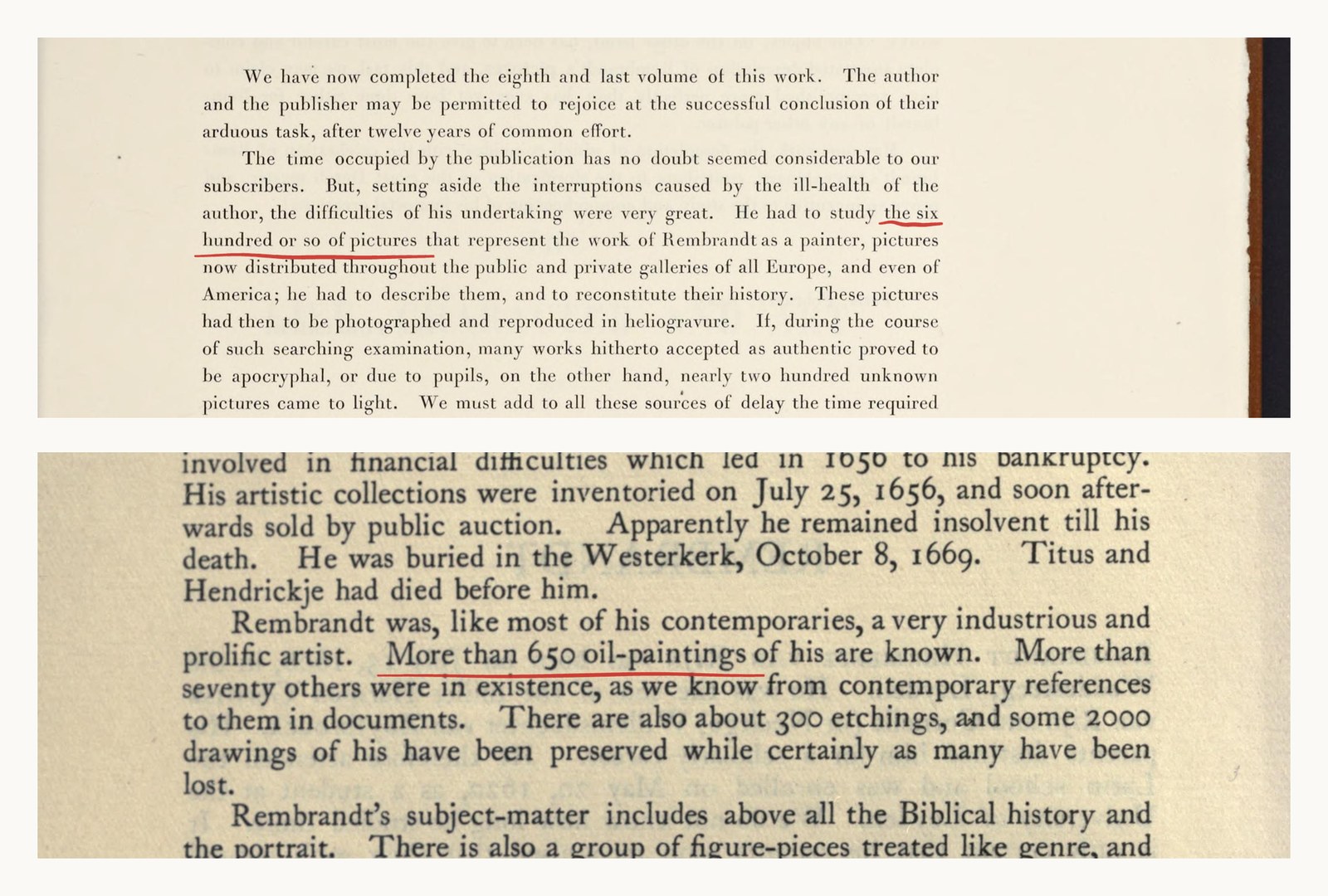
Bode writes of the six hundred or so of pictures; Hofstede de Groot, ten years later, of more than 650 oil-paintings. The corpus was never a fact, it was a running total.
In 1968 six Dutch scholars formed the Rembrandt Research Project, funded by the Netherlands Organisation for Scientific Research. Their brief was to go and look at every painting attributed to Rembrandt and decide.
Here is what the count has done since 1836.
Authority | Year | Accepted paintings |
|---|---|---|
John Smith | 1836 | 614 |
Bode, Valentiner, Hofstede de Groot | c. 1900 | more than 700 |
Abraham Bredius | 1935 | c. 630 |
Horst Gerson | 1969 | 435 |
Christian Tümpel | 1986 | 280 |
RRP, Corpus volumes I to V | 1982 to 2010 | 146 |
Ernst van de Wetering, Corpus volume VI | 2014 | 340 |
Sources: National Gallery of Art and the Burlington Magazine editorial of February 2015. The scopes differ: volumes I to III covered only 1625 to 1642, volume VI is a complete survey. That explains some of the spread but not all of it.
Not one painting was discovered or destroyed in that period. The objects are constant. The number is not.
In 1993 four of the founders, Josua Bruyn, Bob Haak, Simon Levie and Pieter van Thiel, resigned, amid the controversy over their de-attributions. Ernst van de Wetering took over and spent the next twenty years putting works back.
The split was methodological, and it is the most useful thing in the whole story. Bruyn held that Rembrandt's style was uniform within each period, and judged by comparing images. Van de Wetering argued the style was far more various, and judged by studying process: technique, workshop practice, contemporary theoretical texts, material analysis. Late in life Bruyn conceded that van de Wetering's approach had been the better one.
Two committees of specialists, looking at the same paintings, with the same training, disagreed by a factor of two.
The Rijksmuseum's Operation Night Watch: what studying process rather than image actually looks like.
Three paintings

The Frick Collection, New York. Contested for decades, and still catalogued by the Frick under Rembrandt's name. Commons
Pilate Washing His Hands is at the Metropolitan Museum, accession 14.40.610, bequest of Benjamin Altman, 1913. In 1905 Wilhelm von Bode called it a somewhat abnormal work by Rembrandt and kept the attribution. In 1942 Julius Held declared it certainly not painted by Rembrandt himself. The Met's current line is "Style of Rembrandt," probably 1660s, and its curatorial text is unusually blunt: the composition mirrors mature Rembrandt, but the Rembrandtesque surface effects fail to convey anything like the master's command of illumination and modelling.
The Met has not decided who did paint it. Aert de Gelder, a pupil in the 1660s, has been proposed. The record says uncertain.
Why this is hard, and it is not incompetence
Rembrandt ran a workshop. Govert Flinck, Ferdinand Bol, Carel Fabritius, Aert de Gelder and others trained in it, painted in it, learned his handling deliberately, and used his materials.

Rijksmuseum SK-A-714. For generations one of the most loved Rembrandts in the Netherlands. It is not one. Commons
This is the structural problem. A pupil working in Rembrandt's studio used Rembrandt's canvas, Rembrandt's pigments, Rembrandt's lighting, Rembrandt's poses, and was being trained to produce Rembrandt's marks. Every material fact you can establish about such a painting is also true of a genuine one.
What the instruments can actually say
The Metropolitan's Flora comes with its own X-radiograph, released under CC0. Put them side by side.
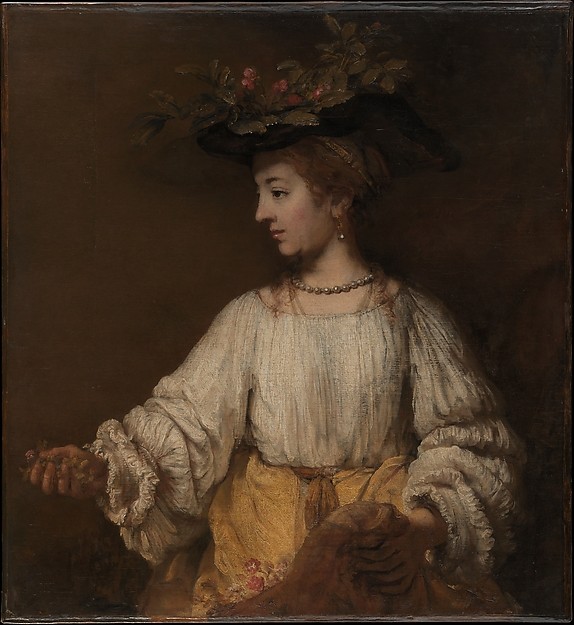
The Metropolitan Museum of Art 26.101.10. Met Open Access
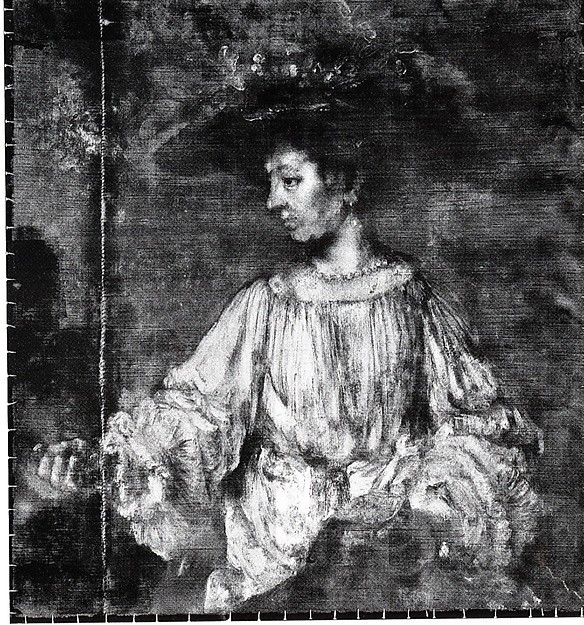
The Met's radiograph shows the build of the picture beneath the surface. It does not show whose hand laid it down. Met Open Access
Method | Establishes | Cannot establish |
|---|---|---|
Dendrochronology | The earliest possible date of the panel | When it was painted, or by whom |
Pigment analysis | That a pigment postdates the claimed date | That a work is genuine |
X-radiography | Underlying structure, pentimenti, reused supports | Authorship |
Infrared reflectography | Whether the underdrawing was invented or transferred | Authorship, where a workshop shared cartoons |
Canvas thread counting | That two canvases came off the same bolt | Authorship, because pupils used the same bolt |
Dendrochronology numbers from the National Gallery of Victoria; thread counting from the Thread Count Automation Project at Rice and Cornell.
Dendrochronology is the clearest case. For Baltic oak, at least nine sapwood rings must be added to the outermost surviving ring, with a median estimate of fifteen and a documented range of nine to thirty six, then a seasoning interval of roughly two to eight years for seventeenth century panels. What it gives you is a floor. Peter Klein's own caveat, quoted by the NGV, is that when a felling date falls earlier than the proposed date, the plank may have come from a tree's centre, or been stored a long time, or the proposed date may simply be wrong, and dendrochronology cannot tell you which.
Radiocarbon dating is the exception that proves the rule. For twentieth century works the atmospheric carbon spike from above ground nuclear testing gives a very tight date, and dating the oil binder rather than the canvas defeats the forger's standard trick of painting on a genuine period canvas. In one documented case a forged painting signed and dated 1866 had a canvas that dated compatibly with 1866 and a paint binder made from oil harvested after 1958.
Every one of these methods establishes a boundary condition. Not one of them establishes who held the brush.
Infrared reflectography at the National Gallery: what an underdrawing reveals, and what it does not settle.
The same question with money attached
Date | Event | Figure |
|---|---|---|
25 June 1958 | Sotheby's London, sold as Boltraffio | £45 |
2005 | Estate auction, New Orleans, catalogued "After Leonardo" | under $10,000 |
Nov 2011 | Exhibited at the National Gallery, London, as Leonardo | |
2013 | Private sale, then resold the same year | $80m, then $127.5m |
15 Nov 2017 | Christie's New York | $450,312,500 |
Oct 2019 | Louvre Leonardo exhibition | did not appear |
Salvator Mundi. Timeline from The Art Newspaper.
Between 2005 and 2017 the only physical event was a restoration by Dianne Dwyer Modestini, during which the worm-eaten panel broke into seven pieces on removal of its backing and had to be reassembled. Everything else that changed was the name.
The dissent is serious and it is still live. Matthew Landrus puts Leonardo's contribution at five to twenty percent and gives the rest to Bernardino Luini. Frank Zöllner argues the picture is too damaged and over-restored for judgement at all, and has said that in some part it is a masterpiece by Dianne Modestini. Carmen Bambach, in Leonardo da Vinci Rediscovered (Yale, 2019), attributes it principally to Boltraffio with limited work by Leonardo.
Forgery, and what actually catches it

The Doerner Institut's finding, as the court recorded it: two layers containing titanium white in the rutile modification, a substance not industrially produced before 1937/38. NRWE
Wolfgang Beltracchi was convicted on fourteen counts of gang fraud, eleven completed and three attempted; police identified fifty eight suspect works. Those fourteen sold for around forty five million dollars.
He was not caught by connoisseurship. He was endorsed by it: Werner Spies, the eminent Max Ernst scholar and former director of the Centre Pompidou, authenticated his fake Ernsts.
He was caught by titanium white, a pigment not commercially available to artists in 1914, found in 2008 by the pigment scientist Nicholas Eastaugh in a work sold at Lempertz in Cologne in November 2006 as a 1914 Heinrich Campendonk. Beltracchi had carefully sourced period-correct tube paints. The titanium white was in a painted sketch on the reverse of the canvas, a surface he had not expected anyone to examine. He was convicted in Cologne on 27 October 2011 and sentenced to six years.
The Forbes Pigment Collection at Harvard: the reference library that makes this kind of detection possible.
The Knoedler case is worse, because it ran through an institution. M. Knoedler & Co., founded 1846, sold about forty forged Abstract Expressionist paintings between 1994 and 2011, worth roughly eighty million dollars. The paintings were made in a garage in Queens by Pei-Shen Qian, who was paid under nine thousand dollars each. The gallery closed on 30 November 2011, the day after the first suit was filed.
At the 2016 trial a forensic accountant testified that without the forged works Knoedler would have run a three point two million dollar loss. The gallery's president had received ten point four million dollars from profits on them. The markup on the De Soles' fake Rothko was 773 percent.
The institution that could say yes has stopped saying anything
The catalogue raisonné is the only document in the art world that can annihilate several million dollars by omission.
The Mayor Gallery sold thirteen Agnes Martin works between 2010 and 2013. The Agnes Martin Catalogue Raisonné, established 2012, declined to include them. The gallery sued in New York in 2016, claiming more than seven million dollars, the total of the original sale prices. The case was dismissed on 2 July 2019: the court held that it cannot determine authenticity or market value, and that the examination agreement gave the catalogue discretion over its own methods.
The consequence is visible in the other direction too. The Andy Warhol Art Authentication Board, founded 1995, was sued roughly ten times. Joel Wachs, the foundation's president, put the defence bill at at least ten million dollars, and said that eventually they decided they wanted the money to go to artists rather than lawyers. The board's dissolution was announced in October 2011 and completed in 2012. The Basquiat and Keith Haring foundations stopped authenticating around the same period.
So for several major twentieth century artists there is now no body that can pronounce at all. Not because the question was settled. Because answering it became uninsurable.
What the market does with all this
You would expect a forgery scandal to destroy prices. Fabian Bocart and Kim Oosterlinck looked at the data and found something stranger. Before a fake is exposed, works by that artist are less likely to be sold through auction houses, because sellers who suspect something avoid scrutiny. After exposure, sellers move toward the major houses, seeking their certification. And on price:
Prices only react negatively with a lag, suggesting that sellers try to postpone their sales as long as possible. Eventually, close to a year after fakes have been made public, prices increase indicating that buyers view the market as purged.
Their other finding: fake discoveries have almost no impact on the probability that an artwork sells.
The scandal does not damage the market. It launders it.
What "genuine" turns out to mean
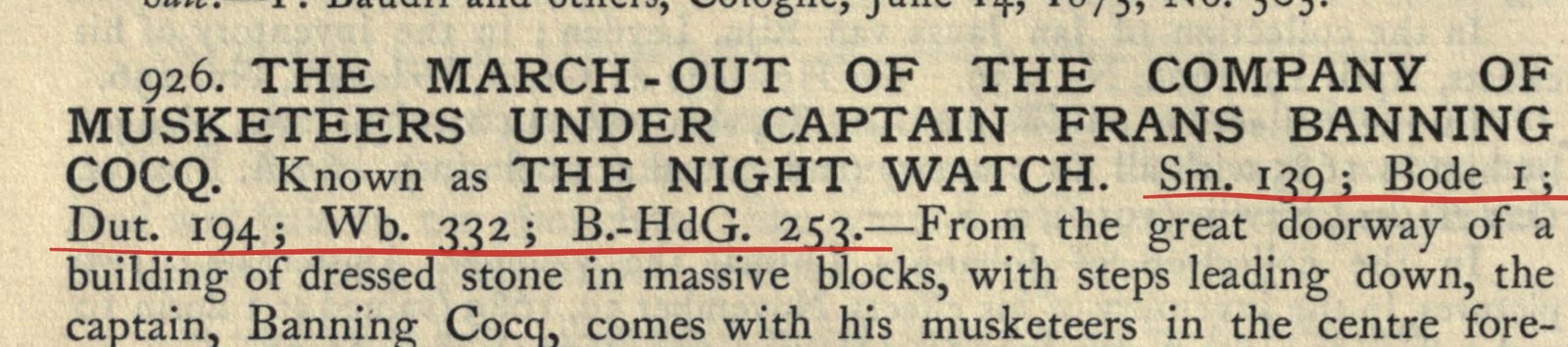
One painting, five catalogues, five numbers: Sm. 139; Bode 1; Dut. 194; Wb. 332; B.-HdG. 253. A catalogue raisonné is an opinion with a number on it. archive.org

The National Gallery, London. Commons
Put the pieces together and a definition falls out that nobody would choose.
Genuine is not a property of the object. Every property of the object that can be measured is shared with the workshop. Genuine is a judgement, produced by a small number of specialists, recorded in a document, and enforced by a market that treats the document as the fact.
And the number of people willing to produce that judgement is smaller now than at any point in a century, because the ones who did it got sued.
Kelch was right in 1985 and the sentence still holds. It is not a fake. It remains a great masterful work. We just stopped being able to say whose.
Sources
National Gallery of Art, "Issues of Attribution in the Rembrandt Workshop"
The Burlington Magazine, "The Rembrandt Research Project and its denouement", February 2015
The Metropolitan Museum of Art, Pilate Washing His Hands, 14.40.610 and Flora, 26.101.10
National Gallery of Victoria, "A note on dendrochronological analyses of panel paintings"
Thread Count Automation Project, Rice University
Laura Hendriks et al., "Uncovering modern paint forgeries by radiocarbon dating," PNAS, 2019
The Art Newspaper, "A timeline of the $450m Salvator Mundi"
The Art Newspaper, "How the detection of titanium white gave away Beltracchi"
The Art Newspaper, "Parties settle in Knoedler case"
Center for Art Law, case review of The Mayor Gallery v. Agnes Martin Catalogue Raisonné
Fabian Bocart and Kim Oosterlinck, "Discoveries of fakes: Their impact on the art market," Economics Letters 113(2), 2011
The Korean version of this research is on my Naver blog at blog.naver.com/veinism. It follows the same question through the same cases, with the numbers laid out for a general reader.
Latest Articles.
© Moc Mallen Studio
Thoughts, ideas, and perspectives on design, simplicity, and creative process.


