Before the Work
Six things to check before the artwork itself: provenance, who signed the certificate, condition, edition, the total rather than the hammer, and what happens in Korea when you sell.
Date
Category
Writer

In 1745 William Hogarth held an auction of his own paintings and printed a ticket for it. The ticket was an etching called The Battle of the Pictures, in which rank after rank of dark, smoky Old Masters march on his own bright modern canvases and stab them.

Rijksmuseum RP-P-2007-200, CC0. The auction ticket for the sale of Hogarth's own work, and a satire on connoisseurship. Commons
It is the right image to start with, because it is about the thing a first-time buyer is actually up against, which is not the artwork. It is the apparatus around the artwork: attribution, provenance, condition, edition, fees, tax, and the professional confidence of everybody in the room.
This essay is the checklist. Five of the six items can be verified without looking at the work at all, and all six become unchangeable the moment you pay.
1. Provenance, and what the databases actually tell you
Provenance is the chain of ownership. A gap is not proof of anything, but the gap that matters most is 1933 to 1945, and the phrase that should always be pushed on is "private collection, Switzerland" with no name and no dates.
There are four databases a buyer can reach, and each is more limited than its reputation.
Database | Access | Coverage | What it cannot tell you |
|---|---|---|---|
Art Loss Register | Paid. £85 per single search plus VAT; £700 for ten a year | More than 700,000 items | Its own FAQ says no database of stolen art can be complete. A certificate is evidence of good faith, not a guarantee |
INTERPOL Stolen Works of Art | The web database requires an account by application. The free route is the ID-Art mobile app, launched 6 May 2021 | About 57,000 items | Only what national police forces reported. An unreported theft is not there |
German Lost Art Database | Free and public | Cultural property expropriated through Nazi persecution, 1933 to 1945 | Absence is not clearance. It is a register of claims and disclosures |
Korea Heritage Service stolen heritage register | Free and public | 525 registered notices, designated cultural heritage | Contemporary art and general fine art are not in it at all |
Art Loss Register FAQs · INTERPOL ID-Art · Lost Art · 국가유산청 도난 국가유산 정보. All checked 21 September 2026.
The important column is the last one. None of these prove a work is clean. They tell you it is not among the things that were reported.
The Getty Research Institute on what provenance research actually involves.
2. Who signed the certificate
A certificate of authenticity has no independent legal force. The blunt version, from an Artsy survey of the practice: a certificate can be forged just as well as the work can be forged, and searching the phrase online returns tutorials on making one yourself.
What has weight is narrow: the artist; the estate or foundation, where one still authenticates; inclusion in the catalogue raisonné. Banksy's Pest Control is treated as essential for his studio works. Note that the Calder Foundation and the Dedalus Foundation authenticate but issue no certificates at all, because inclusion in the catalogue is the document.
And then the fact that changes the whole picture. Around 2012, after a run of lawsuits from collectors whose works they had rejected, the Andy Warhol, Jean-Michel Basquiat and Keith Haring foundations all stopped authenticating.
For several major twentieth century artists, there is now no body that can say yes.
3. Condition, and the one number that exists
A condition report will use words that sound technical and are worth insisting on being shown, not just told: relined, craquelure, inpainting, and the percentage of the surface that is not original paint.
There is no published discount table for damage, because most settlements are private. Two cases are on the public record and they bracket the range.
Work | Incident | Pre-damage value | Claimed loss |
|---|---|---|---|
Picasso, Le Marin, 2018 | A falling paint roller at Christie's New York made a 4.5 inch tear | $100m | 20 percent, $20m |
Picasso, Le Rêve, 2006 | The owner put his elbow through it, a 2 to 3 inch tear | $139m | about 39 percent, $54m |
Ellen J. Epstein FRICS, "How to quantify loss of value when art is damaged", RICS Property Journal, 12 July 2024.
Twenty to thirty nine percent, from two of the most carefully documented incidents in the market. The Le Marin figure explicitly included reputational damage to the work, not only the physical injury.
4. Editions, which is where most first buyers are misled
Marking | Meaning | The catch |
|---|---|---|
24/100 | The 24th impression of a declared edition of 100 | The number has no relationship to quality |
A.P. or E.A. | Artist's proof, épreuve d'artiste | Conventionally about ten percent more exist beyond the stated edition |
P.P. | Printer's proof | Not counted in the edition |
H.C. | Hors commerce, not for sale | They circulate anyway |
Posthumous edition | Struck from surviving plates after the artist's death | The artist never approved it. It is a different object |
Open edition | No declared limit | "Limited" without a number means nothing |
New York's Arts and Cultural Affairs Law, sections 11.01(20) and 13.01, requires a dealer to disclose the size of the edition and how, when and by whom the master and the multiples were made. A buyer who is misled can recover attorney's fees, expert witness fees and nine percent interest. California's Civil Code sections 1740 and following do something similar, as does Iowa.
Roughly a dozen US states have any statute at all. Only California and Iowa also cover sculpture. Outside the United States there is generally no statutory duty to disclose edition facts.
5. The total, which is not the hammer
Item | On a ₩10,000,000 hammer |
|---|---|
Hammer | ₩10,000,000 |
Buyer's premium, Seoul Auction online, 18 percent plus VAT | ₩1,980,000 |
Subtotal | ₩11,980,000 |
Shipping and crating | varies, and a crate is expensive |
Framing | varies; works on paper need acid-free materials |
Insurance, per year | roughly 0.1 to 0.5 percent of agreed value |
Seoul Auction's online premium is a flat eighteen percent plus VAT across every band, so about 19.8 percent. Christie's, from 1 September 2026, charges 28 percent up to two million dollars, 22 percent to eight million, and 15 percent above that. Sotheby's matched those bands on 13 February 2026.
Then there is the exit. A seller's commission applies on the way out. Budgeting roughly thirty percent for the round trip is not pessimistic.

Rijksmuseum RP-P-2015-26-458, CC0. Commons
6. What happens when you sell, in Korea specifically
This is the part Korean buyers most often get wrong, and it is good news.
Item | Rule |
|---|---|
Threshold | Taxable only where the transfer price is ₩60,000,000 or more |
Exemption | Works by a Korean original artist who is alive on the date of transfer are not taxed at all |
Classification | Other income, taxed separately, not aggregated into global income |
Rate | 22 percent withheld, including local income tax |
Deemed necessary expense | 90 percent where the transfer price is ₩100m or less |
80 percent above ₩100m | |
90 percent above ₩100m if held ten years or more |
Samil PwC, "미술품 투자 시 알아두면 도움이 되는 세금 상식". Confirm with a tax professional before acting.
Work it through. At a 90 percent deemed expense the taxable base is ten percent of the sale price, taxed at 22 percent, which is an effective rate of about *2.2 percent of gross proceeds*. At 80 percent it is about 4.4 percent.
And a living Korean artist's work is exempt entirely, at any price.
And from 26 July 2027, something new
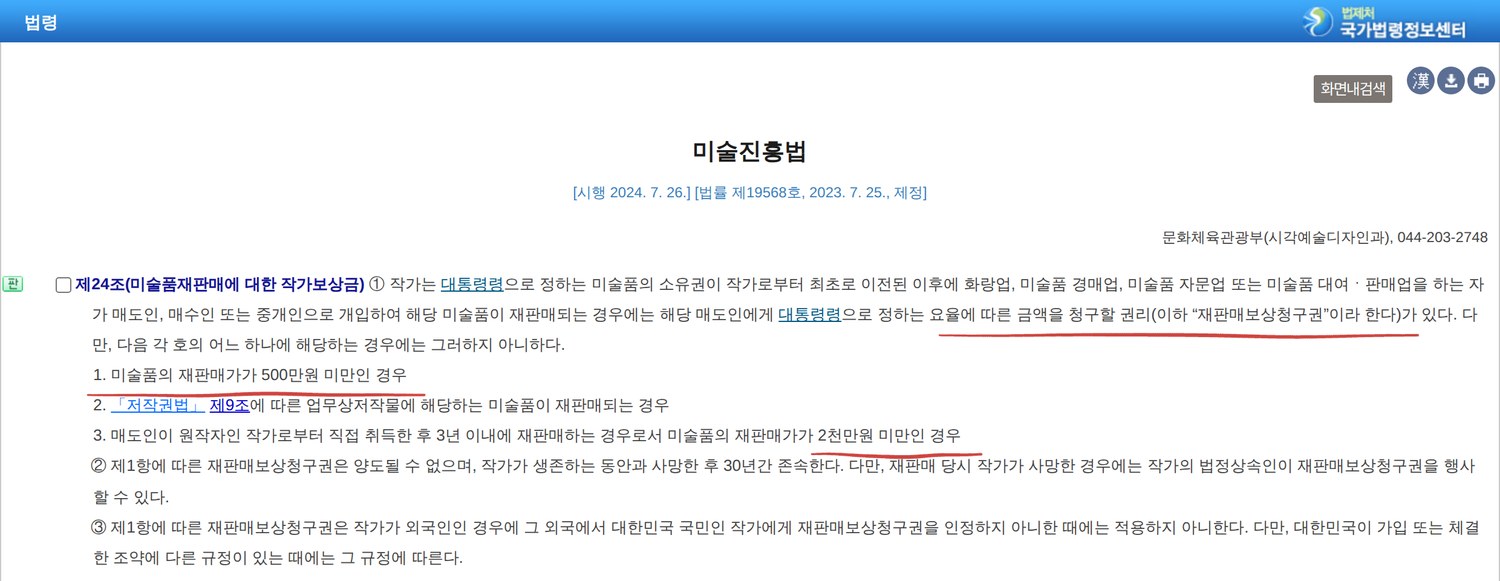
The resale right, and the two thresholds that switch it off: under ₩5m, or under ₩20m within three years of buying direct from the artist. 국가법령정보센터
Korea's Art Promotion Act was promulgated on 25 July 2023. Most of it took effect on 26 July 2024. The artist's resale right takes effect on *26 July 2027*.
Item | Terms |
|---|---|
Threshold | Resale price of ₩5,000,000 or more |
Exclusions | A resale within three years of the artist's own direct sale where the price is under ₩20m; works made for hire |
Duration | The artist's life plus thirty years, inheritable. The EU's is life plus seventy |
Transferability | Not transferable. Foreign artists on a reciprocity basis |
Rate | Delegated to Presidential Decree, and as of mid-2025 not yet set |
For comparison, the EU's Resale Rights Directive runs from four percent on the portion up to €50,000 down to 0.25 percent above €500,000, capped at €12,500 in total, and applies only where an art market professional is involved. Private person-to-person sales are excluded. Note that the structure is regressive: the cheapest works carry the highest rate.
The number to keep in your head
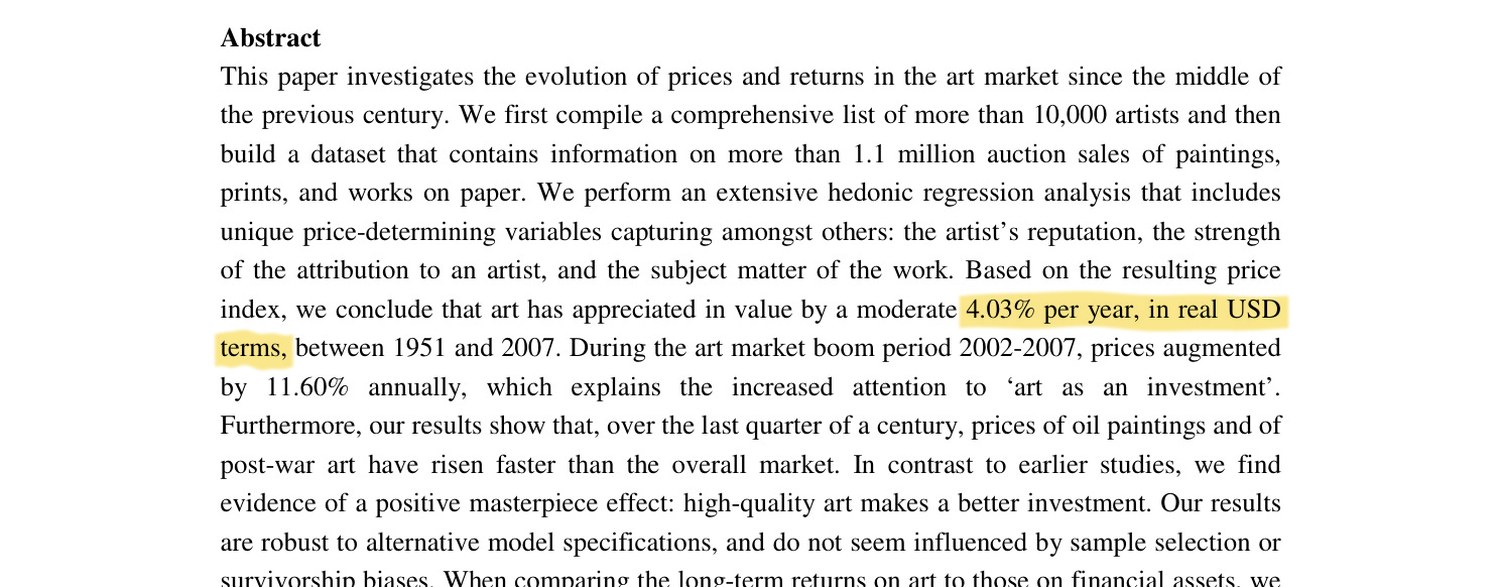
Art appreciated 4.03% a year in real USD terms between 1957 and 2007. Tilburg University
Luc Renneboog and Christophe Spaenjers analysed more than one million auction transactions from 1957 to 2007 and found art returning *3.97 percent per year in real terms*. Their own characterisation: a performance similar to corporate bonds, at much higher risk.
That is before the twenty percent buyer's premium, before insurance, before shipping, and before the seller's commission on the way out.
And the indices are optimistic for a structural reason. Arthur Korteweg, Roman Kräussl and Patrick Verwijmeren showed in the Review of Financial Studies in 2016 that repeat-sales art indices are upward biased, because *works that have risen are more likely to be resold*. The index measures the winners' re-entry, not the average holding.
One more detail worth sitting with: the Mei Moses index, the most cited art return series in existence, built entirely from auction records, was acquired by Sotheby's in 2016.
So what should a first buyer actually do
Nothing in this essay is an argument against buying art. It is an argument against buying it as an asset, because the asset case does not survive contact with the fee structure.
The honest version is this. Buy a work you want to live with, at a price you can lose. Check the provenance because you do not want a claim in ten years. Get the condition report in writing because it is the only thing that can be objectively wrong. Understand the edition because that is where the misrepresentation usually lives. Know the total, not the hammer.
And if you are buying in Korea, buy from a living Korean artist, where the tax on any eventual sale is zero and the money goes to someone who is still working.
Sources
Art Loss Register · INTERPOL ID-Art · German Lost Art Database · 국가유산청 도난 국가유산 정보
Courtney Tenz, "Certificates of Authenticity, Explained", Artsy, 22 February 2021
Ellen J. Epstein, "How to quantify loss of value when art is damaged", RICS, 2024
Judith Wallace, "Art Law on Consumer Protections for Purchasers of Prints and Multiples", Spencer's Art Law Journal 5(3), 2015
Samil PwC, 미술품 투자 시 알아두면 도움이 되는 세금 상식
미술진흥법, 법률 제19589호, promulgated 25 July 2023
EU Directive 2001/84/EC on the resale right
Luc Renneboog and Christophe Spaenjers, "Buying Beauty," Management Science 59(1), 2013
Arthur Korteweg, Roman Kräussl and Patrick Verwijmeren, "Does it Pay to Invest in Art?", Review of Financial Studies 29(4), 2016
The Korean version of this research, with the tax and resale-right sections worked through in full, is on my Naver blog at blog.naver.com/veinism.
Latest Articles.
© Moc Mallen Studio
Thoughts, ideas, and perspectives on design, simplicity, and creative process.


