Before Anyone Signed Anything
Van Eyck wrote was here, not made this. How the byline was invented, why Durer's famous lawsuit probably never happened, and what a catalogue does when there is no author.
Date
Category
Writer

On the back wall of a room in Bruges, painted in 1434, above a convex mirror and below a brass chandelier, there is a line of flourished script that says Johannes de eyck fuit hic. Jan van Eyck was here.
Not made this. Was here. It is a witness statement, in the position where a household would normally paint a family device or a moral precept, and the National Gallery's own catalogue calls the placing of an artist's signature on a wall altogether exceptional.
I have been trying to work out when authorship became a thing you write on the object, because the answer turns out to be late, contested, and driven by commerce rather than by pride.

Jan van Eyck, The Arnolfini Portrait, 1434. Oil on oak, painted surface 82.2 × 60 cm. The National Gallery, London, NG186. Public domain, via Wikimedia Commons.
Five moments in the invention of the byline
1. The colophon, and the fact that it sits outside the work

Colophon page, Silos Apocalypse, British Library Add MS 11695, f. 6v. Public domain, via Wikimedia Commons.
The Lindisfarne Gospels carry a note at folio 259r that names four people and four jobs: Eadfrith wrote it, Æthelwald bound it, Billfrith made the metalwork, Aldred added the Old English gloss.
Two things about that. The book was made around 700 and the note was added roughly two hundred and fifty years later, by the glossator, about people he never met. And it is the only place in the object where any of them are named.
The scribe's complaint is real too, and it has a shelfmark. Trinity College Cambridge MS O.2.5, folio 33v: Explicit hoc totum pro christo da mihi potum. This is the end of the whole thing, for Christ's sake give me a drink. It is a formula rather than one man's joke, which is if anything better: enough scribes wanted a drink that it became boilerplate.
The colophon is the earliest routine "I made this" in the Western book, and it is structurally outside the work. It comes after the text ends.
2. Van Eyck, who signed more than almost anyone
Nine surviving pictures carry Jan's signature, dated between 1432 and 1439, and the National Gallery's catalogue notes that others were probably signed on frames that are now lost. For the 1430s that is extraordinary.
He also had a motto, ALS ICH CAN, painted in Greek letters on the frame of the 1433 portrait in London. The Gallery explains it as an abbreviation of a Flemish saying and a pun on his own name: as I, Eyck, can, but not as I would.
So the signature and the modesty formula arrive together, in the same decade, from the same man. The claim and the hedge are one gesture.
Note the asymmetry the Gallery points out: van Eyck dated three other portraits to the day, and gave the Arnolfini only a year. That detail is what eventually demolished the theory that the painting records a specific ceremony.
3. Dürer's monogram, and a lawsuit that probably did not happen
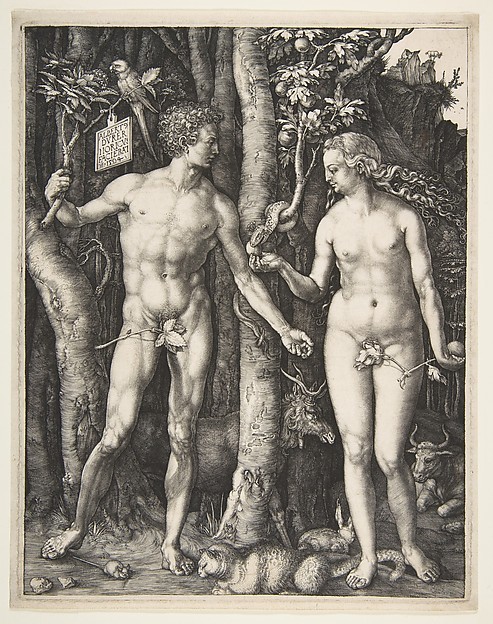
Albrecht Dürer, Adam and Eve, 1504, engraving. The Metropolitan Museum of Art, 19.73.1. Open Access, CC0. The plaque carries a full Latin authorial statement and the monogram, both.
Every account of intellectual property in art tells the same story: Dürer sued Marcantonio Raimondi in Venice, and the court ruled that Raimondi could copy the images but had to stop using the monogram. A perfect trademark-not-copyright parable.
The sole source is Vasari, writing in 1568, sixty years after the events and forty years after Dürer's death. The art historian Lisa Pon puts it flatly: there is no archival evidence to support Vasari's claim that Dürer sought resolution before the Venetian Senate.
The circumstantial case is that Raimondi did stop using the monogram after about 1510, replacing it with an empty tablet, which makes a dispute plausible. The scholarly literature at Primary Sources on Copyright says exactly that, and no more: it is plausible.
What is documented is Dürer's own printed warning, in the 1511 colophon to the Life of the Virgin:
Beware, you envious thieves of the work and invention of others, keep your thoughtless hands from these works of ours. We have received a privilege from the famous Emperor of Rome, Maximilian, that no one shall dare to print these works in spurious forms, nor sell such prints within the boundaries of the empire.
A printed notice, backed by an imperial privilege, addressed to copyists. That is a real document and it is doing the work the mythical lawsuit is usually credited with.
Look at the plaque in the engraving above. Dürer signs twice: a full Latin statement, Albertus Durer Noricus faciebat, and the AD monogram. The sentence and the logo, side by side, in 1504. He was building a mark while the concept was still being invented.
4. The Rembrandt Research Project, or what happens when you audit a byline

Circle of Rembrandt, The Man with the Golden Helmet, 1650 to 1660. Gemäldegalerie, Staatliche Museen zu Berlin, 811A. Public domain, via Wikimedia Commons.
Founded in 1968 to sort out which paintings are actually by Rembrandt. Horst Gerson had already cut the accepted list to 435 and shocked the field. The RRP's first five volumes accepted 146.
Then it partly reversed. Ernst van de Wetering's final survey reinstated no fewer than forty-four works rejected in the first three volumes, and recognises 349 including workshop-inflected pictures. The corpus is not a fact that was discovered. It is a number that moved for forty years depending on who was counting and what they counted.
The reason it moves is that "Rembrandt" was a shop. The National Gallery of Art lists the mechanisms: he could supply a drawing or oil sketch for an assistant to work from, or block in the composition himself and let an assistant finish it. Four etched heads of 1635 are signed Rembrandt geretuckert, Rembrandt retouched. The signature certifies supervision, not execution.
The Berlin picture above did not recover. The museum's own wording: in 1986, following thorough investigation, the attribution was withdrawn once and for all. It is now filed as Circle of Rembrandt, and the filename on Wikimedia already says so.
5. The Notname, or inventing an author because the catalogue needs one
The National Gallery has an artist page for the Master of Liesborn, named from a dismembered altarpiece in a Westphalian abbey dedicated in 1465. There are hundreds of these: the Master of Flémalle, the Master of the Aachen Altar, the Master of the 1540s.
This is the machinery running in reverse and it is the most revealing case of the five. Faced with an unsigned object, nineteenth-century connoisseurship did not record anonymity. It manufactured a person, gave them a name derived from a place or a picture, and assembled a body of work around them, because a catalogue cannot function without an authorial slot to fill.
The same machine runs on the Arnolfini in the opposite direction. A signature exists, so a sitter must be found, and five hundred years of scholarship has gone into naming a woman who is still unnamed.
What the byline is actually for
Case | Who the mark was for |
|---|---|
Colophon | God, the patron, and the next scribe. Placed outside the text |
Van Eyck | The viewer standing in front of it. Placed inside the picture, as an event |
Dürer | Copyists and the market. Backed by an imperial privilege |
Rembrandt | The buyer. It certified the shop, not the hand |
Notname | The catalogue. Invented afterwards, by people who needed a row to sort on |
Table 1. Five different jobs, all done by the same small piece of text.
Video. "See Jan van Eyck's original drawings beneath 'The Arnolfini Portrait'," The National Gallery.
Why this is not a historical question
Every argument now running about machine-generated work is a rerun of these five cases, and the history is useful mainly because it shows which of the arguments were ever settled.
Authorship is an infrastructure decision, not a moral one. Rembrandt's signature meant "this came out of my shop under my supervision," and everybody at the time understood that. The idea that a signature means one pair of hands is later, and it is the idea that made the RRP necessary and then unresolvable. Decide which one your credit line means, and say so.
The strongest protection Dürer had was a printed notice, not a court. The lawsuit may be fiction. The 1511 warning is real, and it worked by being attached to every copy. A claim that travels with the artefact beats a claim you have to go and enforce.
When there is no author, one gets invented. That is the Notname lesson and it is the one I would watch. Systems that require an author field will get an author, accurate or not, because an empty field breaks the sort. If you build a catalogue, decide in advance what it does with genuine anonymity, because otherwise it will fabricate.
A detail-by-detail walk through the Arnolfini room, the mirror and its ten roundels, the single lit candle, the two pairs of discarded clogs and the oranges, is on my Korean blog: 베이니월드.
Sources
The signature, its script, the "altogether exceptional" judgement, the nine signed pictures and the day-dated portraits: Lorne Campbell, The Fifteenth Century Netherlandish Paintings, National Gallery, 1998. ALS ICH CAN: National Gallery, NG222. The Lindisfarne colophon: British Library, Cotton MS Nero D.IV. The drink formula: Trinity College Cambridge, MS O.2.5. Dürer's 1511 warning and the absence of evidence for the Venetian case: Lisa Pon, via Vanderbilt Journal of Entertainment and Technology Law, and Primary Sources on Copyright. The RRP numbers: National Gallery of Art and The Burlington Magazine. The Berlin de-attribution: Staatliche Museen zu Berlin, 811A. The Master of Liesborn: The National Gallery.
A note on images. The National Gallery licenses its own image files CC BY-NC-ND, which forbids derivatives, so the reproduction above is the public-domain Commons file rather than the Gallery's. Their written descriptions are CC BY, which is why the quotations are direct.
Not asserted: Bredius's 1935 count of accepted Rembrandts, which is repeated everywhere without a traceable source; whether the RRP ended in 1993 or 2011, both of which are sourced and conflict; and the Latin original of Dürer's warning, for which I could only verify the translation.
Latest Articles.
© Moc Mallen Studio
Thoughts, ideas, and perspectives on design, simplicity, and creative process.


.jpg)

_-_The_Man_with_the_Golden_Helmet_-_Google_Art_Project.jpg)