After the Room Emptied
SoHo was legalised and then priced out. Three of four estates became foundations and one became a licence. And in 1913 a museum bought one Cézanne, which is the part that mattered.
Date
Category
Writer

This is the last piece in a run of ten about New York between 1977 and 1990, so it should end somewhere. It ends in 1913, which is the only honest place to put it.

J. F. Griswold, The Rude Descending a Staircase (Rush-Hour at the Subway), New York Evening Sun, 20 March 1913. Public domain, via Wikimedia Commons.
Five things that happened after the room emptied
1. SoHo, legalised and then priced out
Artists were living in SoHo lofts illegally through the 1960s, in buildings zoned for manufacturing. In 1971 the city amended the zoning resolution to permit joint live-work quarters for certified artists, creating the M1-5A and M1-5B districts. In August 1973 the Landmarks Preservation Commission designated the SoHo–Cast Iron Historic District.
Both of those are protective measures, and together they made the neighbourhood legible, permanent and expensive. By the late 1990s the galleries were leaving for Chelsea, priced out by the retailers who wanted the same large, airy, top-lit spaces. Matthew Marks opened at 522 West 22nd Street in 1994, in a converted single-storey garage, with Ellsworth Kelly.
The sequence is worth stating plainly: the artists' presence made the district valuable, the city protected the district, and the protection completed the pricing.
2. Four deaths in thirty-six months, and three institutions
Warhol, February 1987. Basquiat, August 1988. Mapplethorpe, March 1989. Haring, February 1990.
Founded | What it does | |
|---|---|---|
Andy Warhol Foundation | 1987, by will | Over $300m in grants to more than 1,000 arts organisations; 52,786 works donated to 322 institutions |
Robert Mapplethorpe Foundation | 27 May 1988 | Two mandates: photography as an art form, and HIV/AIDS medical research |
Keith Haring Foundation | 1989 | Underprivileged children, and AIDS education, prevention and care |
Basquiat | No foundation | Estate licensed commercially through Artestar |
Table 1. Three of the four produced institutions with public mandates, two of them writing the epidemic into the charter. The fourth produced a licensing arrangement.
I do not think that difference reflects anything about the four men. Warhol left a will that directed it. Mapplethorpe and Haring set theirs up while they were dying, with time to plan. Basquiat was twenty-seven and it was an overdose.
That is the whole explanation, and it is the least romantic fact in this series: what survives of a practice is mostly decided by whether anyone had a month to think about it.
3. 1913, and the other time New York was hit by this
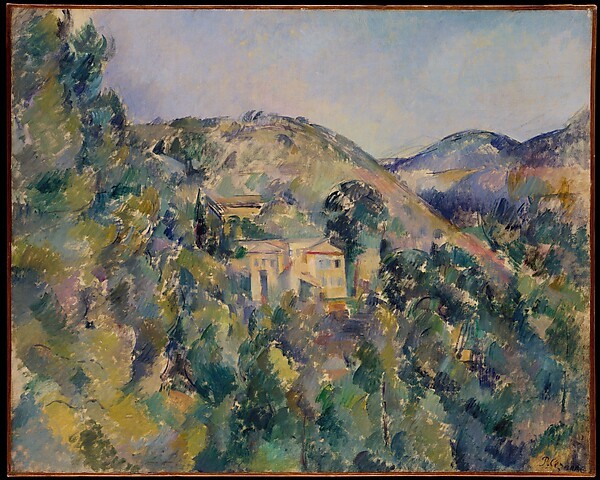
Paul Cézanne, View of the Domaine Saint-Joseph, late 1880s. Oil on canvas, 65.1 × 81.3 cm. The Metropolitan Museum of Art, 13.66, Catharine Lorillard Wolfe Collection, Wolfe Fund, 1913. Open Access, CC0.
The International Exhibition of Modern Art opened at the 69th Regiment Armory on Lexington Avenue on 17 February 1913 and ran to 15 March. Around thirteen hundred works by over three hundred artists. It was organised by the Association of American Painters and Sculptors, which rented the Armory for five thousand dollars plus five hundred for personnel, and which never mounted another exhibition.
The picture everyone attacked was Duchamp's Nude Descending a Staircase, No. 2. Gutzon Borglum called it "a staircase descending a nude." The Evening Sun ran Griswold's parody on 20 March. American Art News offered a prize to anyone who could find the nude.
Theodore Roosevelt reviewed it in The Outlook on 29 March, and the thing everyone quotes from that review is the least representative sentence in it. What he actually wrote first:
The recent "International Exhibition of Modern Art" in New York was really noteworthy. Messrs. Davies, Kuhn, Gregg, and their fellow-members of the Association of American Painters and Sculptors have done a work of very real value.
Then the Navajo rug, and then the phrase he coined in the middle of an art review and that has been in the language ever since:
there is apt to be a lunatic fringe among the votaries of any forward movement.
4. What the Armory Show actually changed
Not taste, immediately. One purchase.
The Metropolitan Museum bought Cézanne's View of the Domaine Saint-Joseph out of the exhibition, for the highest price paid for any work in it, and the Met's own record notes that it was the first Cézanne to enter an American museum.
That is the change. Not that the public liked it — the Chicago leg was investigated by the Illinois legislature's white slave commission for indecency — but that an American institution spent money. Everything downstream, including the Museum of Modern Art in 1929, runs through the fact that in 1913 a museum bought one.
5. The two pictures this series could not show
The first piece in this run was about SAMO©, and I could not show it. This one is about the Armory Show, and I cannot show the Duchamp.
The reasons are opposite and the outcome is identical. Basquiat's work is in copyright until 2058 and licensed through Artestar. Duchamp's painting is public domain in the United States, because it was published abroad before 1929 — and still protected in the European Union and in Korea until 2039, because he died in 1968.
So a picture from 1912 and a wall from 1978 are equally unavailable, for reasons that have nothing to do with either of them.
What is available, in both cases, is the reaction. The Griswold cartoon at the top of this piece is a 1913 newspaper parody of a painting I am not allowed to reproduce, and it is in the public domain because a newspaper printed it. The record of the scandal outlived the terms of access to the thing that caused it.
What I take from the whole run
Ten pieces, and the pattern that kept showing up was not about the work. It was about the apparatus.
A mark on a wall becomes property or does not, depending on whether there is a market standing next to it. A division of labour survives or is laundered, depending on who writes the invoice. An image stays legible or stops working, depending on how often it is repeated and by whom. A practice becomes an institution or a licensing agreement, depending on whether anyone had time.
None of that is visible while you are making the thing. All of it is decided afterwards, mostly by other people, and usually fast.
The only part any of us controls is the part Rubens did: write down what you actually did, while you still can.
Latest Articles.
© Moc Mallen Studio
Thoughts, ideas, and perspectives on design, simplicity, and creative process.


