A File With No Original
An NFT contains a URL, not an image. Museums solved the infinite-copy problem twenty years earlier, with contracts. A history of digital art being refused, from 1965 to the 266 monitors MMCA could not save.
Date
Category
Writer

In January 2022 a cryptographer named Moxie Marlinspike minted an NFT that changed depending on who looked at it. The trick was simple and it exposed the whole structure: an NFT does not contain an image, it contains a URL, and the server at the other end of that URL can serve whatever it likes. On OpenSea his token showed one thing, on Rarible another, and in a crypto wallet it showed a poop emoji.
Then OpenSea removed it, and Marlinspike recorded the result:
After OpenSea removed my NFT, it also no longer appeared in any crypto wallet on my device.
The token was still on the blockchain. The artwork was gone from the owner's own wallet, at the discretion of a company. That is the precise inverse of what the technology was sold as.

The first photograph of a human being. The question "is this really art" was asked about this image too, and the answer took a century. Commons
The forty five year gap
Digital art is usually discussed as though it arrived with NFTs. It arrived in the 1950s, and the institutions took roughly half a century to respond.
Date | Event |
|---|---|
1952 | Ben Laposky, Electronic Abstractions, Sanford Museum, Iowa. Fifty photographs of oscilloscope traces |
5 to 19 February 1965 | Georg Nees at the Studiengalerie, TH Stuttgart. Generally counted as the first public exhibition of computer art |
6 to 24 April 1965 | A. Michael Noll and Bela Julesz at the Howard Wise Gallery, New York. The invitation was a deck of punched cards. Not a single work sold |
2 August to 20 October 1968 | Cybernetic Serendipity at the ICA, London, curated by Jasia Reichardt |
May 1971 | Manfred Mohr at ARC, Musée d'Art Moderne de la Ville de Paris. The first museum solo of work entirely calculated and drawn by computer |
early 1970s | Harold Cohen begins AARON, which drew with machines he built himself |
2008 | The V&A acquires both the Patric D. Prince collection, over 260 works, and the Computer Arts Society collection |
2010 and 2012 | MoMA acquires the @ symbol, then fourteen video games |
First exhibition 1965. First museum solo 1971. Serious institutional collecting 2008 to 2012.

Bayard staged his own corpse in protest at not being credited for inventing photography. The first artwork about being denied authorship in a new medium. Commons
1965: the US Copyright Office had this exact argument and reached the opposite conclusion
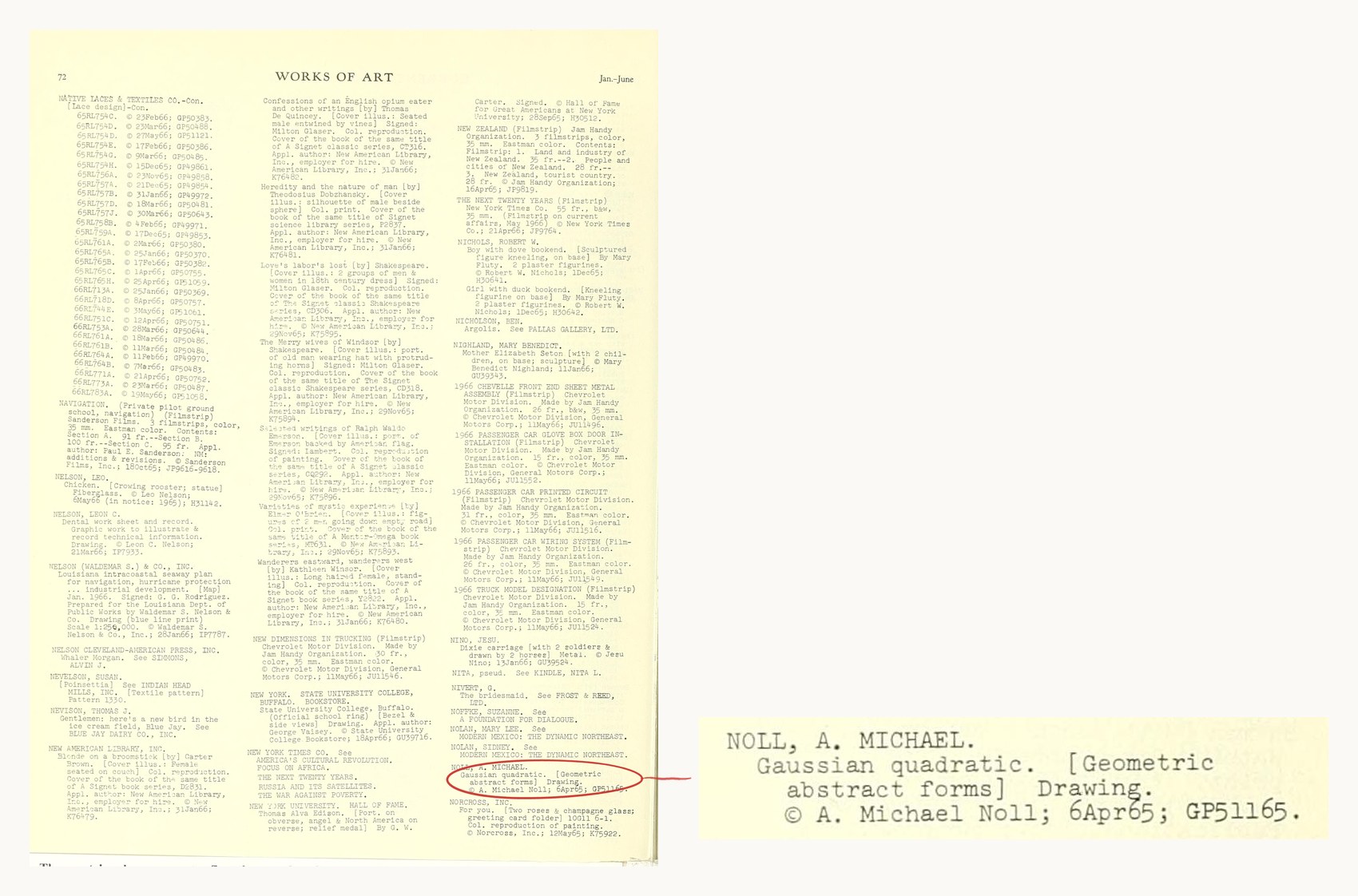
NOLL, A. MICHAEL. Gaussian quadratic. [Geometric abstract forms] Drawing. © A. Michael Noll; 6Apr65; GP51165. Computer art was registered with the US Copyright Office in 1965, after three refusals. archive.org
A. Michael Noll tried to register Gaussian-Quadratic, a plot generated by a FORTRAN program on an IBM 7090. The Copyright Office objected three times, and his own first-hand account of the sequence is worth reading closely.
First it rejected the work as made by a machine. Noll explained that human programming controlled the output. The Office then objected that a work produced by randomness could not be registered. Noll clarified that a program calculated the randomness, and that the numbers only appeared random to humans; the algorithms did everything.
*Registration was granted on 6 April 1965*, classified as a drawing of geometric abstract forms.
The 1965 finding was that authorship is supplied not by machine autonomy and not by randomness but by *human-written algorithms*. That is the same test the same office applied to Midjourney in 2023, and it produced the opposite result, because in 1965 a human had written every rule.
What actually happened to the NFT market
Art NFTs | 2021 | 2022 | 2023 | 2024 | Q1 2025 |
|---|---|---|---|---|---|
Trading volume | $2.9bn | $2.38bn | $197m | $23.8m | |
Active traders | 291,724 | 529,101 | 282,683 | 76,176 | 19,575 |
Average price | $2,044 | $1,251 | $475 | about $850 |
DappRadar, art NFT segment.
Down 93 percent in volume and 96 percent in traders from the peak. A dappGambl report in September 2023 found 95 percent of NFTs had fallen to zero monetary value and 79 percent of all collections remained unsold.
But "dead" is the wrong reading. In Q3 2025 NFT sales count hit 18.1 million, the highest quarterly figure since 2022, and volume nearly doubled to $1.58bn. Many more transactions at far lower prices, with the centre of gravity shifting from art and profile pictures toward tokenised real-world assets.
And the link rot is not hypothetical. On 24 April 2025 more than *19,000 images* from the RTFKT and Takashi Murakami Clone X collection vanished after a server misconfiguration during a migration from DigitalOcean to AWS via Cloudflare.
The problems that are actually real
Strip out the speculation and digital art has two genuine difficulties, and neither is snobbery.
It rots
Tate on Nam June Paik.
The Guggenheim commissioned Shu Lea Cheang's Brandon in 1998, its first internet artwork acquisition, described in the collection as interactive networked code: HTML, Java, JavaScript and a server database. By the 2010s the pages were inaccessible, animations broken, internal and external links dead.
The restoration analysed *more than 65,000 lines of hand-written code* across two semesters, then took four months to migrate: Java applets were converted to GIFs, JavaScript and HTML. It was completed in 2017 under the Conserving Computer-Based Art initiative, funded by the Carl and Marilynn Thoma Art Foundation, NYSCA, Christie's and a private donor.
The best-documented case in the world, though, is Korean.
Nam June Paik, The More, The Better, 1988, MMCA Gwacheon | |
|---|---|
Scale | 1,003 CRT monitors, 18.5 m high, 11 m across |
2018 | Shut down on fire-risk grounds after an assessment by the Korea Electrical Safety Corporation |
2020 to 2022 | Three-year conservation: full diagnosis of all 1,003 monitors, then sourcing of secondhand CRTs and parts |
Outcome | 737 monitors repaired or replaced with CRTs. *266 converted to LCD* |
From MMCA's own account of the conservation. The curator's stated reason for keeping CRTs: an artwork reflects the time it was made, and the CRT television represents twentieth century media.
Two hundred and sixty six is the institution's own count of what it could not save. There is no clearer number anywhere for what conserving digital art means.
Nobody knew what was being sold
This is where the NFT discourse was most ignorant of its own subject, because museums had solved the infinite-copy problem twenty years earlier, and not with technology.
The Met's acquisition procedure for a video artwork specifies what physically changes hands, on a hard drive: a native master exported from the artist's own editing timeline; a ten-bit uncompressed QuickTime preservation master; one magnetic tape per video channel, at the museum's cost; and an artist-approved exhibition copy, with DVDs and Blu-Rays explicitly prohibited. Plus a completed artist's questionnaire, a signed acquisition agreement, installation instructions, and a certificate of authenticity signed by the artist stating the details of the work, the size of the edition and the number.
The Met treats all of it as a *single edition*, and undertakes not to deaccession any part of it as a duplicate.
The framework behind this, Matters in Media Art, a collaboration of the New Art Trust with MoMA, SFMOMA and Tate begun in 2005, states the principle directly:
What you are buying when you buy a media artwork is not a unique material object but rather the means and the rights to be able to display the work, loan it, preserve it and sell it.
The solution to infinite copyability was never technical. It was contractual: a signed certificate naming an edition number, a bundle of files, a set of rights, and a promise that no copy is surplus.
The NFT reinvented the certificate and forgot the files.
The precedent nobody in this argument cites
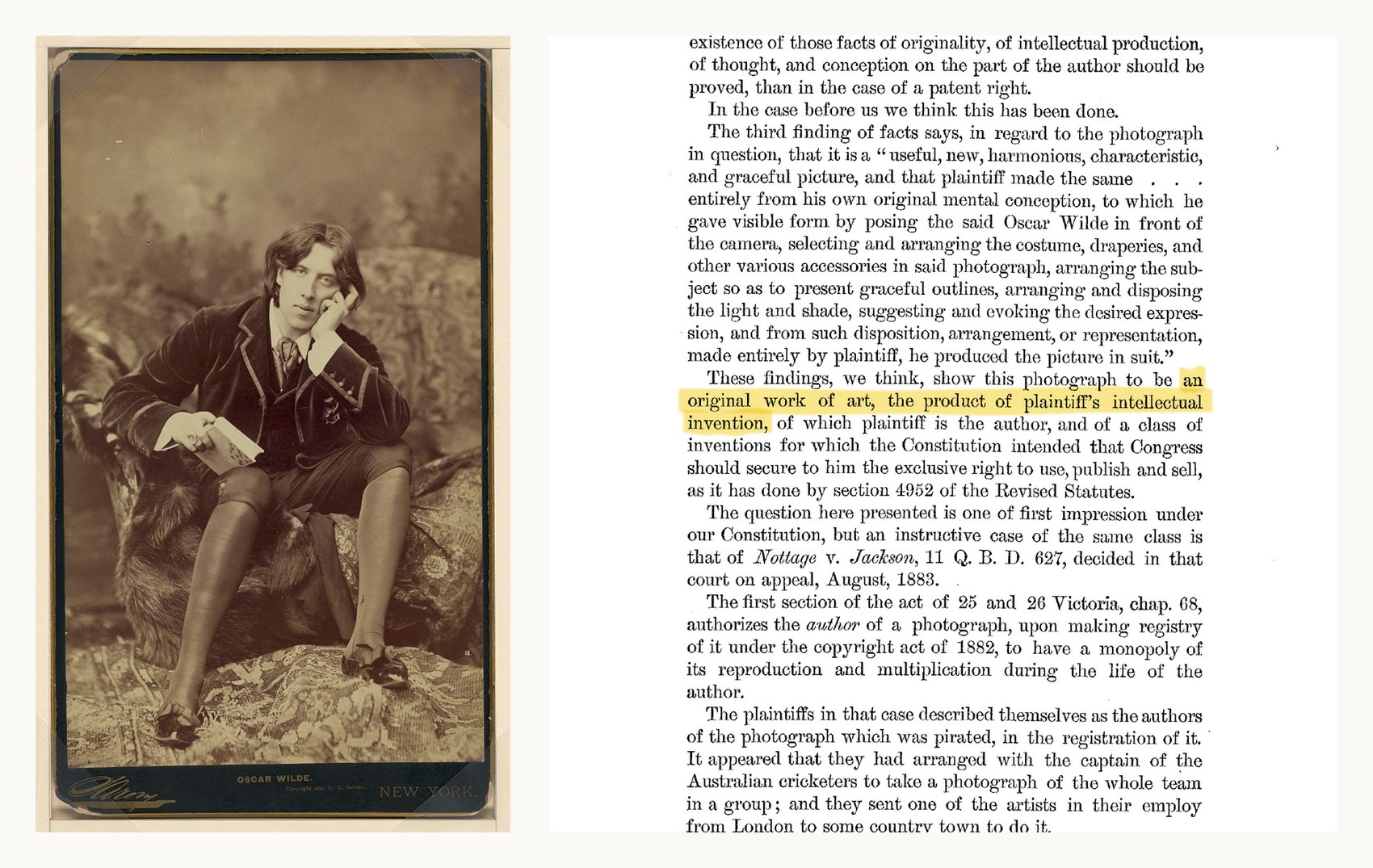
Left: Sarony's Oscar Wilde No. 18, 1882, with the copyright line printed on the mount. Right: 111 U.S. 53 at 60, the Court calling it an original work of art, the product of plaintiff's intellectual invention. Library of Congress

The photograph at the centre of the case that let photography into copyright. Commons
In Burrow-Giles Lithographic Co. v. Sarony, decided unanimously on 17 March 1884, the defendant argued that a photograph is made by a machine, is therefore not the writing of an author under the Constitution, and that copyright in photographs was unconstitutional.
Justice Samuel Miller's opinion defined an author as
he to whom anything owes its origin; originator; maker; one who completes a work of science.
What the Court actually protected was not the camera work. It was the selection: posing Wilde in front of the camera, selecting and arranging the costume, draperies and accessories, arranging the subject to present graceful outlines, disposing the light and shade, and evoking the desired expression. The result was "an original work of art, the product of plaintiff's intellectual invention."

Photography spent another half century arguing its way into museums after it won in court. MoMA's photography department was founded in 1940 under Beaumont Newhall. Commons
Winning the legal argument in 1884 did not settle the aesthetic one. Photography took until roughly 1940 to get a museum department, which is fifty six more years.
Benjamin, who is always quoted backwards

The Work of Art in the Age of Mechanical Reproduction is cited constantly in NFT writing, almost always as an elegy for lost aura. Benjamin's definition:
We define the aura of the latter as the unique phenomenon of a distance, however close it may be.
And what reproduction removes:
even the most perfect reproduction of a work of art is lacking in one element: Its presence in time and space, its unique existence at the place where it happens to be.
But the essay is not mourning. It is an anti-fascist argument that the loss is liberating:
For the first time in world history, mechanical reproduction emancipates the work of art from its parasitical dependence on ritual… the instant the criterion of authenticity ceases to be applicable to artistic production, the total function of art is reversed. Instead of being based on ritual, it begins to be based on another practice: politics.
Benjamin thought a world in which authenticity stopped being the criterion would be a better one. The NFT was an attempt to reinstall the criterion by decree, on a medium whose whole nature is that the criterion does not apply, and it cost a lot of people a lot of money to find that out.
Why the file still has lower status
Put the pieces together and the answer is not aesthetic conservatism.
A file has no original, so the market had to invent one, and it has done so twice: once through the contractual apparatus that museums built between 2005 and 2017, which works, and once through the token, which did not.
A file also rots. Not slowly like a painting but suddenly, when a codec is abandoned or a company reprices a service. MMCA lost 266 monitors. The Guggenheim spent two semesters reading 65,000 lines of code to recover one 1998 artwork.
And the institutional memory is short. When digital art was first shown in 1965 nothing sold, and the museums took forty five years to start collecting. Photography won its legal argument in 1884 and waited until 1940 for a department.
The pattern is the same each time: the medium is admitted long after it has already produced its best work, on terms worked out by conservators and lawyers rather than by critics, and the argument that felt like a debate about art turns out to have been a debate about paperwork.
Sources
Moxie Marlinspike, "My first impressions of web3", January 2022
A. Michael Noll, "First-Hand: Computer Art Copyright", ETHW
DappRadar on the art NFT collapse
Guggenheim, Conserving Computer-Based Art press release, 16 May 2017
Walter Benjamin, The Work of Art in the Age of Mechanical Reproduction, Zohn translation, full text
The Korean version of this research, built around the The More, The Better conservation, is on my Naver blog at blog.naver.com/veinism.
Latest Articles.
© Moc Mallen Studio
Thoughts, ideas, and perspectives on design, simplicity, and creative process.


