A Decade Measured in Time Remaining
Dürer drew a figure surrounded by instruments and using none of them. New York between 1981 and 1990 had the same instruments and picked them up. The dates, the numbers, and the foundations built in advance.
Date
Category
Writer

On 5 June 1981 the CDC published a short case series in its weekly report. Five men in Los Angeles, previously healthy, had been treated for a pneumonia that normally only appears in the severely immunosuppressed. Two were already dead. The report named no syndrome and drew no conclusion about transmission.
Between that page and the end of 1990, 100,777 people in the United States died of AIDS. 31,196 of them died in 1990 alone. New York City recorded 37,436 diagnoses in the same decade, close to a fifth of the national total.
Keith Haring died on 16 February 1990, aged thirty-one. Robert Mapplethorpe on 9 March 1989. Peter Hujar on 26 November 1987. David Wojnarowicz on 22 July 1992. Klaus Nomi in August 1983, one of the earliest figures in the arts whose death was publicly identified as AIDS.
I have been trying to work out what to do with a decade whose central fact is a countdown, and the picture I keep coming back to was made in 1514.
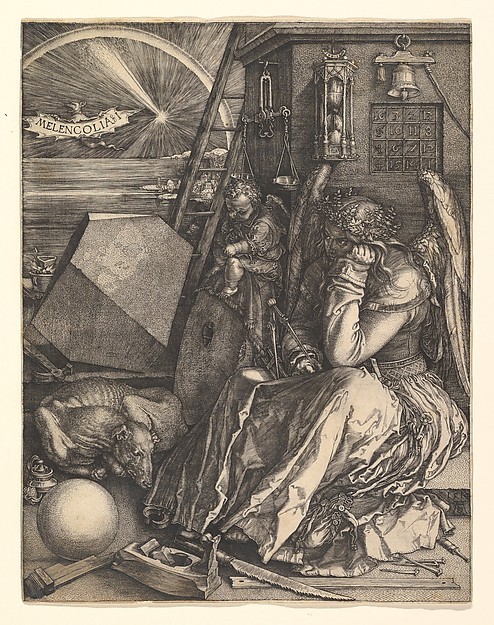
Albrecht Dürer, Melencolia I, 1514. Engraving, 24 × 18.5 cm. The Metropolitan Museum of Art, 43.106.1, Harris Brisbane Dick Fund. Open Access, CC0.
Five ways of drawing time you do not have
1. Everything in the engraving measures something
A winged figure sits with her chin on her fist. She holds a pair of compasses over a closed book. At her belt are keys and a purse.
On the wall behind her, stacked vertically: a magic square, an hourglass with the sand mid-fall, a bell whose rope runs up out of the frame, and a balance scale. On the ground: a plane, a saw, a straightedge, a hammer, pincers, nails. A sphere. A ladder of seven rungs whose top and bottom are both outside the picture. A starved dog asleep. A putto on a millstone, scribbling. A polyhedron of eight faces blocking the middle distance. In the sky a bat carries a banner reading MELENCOLIA I over a flooded landscape.
Every object is an instrument for measuring or making, and not one of them is in use. The compasses are held still. The book is shut. The tools are on the floor. The only figure working is the putto, and he is a child.
2. The magic square is a countermeasure
The four by four square on the wall reads 16 3 2 13 / 5 10 11 8 / 9 6 7 12 / 4 15 14 1. Rows, columns, both diagonals, the four quadrants, the four corners and the four centre cells all sum to thirty-four.
The bottom row is 4, 15, 14, 1. The middle two give the year.
Dürer did not invent magic squares; this is the first one printed in European art, but the four by four Jupiter square came to him through Pacioli from a much older tradition. And it is there for a reason: the Jupiter square was understood as a talisman against Saturn, and Saturn governs melancholy. The picture contains its own antidote, hung on the wall, not being used either.
3. What nobody has settled
Question | Status |
|---|---|
What does the "I" mean? | Panofsky's proposal: the first of Agrippa's three melancholies, the artist's. Widely adopted. Not proven |
What shape is the polyhedron? | Eight faces, six pentagons and two triangles, agreed. The metric shape is not: reconstructions put the underlying rhombus between 72° and 82°, from Weber in 1900 to Kostov in 2020 |
Is there a skull in its shading? | Reported. Not demonstrated |
Is it about his mother's death? | She died 17 May 1514. He drew her in March. He never said so |
Are the three Meisterstiche a trilogy? | Art-historical grouping, not Dürer's. Panofsky rejected it |
Table 1. Five hundred years of attention on one small plate, and the central object in it is still a disputed number of degrees.
There is something useful in that. The most-analysed print in Western art has a solid sitting in the middle of it that nobody can measure, and the discipline has simply carried on describing everything around it.
4. Institutions built before the deaths
The part of the 1980s that surprised me when I checked the dates is how much of the infrastructure was set up in advance, by people who knew.
Robert Mapplethorpe established his foundation on 27 May 1988, the year before he died, with two mandates: to promote photography as an art form, and to support HIV/AIDS medical research. Keith Haring established his in 1989, the year before he died, to fund children's programmes and organisations working on education, prevention and care for AIDS and HIV.
Haring, to David Sheff in Rolling Stone in August 1989:
The hardest thing is just knowing that there's so much more stuff to do. I'm a complete workaholic. I'm so scared that one day I'll wake up and I won't be able to do it.
And:
Everything I'm doing right now is exactly what I want to do.
Both of those are in the same interview. They are not in tension.
5. What the state did with the time
ACT UP was founded on 14 March 1987, two days after Larry Kramer's speech at the Lesbian and Gay Community Services Center, by around three hundred people. Its first action was on Wall Street ten days later; seventeen arrests.
The SILENCE = DEATH poster was not an ACT UP design. It was made by six men — Avram Finkelstein, Brian Howard, Oliver Johnston, Charles Kreloff, Chris Lione and Jorge Socárras — conceived in 1986 and on the street in mid-March 1987, before ACT UP existed. The rights were later transferred to ACT UP, and reproduction is by permission. It is not public domain and it is not free to use, which is why it is described here rather than shown.
Meanwhile: on 12 June 1989 the Corcoran Gallery cancelled Mapplethorpe's The Perfect Moment on its own initiative, citing fear of damaging the NEA's appropriations. On 23 October 1989 the Helms language became law as Section 304 of Public Law 101-121. On 5 October 1990 a jury in Cincinnati acquitted Dennis Barrie and the Contemporary Arts Center, in the first criminal trial of an American museum over the contents of an exhibition.
What I take from it
Dürer's figure has every instrument she needs and is using none of them. That is usually read as paralysis, and Panofsky's reading of the "I" makes it an artist's condition specifically: imagination outrunning reason, capacity without application.
What the 1980s material does to that reading is invert it. Everyone in this piece knew exactly how much time they had, and the response was not paralysis. It was Haring doing forty drawings a day and setting up a foundation a year before he died; it was six men making a poster in a living room; it was three hundred people in a room on West 13th Street.
The instruments were the same ones Dürer drew. What changed was that somebody picked them up.
This is a difficult subject and if any of it is close to you, it is worth talking to someone rather than only reading about it.
Latest Articles.
© Moc Mallen Studio
Thoughts, ideas, and perspectives on design, simplicity, and creative process.

